
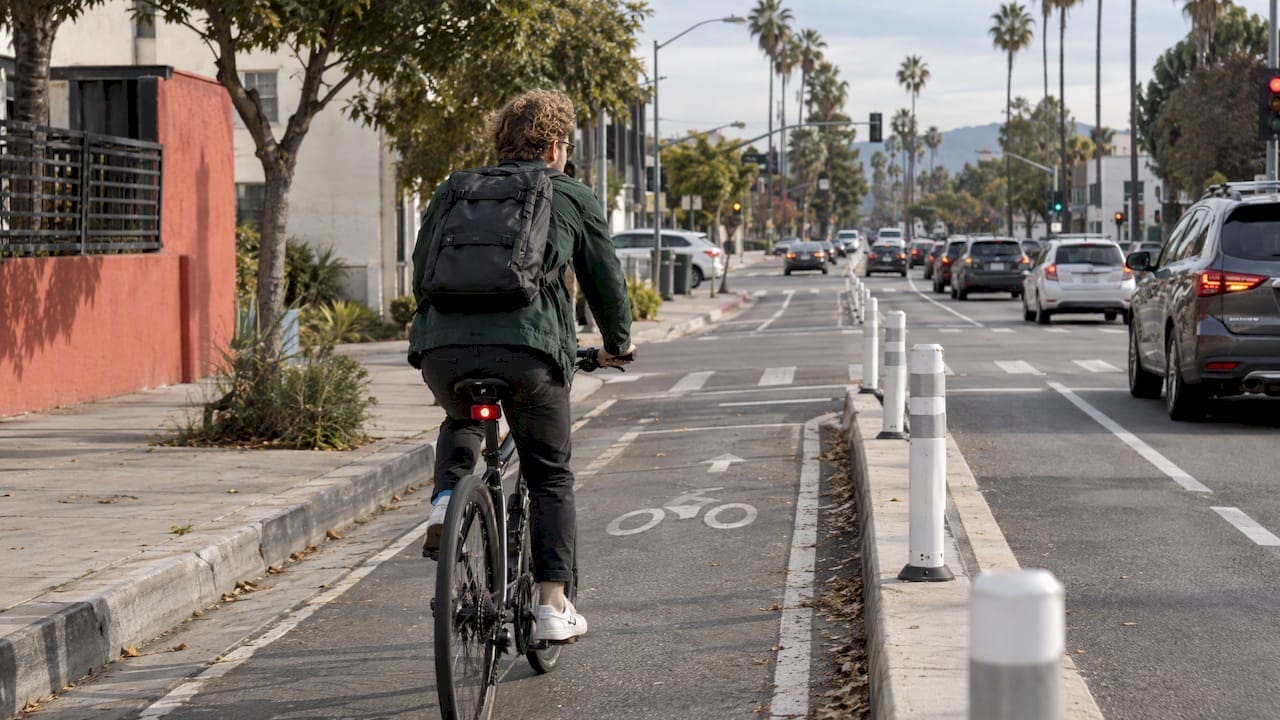
Bike commuting in Los Angeles works best when your trip is short, your route favors protected lanes and paths over the most direct street, and your bike is ready for daily use. The network is incomplete and uneven, so the skill is less about toughness and more about planning: pick the safest connected corridor, test it off-peak, and know the rules that apply to you. This guide walks through each step.
Key Takeaways
- Start with trips of about 3 to 5 miles. Nearly half of all trips in the region fall in that range, and an e-bike stretches it further.
- Choose the safest connected route, even when it is longer. Directness matters less than comfort while you build confidence.
- Use LA Metro’s bike maps, the LA River and San Gabriel River paths, and protected lanes as your building blocks.
- California law gives you the rights and duties of a driver, but sidewalk riding is set by each city, so check local code.
- Test the ride before the first workday, and line up secure parking at your destination.
Table of Contents
- What Bike Commuting in LA Is Actually Like
- Is Your Commute a Good Fit for a Bike?
- How to Find a Safer Route
- Route Features to Look For and Avoid
- What California Law Says About Riding in Traffic
- Getting Ready Before the First Ride
- Metro Bike Share as a Trial Run
- Our Perspective
- Keep Riding with SoCalCycling.com
- FAQ
- Sources
What Bike Commuting in LA Is Actually Like
Los Angeles gives riders freedom and real hazards in the same ride. Reporting from the Los Angeles Times describes a bike network that is incomplete and often disconnected, so quality changes from block to block. You may glide along a protected lane for half a mile and then merge into a busy arterial with no bike space at all.
That unevenness is the first thing to expect. The second is that you are in a small minority. According to 2014 census data, roughly 1% of City of Los Angeles commuters biked to work, and drivers are not always used to sharing the road. Transportation experts quoted in the same USC piece say riding becomes a viable daily option when infrastructure feels safe, easy to use and connected. Until that happens everywhere, you supply the connection through route choice.
The upside is real. Long-term riders interviewed by the Los Angeles Times point out that LA lacks a single downtown-focused structure but is dense enough for many daily errands. Once you learn the safe corridors and the terrain, a bike becomes a practical way to get around.
Is Your Commute a Good Fit for a Bike?
Distance is the quickest filter. According to the city’s Mobility Plan 2035, as summarized by the UCLA Blueprint, nearly 50% of all trips in the Greater LA area are three miles or less, yet over 80% of those short trips are made by car. That gap is the opportunity: the trips most suited to a bike are the ones most people still drive.
The Los Angeles Times riders’ guide suggests a 3 to 5 mile radius as a sensible zone, and notes that an electric bike can significantly extend your practical range and help you keep pace with traffic. If your commute is 8 or 10 miles with a hill in the middle, an e-bike changes the math. Our guide to California e-bike laws and classes explains what each class allows before you buy.
A quick self-check:
- Distance: Is the one-way trip within about 5 miles on a regular bike, or a bit more on an e-bike?
- Route quality: Can you string together at least a few protected or low-stress segments?
- Arrival: Can you park the bike securely, and do you need to freshen up?
- Backup plan: If weather, a flat or fatigue ends the ride, is there a Metro bus, train or bike share station nearby?
If you answer yes to most, run a weekend trial. If not, consider a hybrid commute where you ride one leg and take transit for the other.
How to Find a Safer Route
The single best habit is to plan the ride before you ride it. Experienced cyclists quoted by the Los Angeles Times advise new commuters to prioritize protected routes and take the safest available path, even when it departs from the most direct line, until they feel comfortable with local traffic.
Start with the official maps
LA Metro publishes a printable map showing bike paths, protected lanes and bike-friendly streets across LA County, plus an interactive map that also marks Metro Bike hubs, lockers and nearby bike shops. BikeLA’s bike maps page points to both. Spend an evening tracing your trip on the interactive version, then compare two or three alternatives.
Use the off-street paths where they fit
The LA County Department of Public Works maintains about 100 miles of paved, off-road Class I bike paths, including major routes along the LA River and the San Gabriel River. If your home or office sits near one of these, you may be able to cover a large part of the commute away from cars. Even if the path only handles the middle section, you can use quiet side streets to reach it at each end.

Know which streets to be wary of
The City of Los Angeles identifies a High Injury Network, a set of streets where severe and fatal crashes concentrate. According to LADOT’s January 2024 Vision Zero Safety Study, that network covers 549 miles, or 7.5% of the city’s roadway network. The same study reports a 13% increase in killed and severely injured collisions between 2017 and 2021.

What does that mean for your route? A small share of streets carries a large share of the danger, so avoiding or minimizing time on those corridors can matter more than anything else you do. Check the study’s High Injury Network map against your planned route. When your only path uses one of those streets, look for a parallel residential street, or plan to cross rather than ride along it.
Look for streets that have been redesigned
City projects are slowly improving specific corridors, and those are worth knowing. LADOT’s Hollywood Boulevard Safety and Mobility Project, Phase I, used lane reconfigurations to add protected bike lanes between Gower Street and Hillhurst Avenue, according to the department’s 2023-24 annual report. On Foothill Boulevard, LADOT reported no fatal collisions and a 63% reduction in serious injury collisions since 2017 after safety improvements. Those results show that design matters, and they are a useful signal that redesigned corridors tend to be calmer places to ride.
Route Features to Look For and Avoid
Once you have candidate routes, judge them by what the pavement actually offers.
| Feature | What it means for a commuter |
|---|---|
| Class I path (off-street) | No car traffic. Best for building confidence, though crossings and shared use with walkers need attention. |
| Protected bike lane | Physical separation from traffic. A strong choice on busy corridors. |
| Striped bike lane | Better than nothing, but watch for car doors and turning vehicles. |
| Bike-friendly residential street | Low speeds and low volumes. Often the best connectors between bigger routes. |
| High Injury Network street without protection | Avoid for the through ride when a parallel option exists. |
Intersections deserve special thought, because that is where bikes and cars cross paths. Caltrans’ guide to complete intersections emphasizes that improving safety for bicyclists at major junctions takes specific engineering tools that reduce conflict points between vulnerable users and motor vehicles. As a rider, you can read that as a prompt: look for intersections with dedicated signal phases, bike boxes or protected corners, and treat unprotected ones with extra caution.
What California Law Says About Riding in Traffic
Knowing your legal position helps you ride predictably, which is itself a safety tool. The following points come from Caltrans’ plain-language summary of the California Vehicle Code. Laws change, so confirm current wording on the official code site.
- Same rights and duties as drivers. Under CVC 21200, a bicyclist on a highway has the rights and responsibilities of a motor vehicle driver, except for provisions that by their nature cannot apply. That includes obeying signals and stop signs.
- Keep right, with exceptions. CVC 21202 requires a bicyclist traveling slower than normal traffic to ride as close as practicable to the right-hand curb or edge. Exceptions include passing, preparing for a left turn, avoiding hazards, and approaching a place where a right turn is authorized.
- Sidewalks are a local decision. Cities and counties, Los Angeles included, can regulate or prohibit sidewalk riding under CVC 21206. Check the municipal code of each city on your route, because a commute through several jurisdictions can cross several rules.
That last point is a common question and the honest answer is “it depends on the city.” Even where sidewalk riding is allowed, it is usually slower and riskier near driveways, so use it sparingly and yield to people walking.
If you ride an electric bike, class limits and equipment rules apply on top of this. Our California e-bike law guide covers them.
Getting Ready Before the First Ride
The Los Angeles Times advises new commuters to test the route during off-peak hours, make sure the bike is in good working order, and find secure parking or storage at the destination. Here is how we would turn that into a checklist.
Dry run on a weekend
Ride your chosen route on a Saturday or Sunday morning. Time it, note any spots where you hesitated, and decide where you would dismount or reroute. Then repeat it once at rush hour, preferably with a friend, to see how traffic changes the feel.
Bike and gear
- Brakes and tires: Check pad wear, tire condition and pressure. A commuter covers the same miles again and again, so small wear shows up fast.
- Lights and visibility: Front and rear lights make you easier to see at dawn, dusk and in shaded streets.
- Lock and storage: Plan where the bike sleeps. Ask your employer about indoor parking or a locker, or find a high-quality lock before the first ride.
- Repair kit: Spare tube, mini pump or CO2, and a multi-tool.
If your bike has been in the garage for years, a tune-up is cheap insurance. You can find a Southern California bike shop through our directory post, and LA Metro’s interactive map also marks shops near your route.
A transit backup
Metro’s network gives you an escape hatch and a way to cover longer distances. The Los Angeles Times notes that becoming familiar with Metro’s bike-friendly trains and buses helps with longer trips. Learn the rules for bringing a bike aboard on the lines you might use before you need them.
Metro Bike Share as a Trial Run
If you do not own a bike yet, or want to test a route cheaply, bike share is a low-commitment option. Metro Bike Share operates around the clock with more than 220 stations across service areas that include Downtown LA, Central LA, Hollywood, North Hollywood and the Westside. At the time of that page, the rate was $1.75 per 30 minutes, and you must return the bike securely to a station to end the trip. Pricing can change, so check the Metro Bike Share site for current fares.
Bike share is also useful as a last-mile tool: take the train most of the way, then grab a bike for the final stretch. It works best for short hops rather than a full daily commute, where owning a bike is usually more economical.
Our Perspective
We cover cycling across Southern California, from road races to gran fondos, group rides and everyday riding, and the same lesson shows up everywhere here: preparation beats bravado. The riders who last in this region treat route planning like course reconnaissance. They know where the protected sections are, where the risk concentrates, and where they can bail out.
We also think commuting is the best entry point to the broader cycling community. A rider who starts with a three-mile trip to work often ends up on a weekend club ride, then at a local event. If you want coaching to build fitness for a longer commute, you can find a cycling coach through our site, and the same expertise that helps racers handle fear and traffic applies to commuters.
Our honest view: LA is not yet an easy city for bike commuting, and nobody should pretend otherwise. But with a short trip, a smart route and good gear, it can be a rewarding one. Choose comfort first, speed later.
— SoCalCycling.com
Keep Riding with SoCalCycling.com
Commuting is often the start of a bigger cycling life. Our site brings together independent news, event calendars, race coverage, training stories and product reviews from across Southern California, so you can go from the daily ride to your first group ride or event.

Browse the latest on SoCalCycling.com to find upcoming rides, read race reports and see what the local cycling community is doing.
FAQ
Is it safe to bike commute in Los Angeles?
It can be, but safety depends heavily on your route. LADOT’s Vision Zero study identifies a High Injury Network of 549 miles where severe crashes concentrate, so avoiding those streets when possible lowers your exposure. Favor protected lanes, off-street paths and quiet residential streets, even if they add distance.
Is it illegal to ride a bicycle on the sidewalk in Los Angeles?
California law lets cities and counties set their own sidewalk rules under CVC 21206, so the answer depends on the jurisdiction. Check the municipal code for Los Angeles and for each city your route passes through. When in doubt, use the street or a bike path.
Where can I find safe bike routes in Los Angeles?
LA Metro’s printable and interactive bike maps show paths, protected lanes and bike-friendly streets across the county, and they also mark bike hubs, lockers and shops. The LA River and San Gabriel River paths are major off-street options. Compare your route with LADOT’s High Injury Network map before you commit.
How far is too far to commute by bike in LA?
There is no hard limit, but a radius of about 3 to 5 miles is a practical starting point on a standard bike. An electric bike can significantly extend that range and help you keep pace with traffic. Test the ride on a weekend before you commit.
Can I use Metro Bike Share for my commute?
Yes, for short trips and last-mile connections. The system runs 24/7 with more than 220 stations, and rides were listed at $1.75 per 30 minutes. For a long daily commute, owning a bike usually makes more sense.
Sources
- The ‘freedom’ and hazards of commuting by bike in L.A. (Los Angeles Times, 2023)
- The risks and rewards of biking to work in Los Angeles (USC)
- Bicycling in L.A.: How to go car-free, ride safely, have fun (Los Angeles Times, 2022)
- Biking in Los Angeles (UCLA Blueprint)
- Bike Maps (BikeLA)
- LA County Public Works: Bikeways
- LADOT Vision Zero Safety Study, January 2024
- LADOT Annual Report, FY 2023-24
- LADOT Weekly Update, April 14, 2022
- Caltrans: California Vehicle Code plain-language summary
- Caltrans: Complete Intersections guide
- Metro Bike Share
Recommended
- MINILOOP- An Elevated Bicycling Pathway Proposal for Southern California
- California E-Bike Laws: Classes, Limits, and 2026 Rules
- Bicycling and the Law: Reconstructing a Bicycle Crash