



The fastest way to estimate calories burned cycling is MET × your weight in kilograms × hours ridden. A 70 kg rider spinning at a fitness pace (MET 8) for one hour burns roughly 560 kcal.
That number is a solid ballpark, not a lab result. MET-based math ignores wind, hills, and your actual fitness, so treat it as a planning tool.
- Formula: Calories ≈ MET × weight (kg) × hours
- Example: 70 kg × 8 MET × 1 hour = 560 kcal
- Caveat: MET-based estimates run high or low depending on terrain and effort
- Better accuracy: a power meter or physics-based speed model narrows the margin considerably
A bicycle ride calorie calculator built on MET values gets you moving fast. If you want tighter numbers, keep reading, because the inputs you choose matter almost as much as the formula itself.
Key Takeaways
| Point | Details |
|---|---|
| Use the core formula | Calories ≈ MET × weight (kg) × hours gives a fast, usable estimate for any ride. |
| Expect overestimation | MET-based tools often run 20 to 30% high; stationary-bike tests show 7 to 15% overestimates. |
| Power beats METs | A power meter’s kilojoule output converts near 1:1 to kcal, thanks to consistent gross efficiency. |
| Terrain and wind matter most | Hills can roughly double effort, and drag accounts for 70 to 90% of resistance above 15.5 mph. |
| Weight loss needs food tracking | The 3,500 kcal per pound rule is a rough guide; appetite changes often offset ride-based deficits. |
Table of Contents
- What Should You Enter Into a Bike Ride Energy Calculator?
- What Is a MET and How Do Calculators Use It?
- What Changes Your Real Calorie Burn Versus the Calculator Number
- Are Power Meters More Accurate Than MET Calculators?
- Worked Examples: Turning Speed and Time Into Calories
- How Accurate Are These Estimates, and How Do You Improve Them?
- Does Burning Calories on a Bike Actually Lead to Weight Loss?
- Frequently Asked Questions
- Sources
What Should You Enter Into a Bike Ride Energy Calculator?
Every cycling calorie estimator asks for the same core inputs, and skipping or guessing at them is the single biggest reason calculator numbers feel wrong.
- Weight (kg or lb): the multiplier that scales every MET calculation
- Duration or distance + speed: pick one mode depending on what data you have
- Optional fields: age, gender, height, heart rate, or power output, when available
- Elevation or gradient: rarely a direct field, but essential for correcting flat-ground assumptions
Duration-mode calculators want your ride time and an intensity level. Distance-mode calculators want mileage and average speed, then derive an intensity for you. Use duration-mode for interval or stop-and-go rides where speed swings wildly. Use distance-mode for steady road rides where your average speed reflects the whole effort.
Elevation rarely gets its own input box on simpler calculators, so bump your MET selection up a notch (or two, for sustained climbing) if your route has real vertical gain. Riders training for events with serious elevation gain, the kind covered in route guides for California terrain, should treat any flat-ground calculator output as a floor, not a ceiling.
Pro Tip: Update your weight and age in your calculator or bike computer every few weeks. A stale profile compounds error into every single ride estimate, even when your speed and duration are recorded perfectly.
What Is a MET and How Do Calculators Use It?
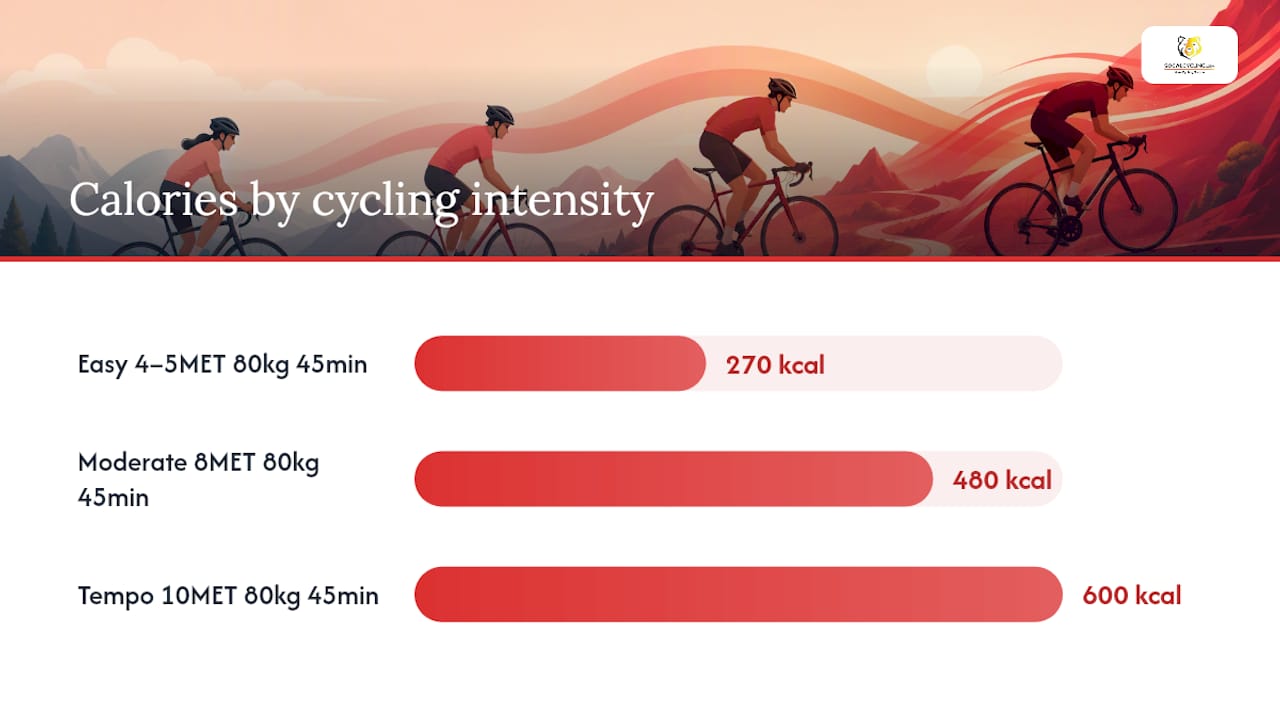
A MET, or metabolic equivalent, measures how many times harder an activity works your body compared to sitting still. One MET equals the energy cost of resting quietly. Cycling at a brisk pace might sit at 8 METs, meaning you burn eight times your resting rate.
The math calculators run is simple: Calories = MET × weight (kg) × hours. Compendium-based MET tables, the kind tools like TrainCalc draw from, assign values across a wide range: very easy cycling sits near 3.5 MET, moderate club-pace riding lands around 6 to 8 MET, and full-gas racing can reach nearly 16.8 MET.
- Leisure cruising (under 10 mph): roughly 4 to 5 MET
- Fitness pace (12 to 14 mph): roughly 8 MET
- Vigorous/tempo (14 to 16 mph): roughly 10 MET
- Racing pace (over 20 mph): roughly 12 to 16.8 MET
Hills, stop-start commuting, and mountain biking all push effective intensity above what flat-ground speed alone would suggest. A rider grinding a steady climb at 10 mph is working far harder than that speed implies on level ground.
Quick example: 80 kg rider, 45 minutes at MET 10 (tempo pace) = 10 × 80 × 0.75 = 600 kcal.

What Changes Your Real Calorie Burn Versus the Calculator Number
Two rides at the identical speed and duration can burn wildly different calorie totals, and terrain is usually the biggest culprit. Gradient alone can roughly double the energy cost of a given speed compared to flat road, since climbing adds constant work against gravity that a flat-ground MET value never accounts for.
Wind matters just as much as hills. Aerodynamic drag dominates resistance once you’re above about 15.5 mph, accounting for 70 to 90% of the resistive force you’re fighting at typical road speeds. A steady headwind can push your effort into a much higher intensity bracket at the exact same GPS speed, while a tailwind or a good draft can mask real effort entirely.
- Terrain and gradient
- Wind speed and direction, plus drafting
- Rider fitness and pedaling efficiency
- Bike type and rolling resistance (gravel vs. road tires, for instance)
- Stop-start traffic or group-ride surges
- Indoor trainer resistance settings
Fitter riders also burn fewer calories at the same pace over time, since efficiency improves with training and static MET presets don’t adjust for that.
Pro Tip: Log ride context, headwind, a long climb, a rough gravel section, alongside your calorie estimate. Without that note, you’ll misread why two “identical” rides produced different numbers weeks later.
Are Power Meters More Accurate Than MET Calculators?
Yes, and by a meaningful margin. MET-based calculators and many consumer devices overestimate energy expenditure by roughly 20 to 30% on average, with stationary-bike studies showing smaller but still real overestimates of 7 to 15% against lab-measured indirect calorimetry.
A power meter sidesteps most of that error because it measures actual mechanical work in kilojoules, and human gross efficiency sits fairly consistently between 20 and 25%. That consistency means 1 kilojoule of mechanical work translates to roughly 1 kilocalorie burned for practical ride-level estimates, since the efficiency conversion and the kJ-to-kcal unit conversion largely cancel each other out.
- If your power meter logs 900 kJ over a ride, you burned approximately 900 kcal
- Individually calibrated power estimates can land within about 1% of lab calorimetry on group averages, though individual rider error can still run near 11%
- Even lab-grade energy equations disagree with each other by a measurable margin, so no method is flawless
If you have a power meter, trust its kJ output over any MET-based number. If you don’t, a MET calculator remains the most practical everyday tool, particularly when paired with an honest read on your ride’s terrain and wind.
Worked Examples: Turning Speed and Time Into Calories
Here are three scenarios you can copy directly for your own numbers.
Example 1: Short moderate ride (30 minutes, 65 kg rider, MET 6)
- Multiply MET × weight: 6 × 65 = 390
- Multiply by hours: 390 × 0.5 = 195 kcal
Example 2: 60-minute tempo ride (75 kg rider, 15 mph average, MET 10)
- Confirm intensity from speed: 15 mph maps to roughly MET 10
- Run the formula: 10 × 75 × 1 = 750 kcal
Example 3: Hilly 90-minute mixed-effort ride (80 kg rider, base MET 8, adjusted for climbing)
- Start with a moderate baseline: 8 × 80 × 1.5 = 960 kcal
- Adjust upward for sustained climbing (add roughly 15 to 25% for significant elevation gain): 960 × 1.20 ≈ 1,150 kcal
Riders training for century-distance events will recognize that third scenario. Rolling terrain rarely behaves like a flat-ground formula assumes.
How Accurate Are These Estimates, and How Do You Improve Them?
The main error drivers are outdated profile data, a mismatched intensity preset, and device algorithms that weren’t built for your body type or riding style.
- Use power data when you have it; it’s the most reliable single input
- Pair heart rate with an accurate rider profile, since wearables and heart rate algorithms measure intensity and land within roughly 10 to 20% error when the underlying fields are correct
- Recheck your weight and age fields monthly
- Choose the intensity preset that reflects your ride’s dominant effort, not its easiest stretch
- Note elevation gain manually if your calculator doesn’t factor it in automatically
Pro Tip: Average your device’s calorie output across four or five similar rides rather than trusting any single number. Random error washes out; systematic bias, like a stale weight field, won’t, so fix that first.
Riders comparing event categories can use that averaging trick to build a realistic baseline before race day rather than guessing off one outlier ride.
Does Burning Calories on a Bike Actually Lead to Weight Loss?
The old rule of thumb says 3,500 kcal roughly equals one pound of fat, but that number is a rough population average, not a personal guarantee. Your body doesn’t burn calories in a vacuum.
Say you ride four times a week and average 500 kcal per session. That’s 2,000 kcal weekly from cycling alone, more than half of the 3,500 kcal “rule” toward a pound of fat loss. In practice, most riders see smaller real-world results than that math implies, because increased appetite, unconscious extra snacking, and modest drops in non-exercise activity all chip away at the deficit.
- Resting metabolic rate accounts for the majority of daily calories burned, often 60 to 75% of total output
- Tracking food intake alongside ride calories matters as much as the ride itself
- Weight loss from cycling alone, without dietary awareness, tends to underdeliver against the simple math
Pairing calorie awareness with a real fueling strategy gives you a far more honest picture than the raw 3,500 kcal rule ever will.
This calculator guide was built because too many riders trust a single app number without knowing where it comes from. For deeper training and fueling context, browse our guide to strength training for cyclists, which pairs well with sharper calorie tracking.
Want to close the gap between guesswork and real numbers? A structured power-based training block does more for accuracy than any calculator tweak. Socalcycling’s 12-week strength and power plan helps you build the kind of consistent output that makes every future calorie estimate more trustworthy, whether you’re training for a local ride or building toward race-day fueling plans for a bigger event.
Frequently Asked Questions
How many calories do you burn cycling for 30 minutes?
A 70 kg rider at a moderate fitness pace (MET 8) burns roughly 280 kcal in 30 minutes. Lighter or slower riders will land lower; racing-pace efforts can push that number past 400 kcal.
How far do you need to ride to burn 500 calories?
At a steady 14 to 15 mph pace, most riders around 70 to 80 kg cover roughly 12 to 15 miles to burn 500 kcal, though hills or headwind shorten that distance considerably.
Will cycling help me lose belly fat specifically?
Cycling burns calories overall and contributes to total-body fat loss over time, but spot reduction of belly fat specifically isn’t how fat loss works physiologically. Consistent training combined with a calorie-aware diet drives visible change, not location-targeted exercise.
How do I estimate my average speed accurately during a ride?
A GPS bike computer or phone app gives the most reliable average speed by tracking moving time separately from stopped time. Manually estimating speed from a rough distance and total elapsed time, including stoplights, tends to understate your actual pace and skews calculator input.
Does age or gender change calorie burn estimates?
Yes. Age affects resting metabolic rate, generally trending downward over time, while men typically carry more muscle mass and burn somewhat more at the same MET level than women of equal weight. Calculators that include these fields produce noticeably tighter estimates than weight-only tools.
Can heart rate data improve my calorie calculation accuracy?
Heart rate data helps, especially paired with an accurate profile, since it reflects real-time effort rather than a fixed intensity preset. It won’t match power-meter precision, but it beats a flat MET guess for rides with variable terrain or pacing.
Sources
- UMass research summary on MET and device overestimation
- Do The Math: MPG of a human (power-to-calorie explanation)
- Energy expenditure equation choice and its effect on gross efficiency estimates (Kent repository)
- Study comparing constant- and variable-intensity cycling and power-based EE estimates (Medicine & Science in Sports & Exercise, 2013 DOI)
For lab-grade precision, pair a power meter with a structured training plan rather than relying on any single calculator output.
Recommended
- How to Fuel Long Distance Cycling Rides Effectively
- Cyclist Hydration Best Practices: Rules That Actually Work
- How to Plan Century Ride Training: Your 12–28 Week Guide
- Why Entry Fees Vary at Cycling Events: Riders’ Guide