


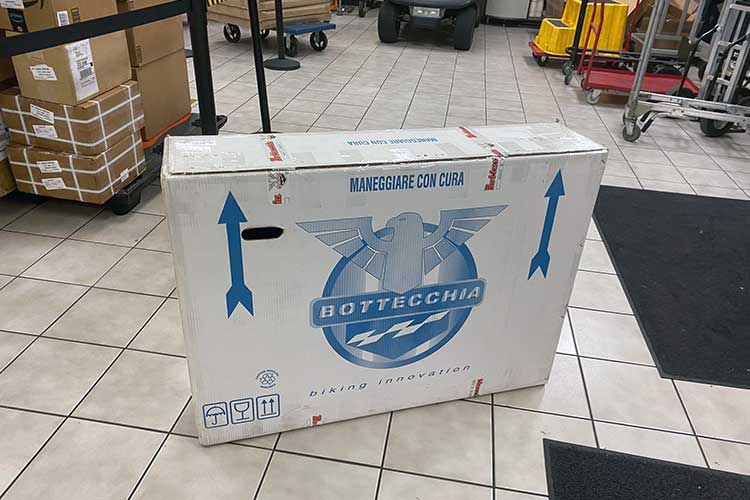
Plenty of Southern California riders end up working out how to ship a bike: for a race back east, a tour that starts three states away, a sale to an out-of-state buyer or a move. The harder calls come first: who carries the box, how much to take apart, whether the tires keep their air and how much coverage to buy. Where the guides disagree, both views are below.
The main ways to ship a bike
There is no single best way to ship a bike. It depends on the deadline, the bike’s value and how much packing you want to do.
Bike-specific shipping services
These services typically ship through the big parcel networks and pass on volume discounts. Many sell a correctly sized box and book the pickup; some guarantee on-time delivery or refund a late one, handy before a race. You still pack it yourself, and home pickup can cost extra.
Parcel carriers and the post office
A carrier’s store is convenient but, per a cycling travel blog, dearer than the bike-specific route. One carrier’s guide lists ground delivery to businesses in one to five business days, a 150-pound limit and 165 inches of length plus girth; its own bike box is 54 by 8 by 28 inches, holds up to 95 pounds, and its stores will pack the bike for a fee. The postal service takes bikes under 70 pounds by ground only, two to eight business days according to a freight shipper’s guide.
Letting a bike shop pack and ship it
The least effort: a mechanic boxes it. A touring cyclists’ organization suggests having the shop send it to a shop at the destination for the rebuild. Call both first. The travel blog calls this the most expensive option and the safest packing.
Flying with it
Checked on your flight, the bike lands when you do. Some airlines charge it like a regular bag, others as oversize; the travel blog’s undated range is zero to more than $300 each way, with more damage risk. A hard case can push you into excess-weight fees, and a mountain-bike site’s boxing guide notes most airlines bar CO2 cartridges and chain lube.
How much does it cost to ship a bike?
Speed, box size, weight, distance and declared value set the price. These figures come from different years and routes, so treat them as rough markers, not current rates:
- The travel blog, undated: usually $60 to $150 within the U.S., more for oversized bikes or long hauls.
- The freight shipper’s 2021 comparison, 35-pound packed bike: about $63 to $84 by ground through a bike-shipping service, $198 to $474 by that service’s air option, $205 to $251 by postal ground, and $129 to about $1,294 through parcel carriers depending on speed and distance.
- A shipping-software blog’s 2020 quotes, Brooklyn to Miami: $102 to $142 by ground, $616 to $773 by two-day or next-day air.
- A bike-travel site’s February 2022 survey, New York to Los Angeles: $74 to $156 within a week and $307 to $795 within two days for a 53 by 7 by 29 inch box; $156 to $357 and $630 to $1,662 for a 59 by 9 by 36 inch one.
On distance the sources split. In the freight shipper’s comparison, ground rates ran about $21 higher on the longer routes; the 2022 survey saw only a few dollars between its New York to Denver and New York to Los Angeles quotes and named speed the biggest factor. It also found that cutting the weight from 44 to 30 pounds didn’t change the quote and that insuring a $2,500 bike cost $31 to $37. A bought box runs roughly $15 to $40 or more, one carrier says.
Box size rules that move the price
A boxed bike is light for its bulk, and the freight shipper’s guide says box size can matter more than weight. The travel blog, quoting a bike-shipping service, says the lowest rates go to packages no longer than 48 inches and no taller than 30, with length plus twice the width plus twice the height at 130 inches or less, under 50 pounds. That carrier box at 54 inches already runs past the length mark.
Getting a box, case or bag
Shops get new bikes in cardboard boxes constantly and often give the empties away; ask for the plastic fork spacer too. Used boxes are rarely pristine, so the mountain-bike guide reinforces hand holds and bottom corners with packing tape, not duct tape, which is made to tear by hand. Some mail-order boxes are reusable kits with a fork mount and hub protectors; one moving-supply retailer rates its kit for up to 85 pounds.
Travel cases start around $300, per the touring organization. Hard shells protect more and weigh more; soft cases with molded padding are lighter and easier to store. They pay off for frequent flyers. For a single shipment, the freight shipper’s guide says a well-packed corrugated box is enough.
Packing the bike, step by step
The moving-supply retailer puts packing at 15 to 30 minutes. A delivery app’s blog describes a first-timer needing over an hour. Plan on the longer number.
Before the first bolt
- Photograph the bike and existing scratches, for a claim and for the later setup.
- Mark saddle height with tape on the seatpost.
- Shift to the easiest gear front and rear so the derailleurs tuck in toward the frame.
- Gather hex keys, a pedal wrench, zip ties, foam pipe insulation, tape, cardboard, a parts bag and pad spacers for hydraulic brakes.
Pedals, seatpost and handlebar
The left pedal is reverse-threaded; the mountain-bike guide’s rule is to turn the wrench toward the back of the bike to loosen either side. Pull the seatpost and saddle together and wrap the greasy post. Take the bar off the stem but leave cables and hoses attached, lay it along the top tube with the levers facing in, then pad and zip-tie it without kinks. Thread the faceplate bolts back in so they can’t get lost.
Wheels, through-axles and disc rotors
Pull the front wheel; an outdoor retailer’s guide says most boxes take the frame with the rear wheel on. Fit a spacer between the fork dropouts so a stacked box can’t crush the fork: half-inch plastic pipe clamped by the skewer or through-axle, a factory plastic spacer or an old hub. Bag any loose axle hardware and cap the axle ends. Remove the rotors, or tape slotted cardboard over them, and keep a pad spacer in each hydraulic caliper while its wheel is out.
Derailleur and drivetrain
The guides split three ways. The outdoor retailer and the shipping-software blog remove the derailleur and hanger where possible, pad them and fix them inside the frame. The travel blogger pads it in place, or, if the rear wheel comes out, unbolts the hanger and zip-ties the derailleur to the chainstay. The mountain-bike guide leaves it on, padded, with something packed behind it against crushing. Keep the chain on the ring and tie the drive-side crank to the down tube.
Tires: keep the air or let some out?
A parcel carrier’s guide says don’t deflate, since full tires cushion the rims. The freight shipper, the shipping-software blog and the travel blog say let some air out, but not all. Nobody recommends dead-flat tires.
Padding, small parts and the shake test
Sleeve every tube in foam. The moving-supply retailer holds padding with stretch wrap so no tape residue reaches the paint. Remove fenders, racks and bottle cages. Small parts go in one labeled bag taped inside the box. Lay extra cardboard on the floor under the fork. Close the box and shake it. If anything rattles, add padding.
Insurance, photos and labels
Standard carrier liability isn’t full coverage; the freight shipper says it won’t cover the full cost of a lost or wrecked bike and recommends buying more, and the travel blogger advises insuring for full replacement value, saying the major options all offer it. With a case, ask anyway: the touring organization reports one major parcel carrier insures bike cases and another doesn’t. Photograph the sealed box. Cover old barcodes, then follow the outdoor retailer: two labels on opposite sides, edges taped but barcode clear, and one inside. The travel blog instead covers the whole label in clear tape.
Timing, tracking and where to send it
Since speed drives price, ship early by ground rather than late by air. Send the box to where you’re staying or to a shop near the start, and call the shop first. Track it daily and have someone there to sign; a bike box on a porch invites trouble.
Shipping an e-bike
Lithium batteries are dangerous goods for most carriers. One parcel carrier ships them only on its express services, under its battery rules; the travel blog says the bike goes only with the battery out. A shipping-software blog lists the requirements: an undamaged battery, insulated terminals, packing that prevents short circuits, a dangerous-goods label, test certification and a hazmat-certified packer. Shipping the battery separately means paying twice, and a battery on its own is still dangerous goods. Watch weight too, since e-bikes can exceed a box’s rating.
How to ship a bike across the country, or skip shipping it
For a coast-to-coast trip, the freight shipper’s guide calls ground service through a bike-specific shipper the cheapest choice. Driving anyway? A rack or the back seat avoids shipping fees, though an outside rack means days of road grime. On a point-to-point tour, the touring organization suggests having a shop at the finish ship the bike home. And an older, cheap bike, the freight shipper suggests, is often better sold before a move and replaced later.
Moving house with the bike
A lone bike suits consolidated freight poorly: that shipper’s minimum billable weight is 120 pounds, so a 25-pound bike is billed as 120. Inside a household shipment it just adds to the total weight.
Green Moving, an Irvine-based moving company serving Los Angeles and Orange County, takes on interstate relocations from Southern California, and its Orange County city pages say bikes are wrapped and loaded so they can’t shift against furniture. On its page for Los Angeles cross country movers, the company describes one coordinator assigned to the whole move, a binding estimate, an inventory documented with photos, trucks that are climate-controlled and followed by GPS in real time, and a delivery window it guarantees. Whoever you hire, ask how the bike will be wrapped and where it rides, make sure it’s on the inventory, and raise any e-bike battery question early.
Unboxing and the rebuild safety check
Cut the tape with a shallow blade, check for damage before tossing packing, and photograph problems right away. Then rebuild slowly:
- Remove the pad spacers, refit the wheel and squeeze each lever to confirm the brakes bite and the rotor runs true.
- Torque the stem, bar and seatpost bolts, through-axles and any removed rotor bolts to the maker’s spec, with a torque wrench on carbon.
- Reset saddle height to the tape mark; center and level the bar.
- Thread the pedals in by turning toward the front of the bike.
- Inflate the tires and run every gear; a bent hanger shows up here first.
- Ride a slow lap of the block before anything serious.
The outdoor retailer suggests packing spares: a tire, a few spokes, a derailleur hanger, a quick link, a shift cable, cable cutters and a shock pump. If the rebuild feels shaky, a local shop can handle it, and before a race that’s money well spent.
Photo by SoCalCycling.com