

You’ve got a powerful e-bike. It eats hills for breakfast and leaves traffic in the dust. But does it feel perfect everywhere? Does that aggressive throttle, so thrilling on an open road, become a liability when you’re navigating a crowded parking lot?
If you’ve ever felt that your bike has more potential than you can access, you’re not wrong. The key isn’t always more power; it’s smarter power. The secret lies in the often-overlooked brain of your machine: the controller.
Think of it less as a simple on/off switch and more as a sophisticated engine management system. It’s where the raw grunt of your motor meets the finesse of digital control. Learning to speak its language allows you to dictate precisely how that power is delivered. After this guide, you’ll be able to transform your single, one-size-fits-all bike into a quiver of specialized tools, perfectly tuned for urban commutes, technical trails, or relentless mountain climbs.
Beyond Peak Power: The Art of Power Delivery
Peak wattage figures are great for marketing, but they tell only half the story. The true character of an e-bike—what you feel through the handlebars and the seat — is defined by the art of power delivery. It’s the difference between raw, abrupt power and a smooth, predictable surge.
This philosophy is perfectly captured by Dmitry Bogdanchikov, CEO of Nucular Electronics, a company known for its focus on advanced controller engineering.
“Many people think raw power is everything. But the real key to the perfect ride is in how that power is delivered. Smoothness, responsiveness, predictability—that’s what we obsess over. It’s this fine-tuning that transforms a good e-bike into a truly great one.”
This is all about throttle response, acceleration curves, and braking behavior. A helpful analogy is the drive mode selector in a modern car. The engine is the same, but flipping from “Eco” to “Sport” mode completely changes the vehicle’s personality. Your e-bike controller offers the same level of transformation, and you are the one writing the software for each mode.
Your Tuning Toolkit: Key Parameters Explained
While some advanced controllers boast over 200 adjustable parameters, you only need to master a handful to completely revolutionize your ride. Let’s break down the most impactful ones.
- Battery Current vs. Phase Current: This is the most fundamental concept to grasp.
- Battery Current (Amps): Think of this as your bike’s overall stamina and high-speed muscle. It’s how much energy the controller is allowed to pull from your battery pack. Bumping this up gives you stronger acceleration past 20-30 mph and helps you push toward your top speed without feeling like the bike is running out of breath.
- Phase Current (Amps): This is the “off-the-line” punch. It’s the current sent directly to the motor’s windings. A high phase current delivers that neck-snapping acceleration from a dead stop and the raw grunt needed to get up a steep incline. It’s a powerful tool that demands respect.
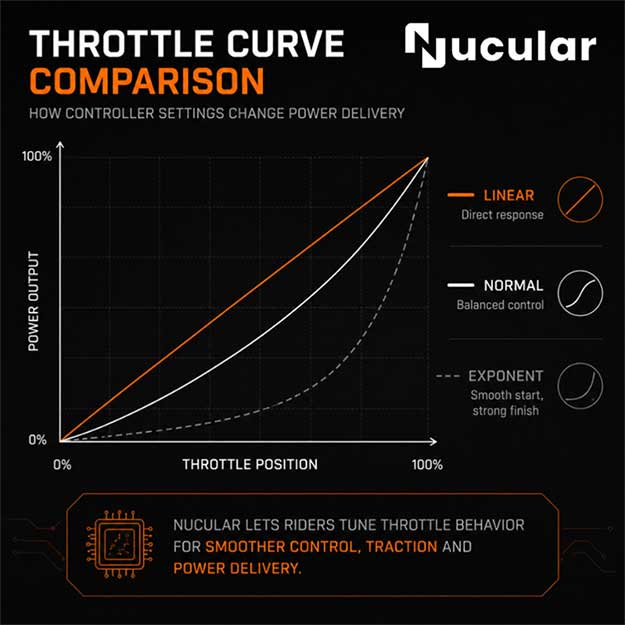
- Throttle Curve (Throttle Mapping): This dictates how the motor responds to your hand. Instead of a 1:1 relationship, you can shape the response. A common “Exponent” curve, for example, makes the initial part of the throttle twist very gentle, perfect for low-speed control. But as you twist further, the power ramps up dramatically, giving you that explosive kick when you really want it. It provides the best of both worlds: tameness for technical spots and raw power on demand.
- Regenerative Braking: This setting determines how strongly the motor brakes when you let off the throttle or use a dedicated brake lever. Finding the right balance is key. Too little, and you barely notice it. Too much, and you risk locking up the rear wheel on a wet or loose surface. An aggressive regen can also be jarring, causing the bike to lurch every time you release the throttle. A good starting point is a mild 10-15A regen current on throttle release to simulate engine braking, with a stronger setting linked to a separate brake lever for controlled slowing on long descents.
Tuning Recipes for Your Ride
Now, let’s put the theory into practice with some starting “recipes.”
- The Smooth Urban Commuter
- Goal: Predictability in traffic, rider confidence, and efficiency.
- Recipe:
- Throttle Curve: Use a “Normal” or “Polynomial” curve. This softens the initial throttle response, preventing jerky starts at stoplights.
- Phase Current: Keep it moderate. You don’t need a drag-race launch when filtering through cars.
- Regenerative Braking: Set a gentle regen on throttle release to help with smooth deceleration in stop-and-go traffic, reducing wear on your brake pads.
- The Off-Road Trail Explorer
- Goal: Maximum traction on loose surfaces and precise throttle control for technical climbs.
- Recipe:
- Throttle Mode: Switches the throttle logic from direct Torque Control to an advanced RPM Control mode. Instead of simply metering out power, in this mode the throttle sets a target rotation speed. The controller then intelligently applies the necessary torque to smoothly reach and consistently maintain that speed, regardless of load or terrain. This results in far more predictable and intuitive handling, acting like a cruise control for every position of your throttle.
- Throttle Curve: An “Exponent” curve is your best friend here. It gives you a large, forgiving range of motion for low-speed maneuvering through rocks and roots, preventing accidental wheelspin from a shaky hand.
- Phase Current: High enough for punch, but not so high that you instantly break traction. The goal is controllable torque, not just raw power.
- The Relentless Hill Climber
- Goal: Maximum, sustained power on long, steep ascents without overheating or shutting down.
- Recipe:
- Battery & Phase Current: Set these to the highest safe limits for your hardware. This is where you need all the power you can get.
- Thermal Management: This is where top-tier controllers prove their worth. Instead of just shutting down when a temperature limit is hit, an intelligent controller will proactively and smoothly reduce power just enough to hold the motor and electronics at their peak safe operating temperature. You might not even notice the slight reduction, but you’ll certainly notice that your bike just keeps pulling all the way to the summit.
Feature Spotlight: Acceleration Limit – Full Power, Better Control
Powerful e-bikes are exciting, but wrestling with instant torque isn’t always an advantage. An aggressive throttle can make low-speed riding stressful, especially on loose surfaces or in crowded areas. The Acceleration Limit feature lets you keep all of your bike’s power while making it significantly easier to control.
The Acceleration limit (ERPM/s) limits how quickly the controller increases motor speed. Unlike reducing current, it does not reduce the motor’s available torque or hill-climbing ability. Full power is still there—the controller simply delivers it more progressively.
One long-time rider we spoke to recently enabled this feature on his high-power e-bike. He told us it completely changed the experience. The bike became more predictable and confidence-inspiring, while steep hill climbs felt exactly the same. The smoother power delivery made everyday riding more enjoyable without sacrificing an ounce of performance.
This feature is particularly appreciated by many experienced riders. With time, many prefer a smooth and predictable throttle over an abrupt burst of acceleration. The bike feels calmer and easier to manage, reducing fatigue while providing full torque whenever needed. It’s not about making the bike less powerful—it’s about making that power more usable.
The Acceleration limit is especially useful for:
- High-power bikes with aggressive throttle response.
- Riding on gravel, wet pavement, snow, or other low-traction surfaces.
- Technical off-road trails where traction is critical.
- Everyday commuting with frequent starts and stops.
- Riders who value confidence, precision, and smooth control.
A simple way to tune the feature is to ride normally and check the “Max acceleration” value in the controller’s status logs. Use this measured value as a starting point, then gradually lower the Acceleration limit until the bike feels comfortable without becoming sluggish. You can always adjust it further to match your riding style and terrain.
Your Ride, Your Rules
The most common mistake is diving into settings without a clear goal. Maxing out everything often results in a bike that is either dangerously unpredictable or instantly shuts down. This happens when the controller tries to draw more amps than the battery’s management system (BMS) can safely provide, forcing it to cut power to protect the cells. If you experience these sudden shutdowns, the fix is to go back into the settings and reduce the ‘Max Battery Current’ parameter. Lower it step-by-step until your BMS is stable even under full throttle.
The modern e-bike controller gives you an incredible degree of authority over the physics of your ride. Don’t be afraid to experiment, but do it methodically. Start with small, single-parameter changes and go for a test ride. Feel the difference. Learn the cause and effect. Your perfect ride—a machine that feels like a true extension of your will—is just a few clicks away. What we’ve covered here is only the tip of the iceberg of what’s possible, especially with a truly open and intelligent control system, like those pioneered by specialist firms such as Nucular, at your command.
About Nucular
Nucular is a team of engineers and enthusiasts creating electric motor controllers for people who are just as passionate. It’s for those who don’t accept compromises and want to get the absolute maximum out of their custom electric vehicle. Nucular products are not “black boxes”; they are powerful tools for fine-tuning power, speed, and response. The company believes in the DIY community and gives it full control over its hardware.