


The ideal race day warm up is a progressive ramp followed by two to three supra-threshold openers, finished 5 to 10 minutes before your start. For most disciplines, 15 to 25 minutes total does the job. Time trials need the long end of that range. This structure, backed by findings like PMC6224842, is commonly observed to work well at race start lines.
TL;DR:
- Short, specific openers of 10 to 30 seconds are most effective, with a full recovery and about 5 to 10 minutes of easy spinning afterward.
- Maximize warm-up benefits with high-intensity efforts at 110%+ FTP, but avoid fatigue by limiting total warm-up time based on race discipline.
- Finish warm-up 5 to 10 minutes before start to maintain physiological gains and prevent cooling or fatigue, adjusting in cold weather or delays.
- Rehearse your warm-up routine in training at least twice to build confidence and prevent performance breakdowns under nerves.
- Use dynamic mobility instead of static stretching before efforts; pack weather-appropriate gear and carry a timer for precise effort management.
Table of Contents
- Race Day Warm Up Plans By Discipline
- What Does the Research Say About Warm-Up Intensity?
- When Should You Finish Your Warm-Up Before the Start?
- How Should Warm-Ups Differ By Racing Discipline?
- What Warm-Up Mistakes Hurt Race Performance Most?
- What Should You Pack for a Reliable Warm-Up Setup?
- Why Does Warming Up Actually Improve Cycling Performance?
- How Do You Prepare Mentally During Your Physical Warm-Up?
- What Should You Eat and Drink Before Warming Up?
- How Do You Cool Down Between Warming Up and Racing?
- Should Beginners Warm Up Differently Than Experienced Racers?
- SoCalCycling’s Race-Tested Warm-Up Checklist
- Sources
- FAQ
Race Day Warm Up Plans By Discipline
Every discipline demands a slightly different ramp, and the differences come down to how fast the race goes hard. A crit that explodes off the line needs different priming than a 40K time trial where you control your own pace from the gun.
Time trial. Spend 20 to 25 minutes on the turbo, building steadily from easy spinning to threshold effort. Roll off the trainer and finish 5 to 8 minutes before your start.
Criterium. Fifteen to twenty minutes of progressive riding, working in 2 to 3 corner-exit simulations (15 seconds each, near-standstill to full gas) and 2 to 3 short sprints. Crits start at race pace immediately, so your legs need to already know what a hard surge feels like. Finish 5 to 8 minutes out.
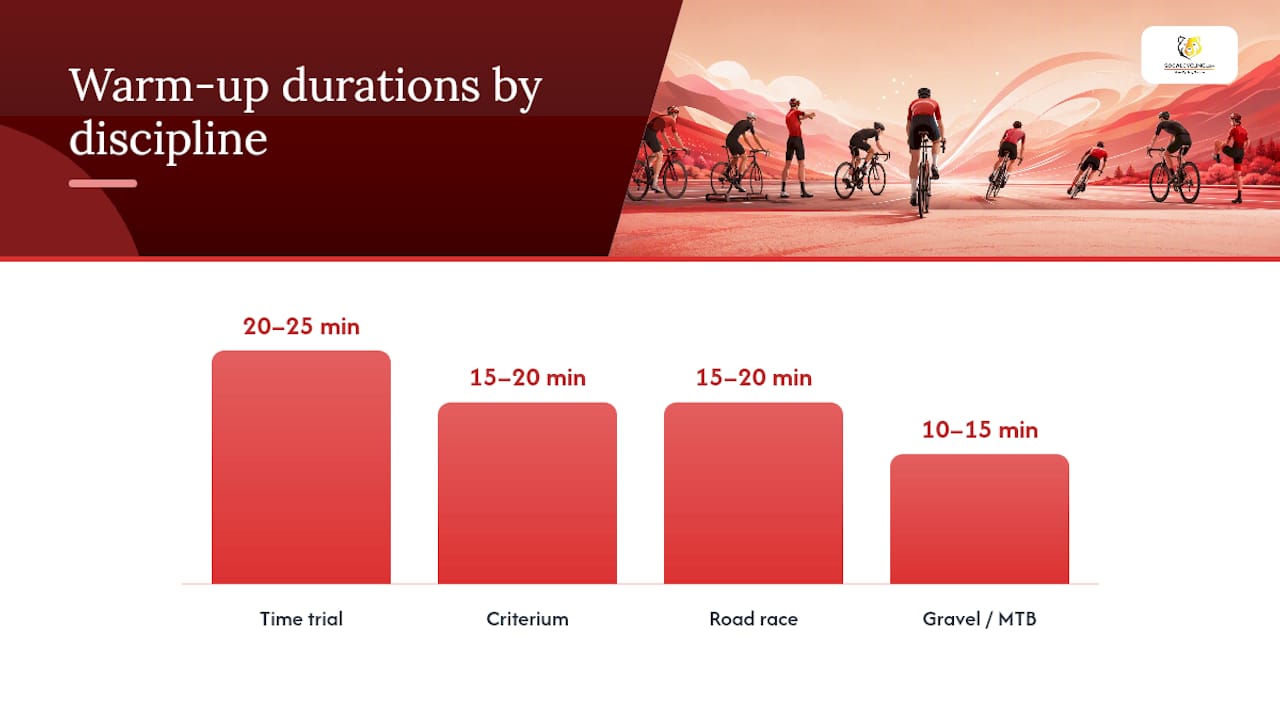
Road race. Fifteen to twenty minutes progressive, but keep openers shorter (around 20 seconds) since the race itself will keep ramping intensity for the first 10 to 15 minutes anyway. You are priming, not exhausting.
Gravel and mountain bike. Ten to fifteen minutes covers most needs, and a chunk of that should be technical recon on course features (loose corners, punchy climbs) rather than pure fitness work. Add 1 to 2 efforts of 20 to 30 seconds hard. Course-specific prep beats generic intervals here.
- Set your trainer or find a quiet stretch of road 30 minutes before your planned finish time.
- Build from zone 2 to threshold over the first 10 to 15 minutes.
- Execute your openers with full recovery between each.
- Roll to the line with 5 to 10 minutes to spare.
Before you clip in for real, run through this: jacket off or on depending on temperature, opener plan set, nutrition timed, and a mental note of your re-opener plan if the start gets delayed.
- Cadence during the ramp should feel conversational, not labored.
- Power zone targets: build through zone 3, touch threshold once, then hit openers at 110%+ FTP.
- Recreational racers can lean toward the shorter end of every range listed above.
Pro Tip: Rehearse your exact warm-up sequence, timer and all, at least twice in training before race day. A routine you’ve never run before is a routine that falls apart under nerves.
What Does the Research Say About Warm-Up Intensity?
A 2018 study published in PMC compared work-matched moderate intensity (about 40% VO2peak) against high intensity (about 80% VO2peak) warm-ups before a 120-second supramaximal sprint test. Both improved late-stage 30-second sprint output compared to no warm-up at all. The high-intensity version produced a noticeably higher peak power for efforts under 10 seconds, with supported data showing a difference in watts around that range.
That’s the case for supra-threshold openers if your race finishes in a sprint.
But intensity has a ceiling. Research from the International Journal of Sports Physiology and Performance found that intense warm-ups paired with short recovery windows can actually reduce output in subsequent maximal efforts. The fix isn’t skipping the hard openers. It’s giving them room to work: 5 to 10 minutes of easy spinning after your last hard effort before you line up.
Duration matters less than most riders assume, at least for pure endurance events. A study on 5K time trial performance found no significant difference in finish times between short (3-minute) and long (10-minute) warm-ups in recreationally trained cyclists, though the early kilometers trended faster with a warm-up. For elite-level racing, where the first few minutes decide positioning, that early-race boost is worth chasing.
The practical rule that falls out of all three findings: short, sharp openers, real recovery after them, and don’t confuse a longer warm-up with a better one.
- Supra-threshold openers boost late-race sprint power.
- Skimping on recovery after hard openers can backfire.
- Warm-up length barely moves finish time in pure endurance efforts, but helps early pace.
When Should You Finish Your Warm-Up Before the Start?
Finish a few minutes before your race begins—commonly within about 5 to 10 minutes—to preserve physiological gains without fatigue. That window keeps the physiological gains, elevated muscle temperature, primed oxygen delivery, active VO2 kinetics, without giving lactate and other metabolites time to clear and cool your system back down.
- If your start gets delayed, don’t just stand around: an easy spin plus one short opener roughly 3 to 4 minutes before the revised gun time keeps you primed.
- Keep jackets or arm warmers on until the last possible moment, especially in cool conditions.
- Racing multiple events in a day (common in track and cyclocross doubleheaders)? Do your full warm-up before the first race, then a shorter re-priming spin, 5 to 8 minutes with one opener, before the second.
- Cold weather adds roughly 5 minutes to your total warm-up time, and insulation matters more than duration.
Pro Tip: Carry a spare base layer specifically for the warm-up. Sweating through your one dry layer before the gun even fires is a rookie mistake that’s easy to avoid.
How Should Warm-Ups Differ By Racing Discipline?
Criterium riders should build their warm-up around corner-exit simulations: 15-second maximal efforts from a near-standstill or slow roll in a big gear, mimicking the torque demands of exiting a tight corner at race pace. This kind of specificity beats generic threshold intervals for events that go hard from the whistle.
Time trial riders get the most benefit from finishing with 2 to 3 openers at max aerobic power, then respecting a full 5 to 8 minutes of recovery before rolling to the start ramp. A turbo trainer is worth the hassle here because it removes traffic, terrain, and pacing variables you can’t control on an open road.
Track and fixed-gear starts call for low-cadence, big-gear standing starts, or slow-roll big-gear repeats, since the demand is raw torque application from a dead stop, not sustained spinning.
Gravel and mountain bike racers benefit from a brief technical recon of the opening sector combined with 20 to 30 second hard efforts. Knowing exactly how the first loose corner or punchy rise rides matters as much as raw fitness in these formats.
- Crit: corner-exit reps, 15 seconds, near-standstill starts.
- TT: MAP-level openers, longer recovery, turbo preferred.
- Track: low-cadence standing starts in a big gear.
- Gravel/MTB: course recon paired with short hard efforts.
What Warm-Up Mistakes Hurt Race Performance Most?
The single most common error is turning the warm-up into a training session. Anything over 30 to 40 minutes stops priming your body and starts fatiguing it before the gun even fires.
- Skip long hard efforts entirely. Openers are short (10 to 30 seconds) and specific to your race demands, not a chance to test your threshold.
- Never leave a long dead zone between finishing your warm-up and starting. Plan re-openers and keep layers on if delays happen.
- Drop static stretching right before power efforts. It can reduce peak power by roughly 5%, according to evidence-based cycling warm-up guidance. Dynamic mobility work is the better substitute.
- Never test a new routine for the first time on race morning. Rehearse it in training first.
What Should You Pack for a Reliable Warm-Up Setup?
- Decide turbo versus road ahead of time. A smart trainer gives you controlled intervals without traffic or terrain variables, which matters most at big events with congested venues; a quiet road loop works fine for smaller local races.
- Pack a jacket or gilet plus a towel to manage sweat and temperature between efforts.
- Bring a small pump and multi-tool, mechanicals during warm-up are common and preventable disasters.
- Set an interval timer on your bike computer or watch for openers and recovery so you’re not guessing at effort duration mid-ramp.
Why Does Warming Up Actually Improve Cycling Performance?
Muscle temperature drives most of the benefit. Raising deep muscle temperature by roughly 1 to 3°C speeds up the chemical reactions that fuel contraction, meaning your muscle fibers generate force faster and more efficiently once you’re racing. Cold muscle is stiff muscle, and stiff muscle produces less power per pedal stroke.
Enzyme activity climbs alongside temperature. The enzymes responsible for breaking down glycogen and fat into usable energy work faster in warmer tissue, which means your body can meet the sudden energy demand of a race start without lagging behind the effort.
Oxygen delivery is the third piece. A progressive warm-up primes what exercise physiologists call VO2 kinetics, the speed at which your cardiovascular system ramps oxygen delivery to working muscles. Prime that system beforehand, and you avoid showing up to the start line still running an oxygen deficit from a cold start, the uncomfortable early-race sensation every racer knows.
Supra-threshold openers add a fourth mechanism on top of temperature and oxygen delivery: they recruit fast-twitch motor units that a gentle spin never touches. That’s precisely why work-matched high-intensity warm-ups produced higher peak power than moderate ones in short maximal efforts. You’re not just warming the engine. You’re waking up the specific muscle fibers you’ll need for a race-winning surge.
None of this happens instantly, which is exactly why a 5-minute warm-up rarely cuts it and a 45-minute one wastes energy you’ll want later.
How Do You Prepare Mentally During Your Physical Warm-Up?
Physical and mental preparation happen on the same clock, not in separate boxes. The progressive ramp is also your window to run through race tactics: where you need to be positioned at the start, who the strong riders in your field are, and what your opening move looks like.
Use the easy spinning phase for visualization. Picture the start line, the first corner, the moment the pace lifts. Riders who mentally rehearse the opening minutes tend to react faster when the race actually goes hard, because the scenario isn’t a surprise.
Save the openers themselves for building competitive arousal. Many experienced racers treat their final opener as a deliberate switch-flip moment, the signal that easy warm-up time is over and race mode starts now.
Breathing control matters in the last few minutes before the start. Nerves tighten breathing and raise heart rate independent of physical effort. A slow, deliberate breath cycle during your final easy spin keeps you from arriving at the line already anxious on top of physically primed.
Talk to teammates or your coach during the ramp if tactics need confirming, but keep the final 3 to 5 minutes quiet and internal. That’s when most riders shift from thinking about the race to simply being ready for it.
What Should You Eat and Drink Before Warming Up?
Your last real meal should land 2 to 3 hours before your start, giving you time to digest without racing on an empty tank. As the warm-up itself approaches, shift to easily digestible carbohydrates, a gel, a banana, or a small amount of sports drink, consumed 15 to 30 minutes before you begin your ramp.
Hydration needs to start well before the warm-up, not during it. Aim to be drinking steadily in the hour leading up to your start, particularly in warm conditions where you’ll lose fluid through sweat during the ramp itself. A small bottle on the turbo or nearby during a road warm-up lets you sip between efforts without overloading your stomach right before racing.
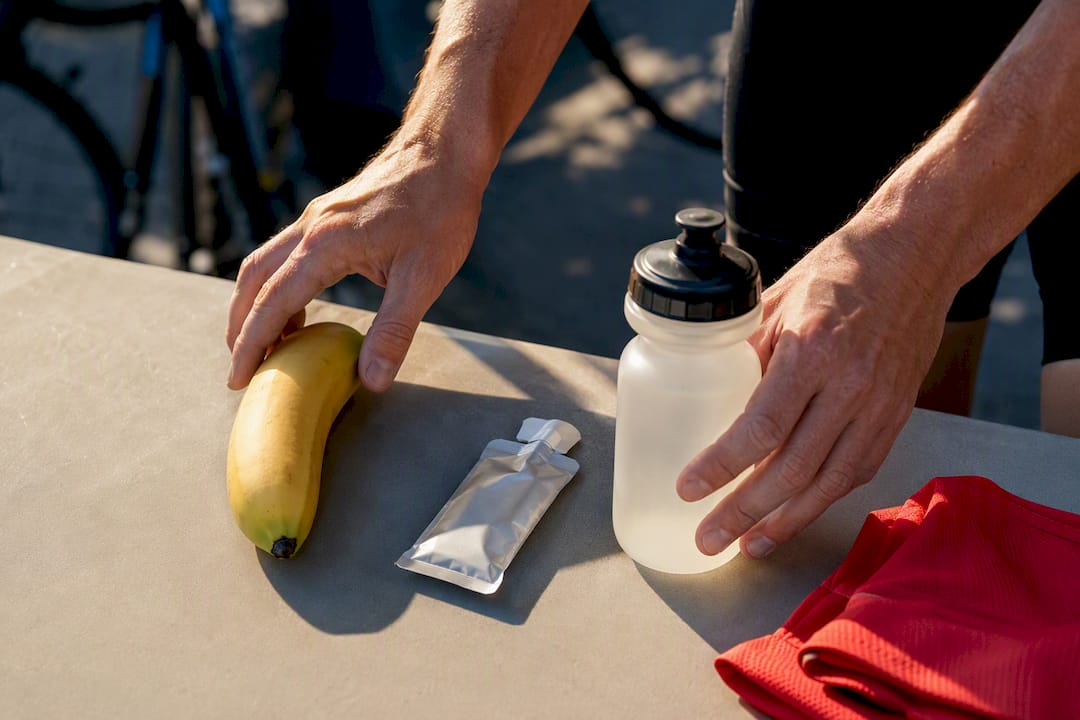
Avoid large amounts of fiber, fat, or unfamiliar foods in the pre-race window. Race morning is not the time to test a new energy bar or breakfast, digestive issues mid-warm-up are entirely preventable and entirely common among riders who experiment on race day instead of in training.
Caffeine, if you use it, works best consumed 45 to 60 minutes before your start, timed so peak effect lines up with the gun rather than your warm-up’s opening minutes. Electrolyte intake matters more in hot conditions or longer warm-up windows (the 20 to 25 minute time trial ramp, for instance) where sweat losses climb even before the race starts.
How Do You Cool Down Between Warming Up and Racing?
The 5 to 10 minute window between finishing your warm-up and rolling to the start line is a heat management problem as much as a physiological one. You’ve raised muscle temperature and started sweating. Standing around in cool air or wind during that gap can undo the temperature gains faster than most riders expect.
Keep a jacket, gilet, or arm warmers on right up until the moment you clip in for real, even if you feel warm from the effort. This matters most in cold or windy conditions, where exposed, sweat-dampened skin loses heat quickly through evaporation. A dry base layer change during this window, if you have time, prevents that clammy chill that saps focus right before the start.
Keep moving if possible rather than standing completely still. A slow roll or gentle pedaling in place maintains blood flow and body heat better than standing flat-footed, even for just those final few minutes.
In hot weather, the opposite concern applies: overheating before the start. Shade, a cooling towel, or simply unzipping a jersey during the waiting period helps manage core temperature without losing the muscular benefits of the warm-up itself.
Should Beginners Warm Up Differently Than Experienced Racers?
Fitness level and racing experience both change how much warm-up you actually need. A rider new to racing, still building an aerobic base, often benefits from a shorter, gentler ramp, 10 to 15 minutes, since their body reaches working temperature faster and pushing hard efforts before a first race can spike nerves as much as it primes muscles.
Experienced racers with higher fitness typically need the fuller 20 to 25 minute protocol, particularly for time trials, because a well-trained cardiovascular system takes longer to reach its ceiling and benefits more from a longer progressive build before hard openers pay off.
Masters and older racers often need extra time in the early, easy portion of the ramp. Connective tissue and joint mobility respond more slowly to temperature increases with age, so rushing straight into openers without a longer gentle base increases injury risk without adding benefit.
Newer racers should also treat their first few race warm-ups as practice in themselves, dialing in what pace feels right and how their body responds to openers, rather than copying an elite protocol wholesale on day one. Confidence in the routine matters as much as the physiology behind it, and that confidence only comes from repetition.
SoCalCycling’s Race-Tested Warm-Up Checklist
These plans reflect what actually happens at start lines, not just what a lab predicts. Before you roll out, run through this: confirmed start time, turbo or road decision made, openers planned and timed, clothing layered for conditions, nutrition timed, and team roles assigned if you’re racing with support.
For deeper prep on the strength side of race readiness, see Socalcycling’s power development guide, and don’t underestimate how recovery weeks factor into whether your legs respond to openers at all on race morning.
Ready to build your event calendar around a season of dialed-in race mornings? Socalcycling’s guide on race director roles and event logistics is a useful next stop for organizers and racers alike, and if you’re chasing a broader community perspective on race prep, this training and event guide covers similar ground from a different angle.
— SoCalCycling.com
Sources
- Effects of warm-up intensity on sprint performance — PMC6224842
- Warm-Up Strategy and High-Intensity Endurance Performance in Trained Cyclists
- Cycling warm-up and cool-down — evidence-based guide (Roadman Cycling)
FAQ
How Long Should a Race Day Warm Up Last?
Most disciplines need 15 to 25 minutes total. Time trials sit at the longer end, 20 to 25 minutes, while gravel and mountain bike races can work with 10 to 15 minutes.
Should I Finish My Warm-Up Right Before the Start?
No. Finish 5 to 10 minutes before your start to keep the physiological benefits without letting fatigue from your openers carry into the race.
Is Static Stretching Good Before a Race?
No. Static stretching immediately before power efforts can reduce peak power by roughly 5%, according to evidence-based warm-up guidance. Use dynamic mobility work instead.
Do I Need a Turbo Trainer to Warm Up Properly?
Not always. A turbo gives controlled intervals without traffic, useful at large or congested events, but a quiet road loop works fine for smaller local races.
Recommended
- What Is a Cat 5 Cycling Race? Beginner’s Guide
- Cyclist Hydration Best Practices: Rules That Actually Work
- Strength Training for Cyclists: 12-Week Power Plan
- Road Race Categories for Beginners: A Clear Comparison