


An event corral in cycling is a designated starting zone where riders group by expected pace or assigned wave before the gun goes off. The industry term is “start corral” or “start wave,” and you will hear both used interchangeably at gran fondos, road races, and gravel events. The core purpose is simple: keep fast riders at the front and slower riders behind, so the first kilometers of a race stay safe and orderly. Without corrals, a mass start turns the cycling event start area into a dangerous scramble of speed differentials. Understanding what does event corral mean cycling is the first step toward a better race day, whether you are pinning on a bib or directing the event.
What does event corral mean in cycling?
An event corral is a marked zone at the start of a race that groups participants by pace or wave to reduce congestion and improve safety in the opening kilometers. Large events may use corral areas stretching a full mile and up to eight distinct start waves to safely manage crowds. That scale demands serious logistics, from barrier placement to volunteer staffing, and it shows why corrals are far more than a simple line in the road.
The term “start corral” borrows from livestock management, where animals are held in pens before release. In cycling, the pen is a fenced or coned section of road, and the release is a timed wave start. Each corral holds riders of roughly similar speed, so the group that rolls out together stays together through the first technical sections of the course.
Corrals appear across every major cycling format. Gran fondos use them to separate competitive and recreational riders. Gravel events apply them to manage mixed fields of hundreds or thousands of participants. Even criteriums with smaller fields use informal corral staging to keep licensed categories separated before the whistle. The event corral definition in cycling is consistent across formats: a controlled holding area that produces a safer, fairer start.
How are event corrals organized and assigned in cycling races?
Corral assignments are based on predicted finish times provided during registration or verified by historical race results. Organizers sort those times into bands, assign each band a corral letter or number, and print that designation directly on the rider’s bib. The bib number is the rider’s ticket to the correct zone.
Here is how the assignment and check-in process typically works at a well-run event:
- Registration: Riders submit an estimated finish time or link a past race result. Organizers use that data to place each rider in a corral bracket.
- Bib pickup: The bib number identifies corral placement, which corresponds to predicted finish categories or age groups. Riders receive corral instructions with their packet.
- Morning arrival: Participants must be present 10–15 minutes before their scheduled wave start for smooth release. Arriving late risks missing the wave entirely.
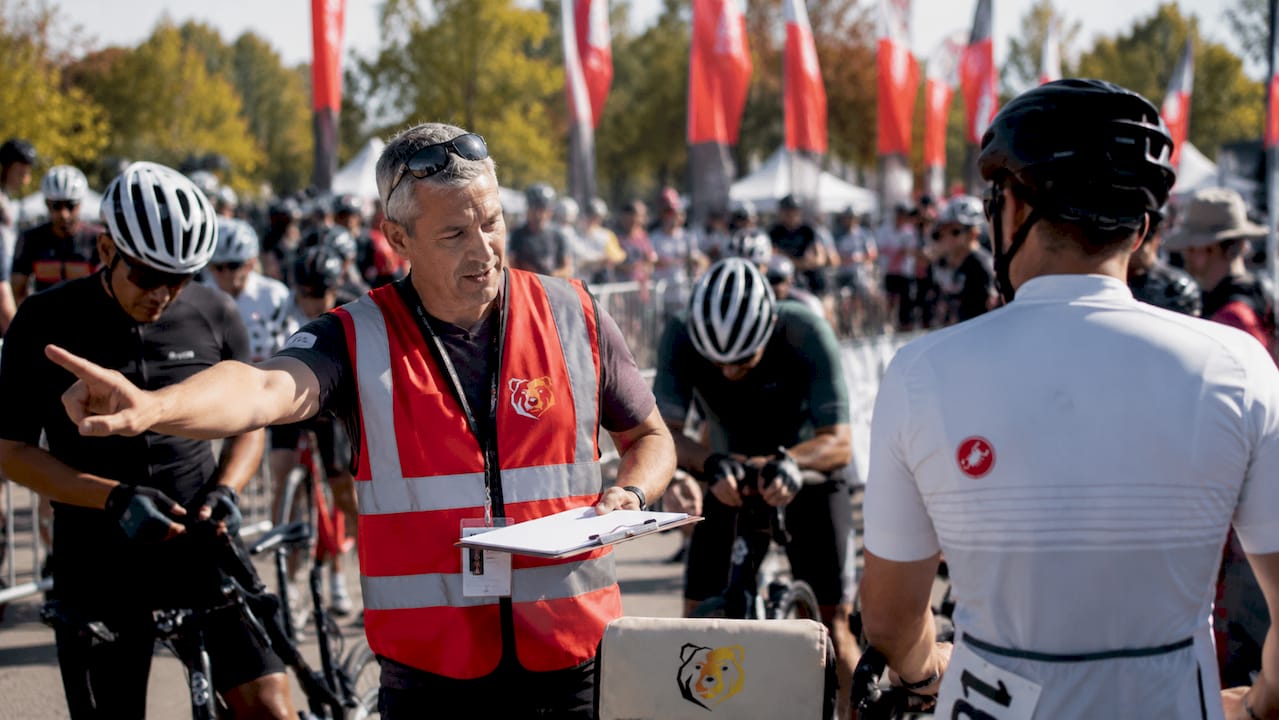
- Corral entry: Volunteers and signage direct riders to the correct zone. Barriers keep corrals separated until the wave is released.
- Wave release: Corrals go off in sequence, typically two to five minutes apart, so each group has clear road ahead before the next wave launches.
Pro Tip: Arrive at the cycling event start area at least 30 minutes before your wave. Use that buffer to find your corral, check tire pressure, and settle your nerves before the countdown.
Large events add another layer of complexity. The 2026 Chevron Houston Marathon, for example, featured eight separate start waves including elite and athlete development programs. That level of sequencing requires a one-mile start line operation with coordinated barriers, timing mats, and radio communication between zone captains.
What are the benefits of event corrals for safety and race management?
Corrals solve the single biggest danger at mass participation events: speed differentials at the start line. When a 15 mph recreational rider launches next to a 25 mph racer, the result is swerving, braking, and crashes within the first 500 meters. Corrals eliminate that mismatch before it happens.
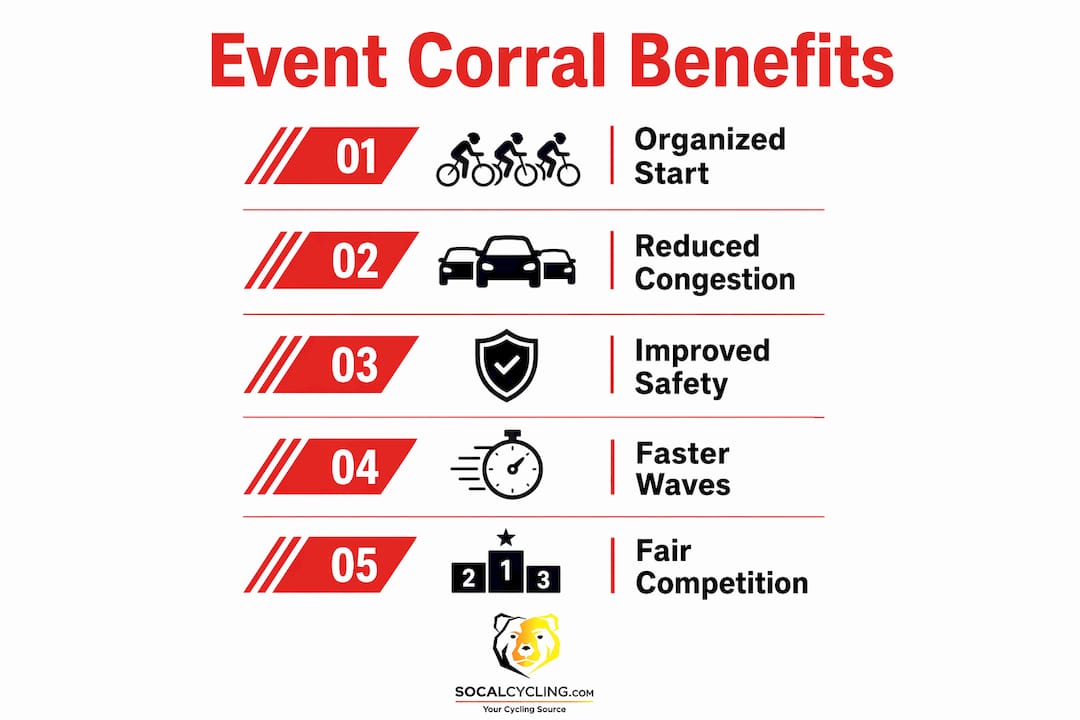
The core purpose of corrals is reducing chaos and dangerous bottlenecks by grouping riders of similar speed at the start. That grouping benefit extends well beyond the first kilometer. Riders who start with peers of similar fitness settle into their natural pace immediately, which prevents the accordion effect of surging and braking that plagues mixed-speed groups.
Key benefits for both riders and organizers include:
- Reduced crash risk: Similar speeds at the start mean fewer sudden braking events and less contact between riders.
- Fairer competition: Riders in the same corral face the same road conditions and traffic at the same time, producing more comparable finish times.
- Better crowd management: Organizers can release thousands of riders in controlled waves rather than one chaotic mass, keeping intersections and aid stations manageable.
- Improved pacing: Corrals allow every participant to settle into natural pace immediately, preventing the energy waste of fighting through slower or faster traffic.
- Sponsor and media visibility: Elite corrals at the front give sponsors and cameras a clean shot of the fastest riders without recreational participants in the frame.
“Starting elites first in separate corrals improves sponsor visibility and event efficiency while maintaining competitive separation. The structure benefits every stakeholder: riders get a fair start, organizers get a manageable crowd, and sponsors get the exposure they paid for.”
That last point matters more than most riders realize. Starting elites first in separate corrals is now standard practice at GFNY World Championship events and most major gran fondos. It is both a competitive and commercial decision.
What nuances and special considerations exist in corral management?
Not every corral situation is straightforward. Elite riders, late arrivals, and different event formats each create specific challenges that organizers must plan for in advance.
Elite vs. mass participation corrals
Professional and elite riders start ahead of mass participation groups for competitive separation and sponsor visibility. Their corral is typically smaller, tightly controlled, and released several minutes before the first mass wave. At events like the GFNY NYC, elite riders start separately to preserve the integrity of the competitive field. Mass corrals then follow in sequence, with each wave given enough road clearance before the next release.
Handling late arrivals
Late arrivals are a persistent problem at large events. The solution is a dedicated “Late Arrivals” corral, positioned at the back of the start area. Late arrivals must be managed with designated corrals to maintain overall event safety without disrupting flow. Placing a late rider into an earlier wave mid-release creates a speed mismatch and a safety hazard. The Late Arrivals corral absorbs that problem cleanly.
Corral design by event type
| Event type | Typical corral structure | Key consideration |
|---|---|---|
| Gran fondo | 4–8 waves by predicted time | Large footprint, mile-long staging |
| Gravel race | 2–4 waves by category | Neutral rollout before timed section |
| Criterium | 1–2 corrals by license category | Compact staging, short pre-race window |
| Cyclocross | Grid start by ranking | Row-by-row release, no wave gaps |
Pro Tip: If you are organizing a gravel event, consider a neutral rollout for the first mile before the timed segment begins. This naturally separates pace groups without requiring multiple formal corrals.
Large-scale corral systems can span an entire mile or more, requiring coordinated logistics with extensive signage, volunteers, and safety planning. That footprint demands early course closure, clear pedestrian detours, and radio communication between corral captains at each zone boundary.
How should participants and organizers prepare for event corrals?
Preparation is the difference between a smooth corral experience and a stressful one. Both riders and organizers carry specific responsibilities that, when executed well, make the start line feel effortless.
What riders need to do
- Arrive early. Report to the cycling event start area at least 30 minutes before your wave. Corrals close to new entrants once the wave ahead releases.
- Be honest about your pace. Submitting an inflated finish time to get a faster corral is unfair and dangerous. You will be surrounded by riders faster than you, creating the exact speed differential corrals are designed to prevent.
- Know your bib number. Your bib number confirms your corral assignment. Check the race guide the night before so you know exactly where to go on race morning.
- Follow volunteer directions. Volunteers manage corral entry and exit. Arguing with a volunteer about your corral placement on race morning wastes time and creates congestion.
- Stay in your corral. Moving forward into a faster corral without authorization puts you and other riders at risk.
What organizers need to do
Effective corral signage, volunteer staffing, and early arrival protocols improve participant compliance and the start line experience. The role of the race director includes designing the corral layout, briefing volunteers, and communicating wave times clearly in the race guide. Signage must be visible from 50 meters away, with corral letters or numbers large enough to read while rolling in on a bike. Volunteers at each corral entry point need clear authority to redirect misplaced riders without confrontation.
Organizers should also publish corral assignments in the race guide at least 48 hours before the event. Riders who know their corral in advance arrive with a plan. Riders who find out on race morning create bottlenecks at the information tent. Reviewing your cycling event checklist well before race day keeps corral logistics on track.
Key takeaways
Event corrals are the single most effective tool for managing safety and fairness at the cycling start line, and both riders and organizers share responsibility for making them work.
| Point | Details |
|---|---|
| Corral definition | A designated start zone grouping riders by pace or wave to reduce congestion and improve safety. |
| Assignment method | Organizers assign corrals based on predicted finish times submitted at registration or verified race history. |
| Safety benefit | Grouping riders of similar speed eliminates dangerous speed differentials in the opening kilometers. |
| Elite separation | Professional riders start in a dedicated front corral for competitive integrity and sponsor visibility. |
| Late arrivals | A dedicated Late Arrivals corral absorbs riders who miss their wave without disrupting the main field. |
Socalcycling’s take on event corrals
We have covered hundreds of cycling events across Southern California and beyond, and the corral system is one of those race-day details that separates a well-run event from a chaotic one. The difference is visible within the first 200 meters of the start.
The most common mistake we see riders make is underestimating their finish time to get a faster corral. It feels like a competitive advantage, but it backfires immediately. You spend the first five miles getting passed by everyone around you, which is demoralizing and genuinely dangerous on a technical descent or narrow road section.
On the organizer side, the biggest gap we observe is inadequate signage. A single banner at the corral entrance is not enough when 3,000 riders are trying to find their zone in the dark at 6:30 AM. The events that run smoothly invest in multiple signs, ground markings, and well-briefed volunteers at every corral boundary.
The deeper truth about corrals is that they only work when everyone respects them. One rider who pushes into a faster corral creates a ripple effect. Corrals are a collective agreement, and the events where riders honor that agreement produce the best race experiences for everyone on the course.
Socalcycling’s cycling event resources
Socalcycling covers cycling events from Southern California to worldwide destinations, with race guides, event calendars, and category explainers built for riders and organizers alike.

Whether you are preparing for your first gran fondo or planning a multi-wave start for hundreds of riders, Socalcycling has the resources to help. The cycling event category guide breaks down start formats, field structures, and corral practices across road, gravel, and cyclocross disciplines. For organizers, the race director guide covers corral layout, volunteer coordination, and wave timing in practical detail. Visit Socalcycling for the full event calendar and the latest race coverage from across the cycling world.
FAQ
What is an event corral in cycling?
An event corral is a designated, marked zone at the start of a cycling race that groups participants by expected pace or assigned wave. Its purpose is to reduce congestion and prevent dangerous speed differentials in the opening kilometers of the event.
How do organizers assign riders to corrals?
Corral assignments are based on predicted finish times submitted during registration or verified historical race results. Riders receive their corral designation on their bib number and in the official race guide.
What happens if you miss your corral wave?
Riders who miss their assigned wave are directed to a Late Arrivals corral at the back of the start area. This keeps the main field safe and prevents mismatched speeds from disrupting riders already on course.
Do elite riders use the same corrals as everyone else?
No. Professional and elite riders start in a dedicated front corral, released before the mass participation waves. This separation maintains competitive integrity and gives sponsors and media a clean view of the lead group.
How early should you arrive at your corral?
Riders should arrive at the cycling event start area at least 30 minutes before their wave, and be in their assigned corral 10–15 minutes before the scheduled release. Arriving late risks missing the wave and being redirected to the Late Arrivals corral.
Recommended
- Cycling Event Category Guide: What Riders Need to Know
- Why Gravel Events Have Different Categories: 2026 Guide
- Why Cycling Events Need Insurance: 2026 Guide
- What Is a Cycling Passport Event? Your 2026 Guide