


Two targeted strength sessions per week during base and preseason typically produce measurable watt gains, improved pedaling efficiency, and better injury resistance. It is common to drop to one session per week during build, and maintain that single session through your race block to preserve the adaptations you built.
Core program at a glance:
- Frequency: 2×/week in base/preseason, 1×/week during build and in-season
- Priority exercises: Back squat, deadlift, Bulgarian split squat, single-leg deadlift, hip thrust
- Rep ranges: 3–6 reps at heavy load for neuromuscular strength; 6–10 reps for strength-endurance phases
- Testing cadence: Baseline power test before Week 1, retest at Week 6 and Week 12
- Session length: 45–60 minutes including warm-up and cool-down
Immediate action steps:
- Schedule two 45–60 minute gym sessions this week on easy-ride or rest days.
- Pick three compound lifts (squat, deadlift, hip thrust) and two single-leg exercises (Bulgarian split squat, step-up) for your first session.
- Run a baseline 20-minute power test on the bike before your first gym session so you have a number to beat.
This plan draws on a peer-reviewed 12-week trial published in PMC, a systematic review and meta-analysis of 17 studies, and practical scheduling guidance from TrainerRoad and NASM.
Key Takeaways
Two targeted strength sessions per week during base, built around heavy compound and single-leg lifts, produce measurable sprint and time-trial power gains within 12 weeks without requiring significant body weight changes.
| Point | Details |
|---|---|
| Optimal frequency | 2×/week in base/preseason; reduce to 1×/week during build to maintain gains. |
| Priority exercises | Back squat, deadlift, Bulgarian split squat, single-leg deadlift, and hip thrust cover the full pedal stroke. |
| Loading for watts | Heavy phases at 80–85% 1RM (3–6 reps) drive the neuromuscular adaptations that improve efficiency and anaerobic power. |
| Testing cadence | Run 5s, 60s, 5-min, and 20-min power tests at baseline, Week 6, and Week 12 to track real gains. |
| Socalcycling resources | The Socalcycling training library pairs this strength plan with century ride guides, recovery week protocols, and event calendars. |
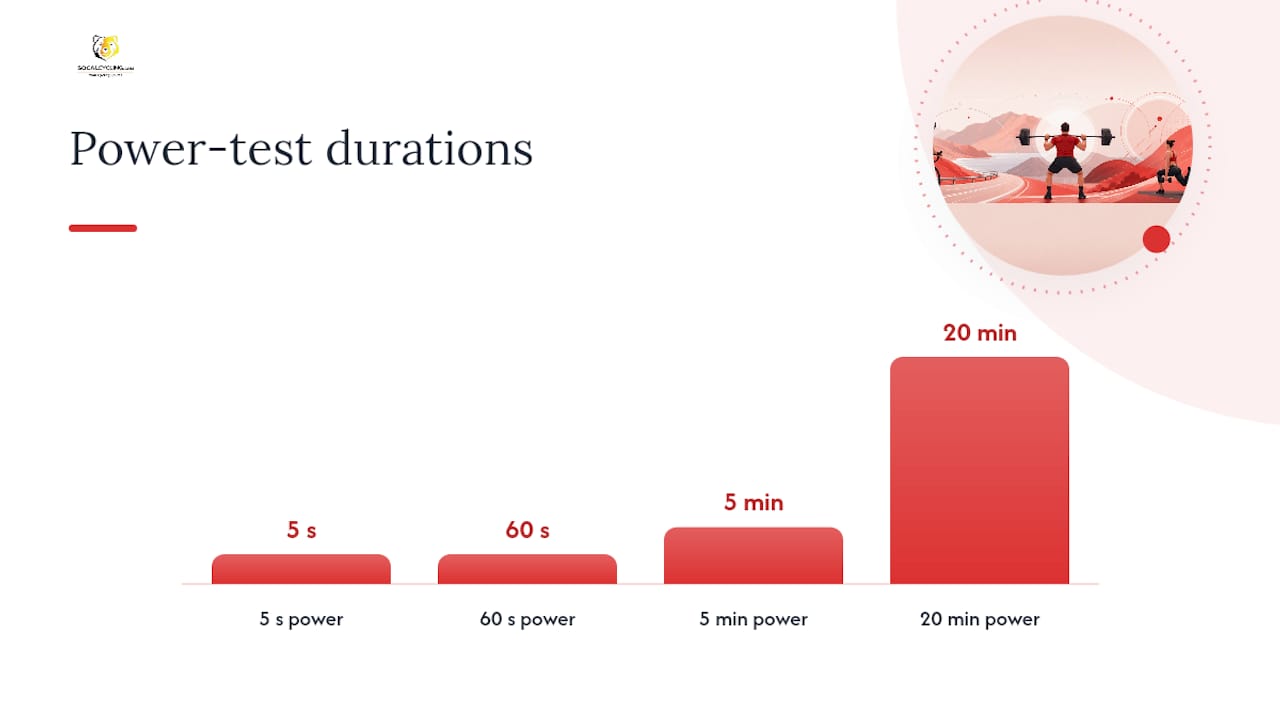
Table of Contents
- Why does strength training make cyclists faster?
- How often should you strength train as a cyclist?
- Which strength exercises give cyclists the most return?
- How do you choose reps, sets, and load for cycling gains?
- What does a complete 12-week cycling strength program look like?
- How do you measure progress and know the program is working?
- How do you avoid common mistakes and stay injury-free?
- Our take on making strength work actually stick
- Keep building with Socalcycling’s training resources
- Sources
Why does strength training make cyclists faster?
The short answer from the literature: heavy strength training reliably improves sprint and short-duration power, cycling efficiency, and time-trial performance. It does this without meaningfully changing VO2max, which tells you the mechanism is neuromuscular, not metabolic.
A supervised 12-week program using twice-weekly sessions at 6RM intensity produced the following peak power improvements compared to core training or no training:
5-second power: +1.25 W/kg (strength group) vs. +0.47 W/kg (core group) vs. −0.17 W/kg (no training). 20-minute power: +0.22 W/kg (strength) vs. +0.07 W/kg (core) vs. +0.06 W/kg (no training).
Those are meaningful numbers for a trained rider. Improvements in 20-minute power translate directly to faster time trials and stronger climbing.
The meta-analysis of 17 studies (n=262) found small-to-moderate effect sizes: cycling efficiency (ES=0.353), anaerobic power (ES=0.560), and cycling performance in time trial or time-to-exhaustion tests (ES=0.463). No significant effect on VO2max was detected. Evidence certainty was rated low to moderate, so these are promising signals rather than guarantees.
What drives the improvements?
- Neuromuscular adaptations: Strength training recruits more motor units and improves rate of force development, so each pedal stroke uses less of your available capacity.
- Fiber-type shifts: Heavy loading converts type IIX fibers toward type IIA, which are more fatigue-resistant and better suited to sustained cycling efforts.
- Tendon stiffness: Increased muscle-tendon stiffness improves energy return through the pedal stroke, contributing to better economy.
- Muscle cross-sectional area (CSA): A comparison of men and women found that modest increases in locomotor muscle CSA correlate with improved cycling economy and power, and that both sexes gain similar performance benefits from concurrent strength and endurance training.
Realistic expectations for an 8–12 week block are that sprint power improvements typically appear first within the initial weeks, followed by efficiency gains that manifest in longer efforts. Gains beyond 12 weeks require continued progressive overload or a new stimulus. The meta-analytic evidence suggests these improvements come primarily through non-metabolic pathways, which is why you can gain watts without gaining significant body weight when the program is targeted.
How often should you strength train as a cyclist?
Two sessions per week in base and preseason, reduced to one during build, is the evidence-backed standard. TrainerRoad’s coaching guidance recommends 2–3 sessions per week for beginners in the offseason, dropping to 1–2 during build, and prioritizing cycling quality by doing it first on same-day training days.
Seasonal frequency rules:
- Offseason/base: 2–3 sessions per week. This is when you build the neuromuscular foundation. Cycling volume is lower, so recovery capacity is available.
- Build phase: 1–2 sessions per week. Cycling intensity rises, so gym volume drops. Keep the heavy compound lifts; cut accessory volume.
- Race block/specialty: 1 session per week. Maintenance only. Three sets of your two priority lifts is enough to hold what you built.
- Peak week/taper: Skip or reduce to one very light session. Fatigue management takes priority.
Scheduling by rider volume:
- Low-volume riders (6–8 hours/week cycling): Strength sessions can go on any non-key-ride day. Monday/Thursday works well for most.
- Mid-volume riders (8–12 hours/week): Place strength on easy-ride days or rest days. Avoid the day before a VO2max or threshold session.
- High-volume riders (12+ hours/week): Same-day pairing is often necessary. Do the key cycling session first, then strength 6+ hours later if possible. If that gap is not available, do strength after the ride and accept slightly reduced gym performance.
Same-day sequencing: Cycling quality takes priority. If you must do both on the same day, ride first, then lift. The 6-hour separation rule from TrainerRoad applies when you have the schedule flexibility. For absolute beginners, the order matters less because neither session is at a quality-limiting intensity yet.
Avoid heavy squats or deadlifts the day before a VO2max interval session. The residual fatigue in the posterior chain and quads will blunt your top-end power output on the bike.
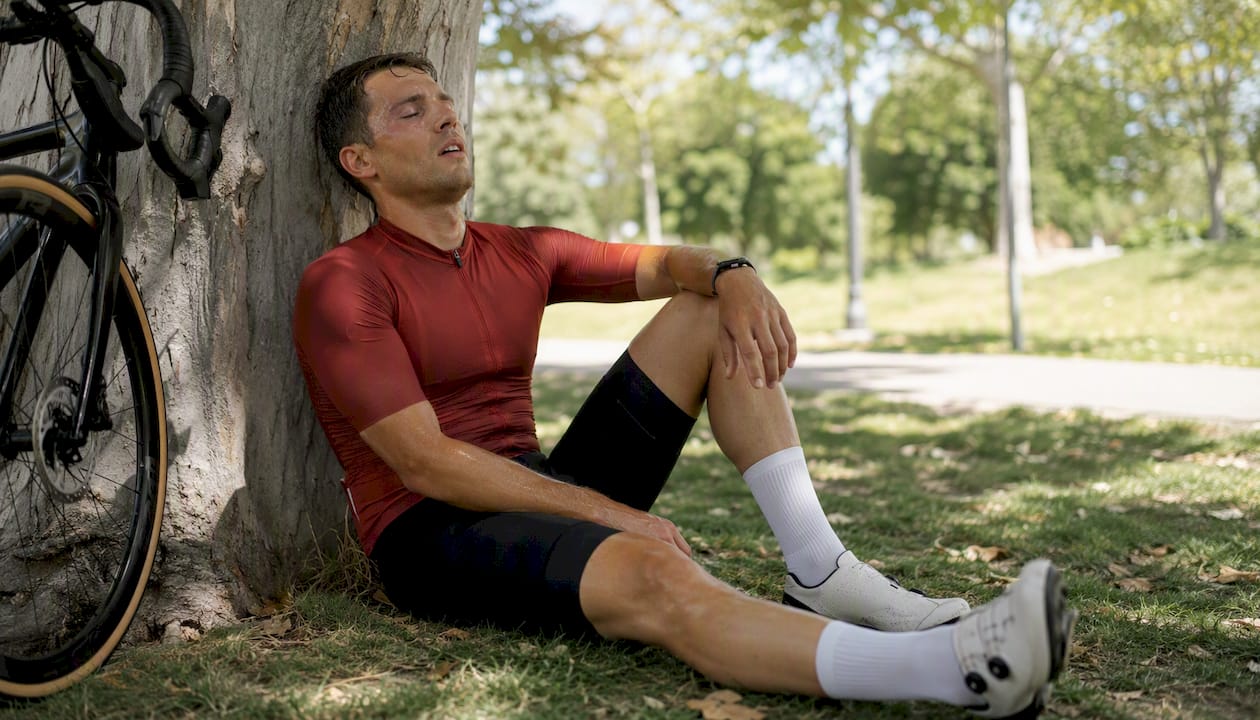
Pro Tip: Set a recurring calendar block for your two strength sessions before the week starts. Cyclists who schedule gym work reactively, fitting it in when rides get cancelled, consistently underdeliver on gym volume and lose the adaptation stimulus.
Which strength exercises give cyclists the most return?
The five highest-transfer exercises for the pedal stroke, in order of priority:
- Back squat (or goblet/front squat): Builds bilateral quad and glute strength that maps directly to the power phase of the pedal stroke. The ACE Exercise Library back squat guide provides step-by-step technique cues and regressions for riders new to barbell work. Key cue: maintain a neutral spine, push the floor away rather than thinking “stand up.”
- Deadlift / hip hinge: Posterior chain emphasis (hamstrings, glutes, erectors) that counters the hip-flexor dominance cyclists develop from hours in an aero position. Romanian deadlifts are the preferred variation for most cyclists because they load the hamstrings through a long range of motion.
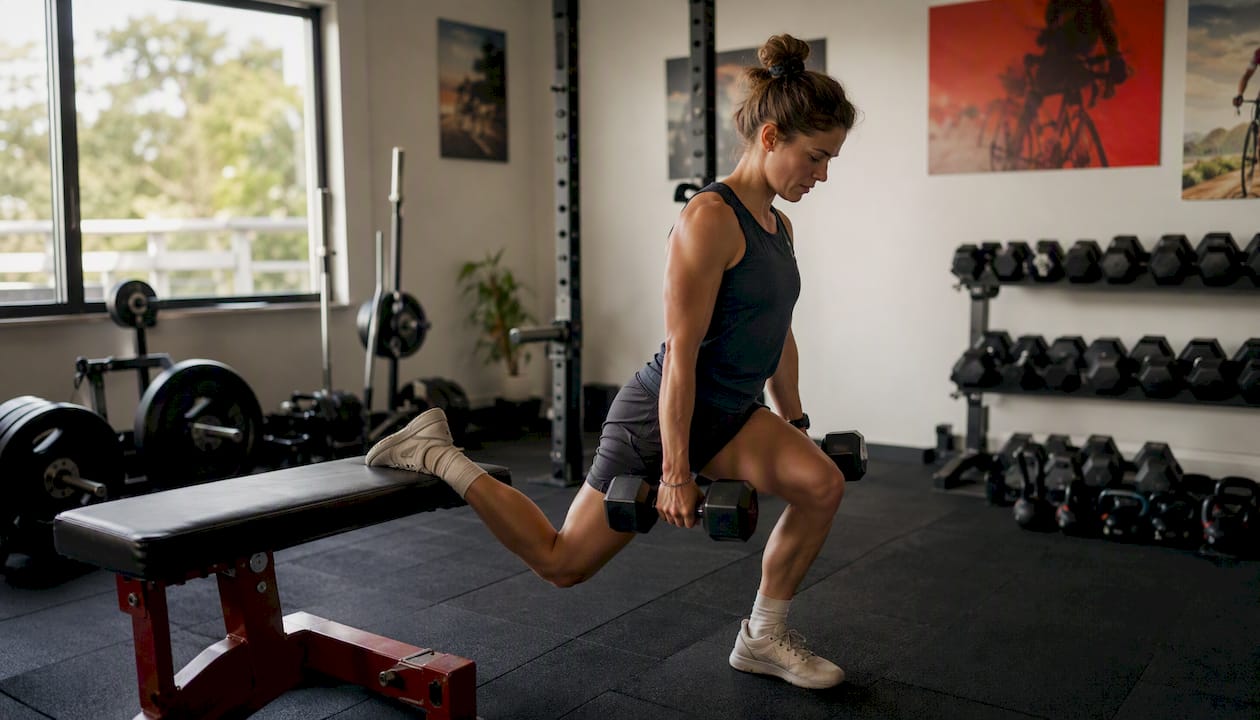
- Bulgarian split squat: The single best unilateral exercise for cyclists. It corrects side-to-side strength imbalances, loads each leg independently the way the pedal stroke does, and builds hip stability. The ACE Bulgarian split squat guide covers setup and progressions.
- Single-leg deadlift: Develops hip stability and posterior chain strength in the exact single-leg loading pattern of cycling. Start with a light dumbbell or bodyweight until balance is solid.
- Hip thrust (barbell or banded): Isolates glute max through full hip extension, the position where cyclists generate peak force. Loaded hip thrusts transfer well to seated climbing power.
Accessory work worth adding:
- Step-ups: Functional unilateral quad and glute work; easy to load progressively with dumbbells.
- Nordic hamstring curl: One of the most effective exercises for hamstring injury prevention. Demanding; start with 2–3 reps and build slowly.
- Calf raises / single-leg calf raises: Plantar flexion contributes to the bottom of the pedal stroke; often neglected.
- Anti-rotation core work (Pallof press, dead bug): Stabilizes the pelvis during hard efforts. Avoid crunches as a primary core exercise for cyclists.
- Upper-body pull (cable row, single-arm row): Counters the rounded-shoulder posture from the drops. One upper-body pull per session is enough.
Minimal-equipment substitutions: Goblet squat replaces back squat; single-leg Romanian deadlift with a kettlebell replaces barbell deadlift; reverse lunge replaces Bulgarian split squat when a bench is unavailable. Bodyweight versions of all five priority exercises are valid starting points for the first two weeks.
Technique cues that matter most for cyclists:
- Keep trunk angle consistent through the squat and hinge; don’t let the chest collapse forward under load.
- Emphasize the eccentric (lowering) phase: 2–3 seconds down, 1 second up. Controlled eccentrics build more tendon stiffness.
- Track the knee over the second toe on all squat and lunge variations.
- Posterior chain emphasis: think “push the floor away” in squats, “hinge at the hip” in deadlifts, not “bend the knees.”
The NASM cycling workout guide structures these exercises into progressions that move from technique work to heavier loading over several weeks, which mirrors the phase structure of the 12-week plan below.
How do you choose reps, sets, and load for cycling gains?
Progression rules:
- Add load only when you can complete all prescribed reps with 2–3 reps in reserve (RPE 7–8 out of 10). If the last rep feels like a grind, hold the weight.
- Use small absolute increases: 5 lbs on lower-body lifts, 2.5 lbs on upper-body. Micro-plates are worth the investment.
- Deload every 4th week: reduce volume by 40–50% (keep intensity), then return to progressive loading. This is non-negotiable during high-volume cycling weeks.
- Never train to failure in-season. Repeated maximal efforts create residual fatigue that bleeds into your key rides for 48–72 hours.
A practical 4-week progression example for the back squat: Week 1 at 135 lbs × 3 sets × 8 reps; Week 2 at 145 lbs × 3 × 8; Week 3 at 155 lbs × 3 × 6; Week 4 deload at 115 lbs × 2 × 8. That pattern, applied consistently, builds the neuromuscular base the 12-week plan depends on.
What does a complete 12-week cycling strength program look like?
This plan delivers measurable watt gains, improved pedaling efficiency, and injury-resilient posterior chain strength. It runs two sessions per week and fits alongside a standard base or preseason cycling block.
Phase structure:
- Weeks 1–4 (Foundation): Technique and moderate load. Build movement quality before adding intensity.
- Weeks 5–8 (Strength): Heavy loading at 80–85% 1RM. This is where neuromuscular adaptations accumulate.
- Weeks 9–12 (Power and Retention): Explosive rep schemes and taper into your first event or build phase.
| Week Block | Session A (Bilateral) | Sets × Reps | Session B (Unilateral) | Sets × Reps |
|---|---|---|---|---|
| Weeks 1–4 | Goblet squat | 3 × 10 | Bulgarian split squat | 3 × 10 each |
| Romanian deadlift | 3 × 10 | Single-leg deadlift | 3 × 10 each | |
| Hip thrust | 3 × 10 | Step-up | 3 × 10 each | |
| Dead bug | 3 × 10 | Pallof press | 3 × 12 each | |
| Weeks 5–8 | Back squat | 4 × 5 | Bulgarian split squat | 4 × 5 each |
| Deadlift | 4 × 4 | Single-leg RDL | 3 × 6 each | |
| Hip thrust (loaded) | 4 × 5 | Nordic hamstring curl | 3 × 4 | |
| Cable row | 3 × 8 | Single-arm row | 3 × 8 each | |
| Weeks 9–12 | Jump squat (bodyweight) | 4 × 4 | Split squat jump | 3 × 4 each |
| Trap bar deadlift | 3 × 4 (explosive) | Step-up (fast) | 3 × 6 each | |
| Hip thrust | 3 × 5 | Single-leg deadlift | 3 × 5 each | |
| Dead bug | 2 × 10 | Pallof press | 2 × 12 each |
Session A warm-up (10 minutes): 5 minutes easy spin or row, leg swings (front/back and lateral, 10 each), glute bridges × 15, bodyweight squat × 10, hip hinge with dowel × 10.
Session B warm-up (10 minutes): Same cardio warm-up, add single-leg balance holds × 30 seconds each, reverse lunge × 8 each, lateral band walks × 15 each direction.
Cool-down (5–10 minutes): Hip flexor stretch (kneeling, 60 seconds each), hamstring stretch, pigeon pose or figure-four, thoracic rotation × 10 each side.
Progression markers to log each session: 6RM estimate or actual 6RM weight for back squat and deadlift; RPE for each working set; any on-bike power changes noted after key rides.
If you miss a session: Skip it and resume the next scheduled session. Do not double up.
How do you measure progress and know the program is working?
Run four tests: baseline before Week 1, a mid-point check at Week 6, and a full retest at Week 12. Testing more often than that introduces fatigue without adding useful data.
Testing protocol by duration:
- 5–10 second sprint: Maximal effort from a rolling start on a flat road or trainer. Record peak power. Rest 10 minutes before the next test.
- 60-second effort: All-out effort from a standing start. Record average power. This tests anaerobic capacity, the metric most sensitive to strength training gains.
- 5-minute effort: Near-maximal sustained effort. Average power reflects VO2max-adjacent capacity.
- 20-minute effort: Standard FTP proxy. Average power × 0.95 gives an estimated FTP. This is your primary benchmark for time-trial and climbing performance.
The 12-week trial data showed a 1.25 W/kg improvement in 5-second power for the strength group, which is well above normal variability. For 20-minute power, the 0.22 W/kg improvement is meaningful for a trained rider.
Tracking gym progress: Log your 6RM or estimated 1RM for back squat and deadlift every two weeks. A consistent upward trend in gym numbers that coincides with flat or improving on-bike power means the program is working. If gym numbers climb but on-bike power drops, you are accumulating too much fatigue. Reduce gym volume immediately.
Connecting gym to bike: After each strength block week, note your RPE on the following day’s key ride. If perceived effort at a given power output decreases over the 12 weeks, that is cycling efficiency improving, exactly the mechanism the meta-analysis identified.
How do you avoid common mistakes and stay injury-free?
The most common errors cyclists make when adding gym work:
- Too many heavy sessions in-season. Two heavy sessions per week during a high-volume cycling block creates cumulative fatigue that degrades both gym and bike performance. One maintenance session is the correct in-season dose.
- Poor exercise technique under load. Cycling-specific posture (anterior pelvic tilt, rounded thoracic spine) transfers into the gym and creates injury risk under a barbell. Spend the first four weeks on technique before adding meaningful load.
- Neglecting single-leg work. Most cyclists have measurable left-right power imbalances. Bilateral squats and deadlifts alone will not correct them. Bulgarian split squats and single-leg deadlifts are non-negotiable.
- Lifting to failure during high-volume weeks. Training to failure spikes muscle damage and delays recovery. Keep 2–3 reps in reserve on every working set.
- Skipping the posterior chain. Cyclists are quad-dominant by nature. Programs that emphasize squats without matching deadlift and hip thrust volume reinforce that imbalance.
Prevention strategies:
- Apply progressive overload consistently: small load increases over weeks, not jumps.
- Schedule a deload week every 4th week, especially when cycling volume is rising.
- Balance bilateral and unilateral work in every session. The NASM framework recommends pairing each bilateral lift with a unilateral variation.
- Integrate mobility work into warm-ups, not as an afterthought. Hip flexor and thoracic mobility are the two highest-priority areas for cyclists.
Red flags that require professional attention: Persistent joint pain (not muscle soreness) lasting more than 48 hours after a session; sharp or localized pain during a lift; rapidly increasing fatigue that affects your key rides for more than a week. Back off immediately and consult a sports physiotherapist or certified strength and conditioning coach before resuming.
Pro Tip: When time is tight, prioritize one posterior chain bilateral lift (deadlift or loaded hip thrust) and one unilateral squat variant (Bulgarian split squat) per session. That two-exercise combination maximizes pedal-force transfer and corrects imbalances in under 25 minutes.
Our take on making strength work actually stick
The biggest mistake we see cyclists make is treating the gym as optional. You schedule your intervals, your long rides, your recovery weeks. The strength session needs the same calendar commitment, or it will always be the first thing dropped when life gets busy.
What actually works in practice: start with the 12-week plan above, but adapt the loading to your current gym experience. If you have never done a barbell back squat, spend the first four weeks with a goblet squat and a light trap bar deadlift. Technique built in Weeks 1–4 is what allows you to load safely in Weeks 5–8, and the heavy phase is where the neuromuscular adaptations that move your watts actually accumulate.
For riders with limited time, the two-exercise minimum (hip hinge plus unilateral squat variant) is not a compromise. It is a legitimate program. Two focused exercises done consistently for 12 weeks outperform six exercises done sporadically.
One practical note on measurement: log both your gym lifts and your on-bike power numbers in the same place. When you can see a 6RM squat increase alongside a 5-minute power improvement in the same week, the connection between the gym and the bike becomes concrete. That data is what keeps you consistent through the weeks when the gym feels like a detour from riding.
Keep building with Socalcycling’s training resources
Strength work is one piece of a complete performance plan. Socalcycling covers the full picture: periodized training guides, fueling strategies, recovery protocols, and event calendars for riders across California and beyond.

If you are building toward a specific event, the century ride training guide maps out a 12–28 week plan that integrates strength phases with endurance volume. For riders targeting cyclocross or gravel, the road race categories guide helps you identify the right event tier to target once your power numbers improve. When your strength block wraps up, the recovery weeks article explains exactly how to structure the transition back to full cycling volume without losing your gym gains.
Browse the full Socalcycling training library for guides on fueling, race prep, and community events across Southern California and the US.
Sources
- Influence of Conventional Resistance Training Compared to Core Exercises on Road Cycling Power Output
- Heavy strength training effects on physiological determinants of endurance cyclist performance: a systematic review with meta-analysis
- A Comparison of the Effect of Strength Training on Cycling Performance between Men and Women
- Combining Cycling & Weight Training: How to Time Your Workouts | TrainerRoad Blog
- Strength Exercises for Cyclists: Cycling Workout Plan
Recommended
- Why Recovery Weeks Are Essential for Cyclists
- How to Plan Century Ride Training: Your 12–28 Week Guide