
Charity cycling rides require participants to meet a minimum fundraising target that is entirely separate from the registration fee. This requirement, formally called a fundraising minimum or pledge minimum, exists to protect the nonprofit’s financial position and guarantee that the event generates real charitable impact. Without it, a ride with hundreds of participants could still fail to fund the cause it was built around. If you are preparing for your first charity ride or trying to understand why charity cycling rides have minimum fundraising rules, this guide breaks down every layer of that structure.
Why charity cycling rides have minimum fundraising requirements
Charity cycling event costs are split into two separate buckets: registration fees that cover operations and fundraising minimums that fund the nonprofit’s mission. Registration fees typically range from $30 to $150 and pay for permits, medical support, rest stops, and insurance. That money keeps the event running safely. The fundraising minimum is a completely different obligation. It is the amount each rider must raise from donors to secure their spot and contribute to the cause.
Registration fees rarely count toward the fundraising minimum. This surprises many first-time participants. The two figures serve entirely different purposes, and conflating them creates last-minute stress when riders realize they are short of their pledge target days before the event.

Fundraising minimums vary widely based on event scale. A local 25-mile charity ride might set a minimum of $100 to $250. A major multi-day event like a coast-to-coast challenge can require $2,000 to $4,000 or more. The table below shows how fees and minimums typically compare across event types.
| Event type | Typical registration fee | Typical fundraising minimum |
|---|---|---|
| Local 25-mile ride | $30–$75 | $100–$250 |
| Regional century ride | $75–$125 | $500–$1,500 |
| Multi-day challenge | $100–$150 | $2,000–$4,000+ |
Pro Tip: Read the registration terms carefully before you sign up. Some events allow you to self-fund the minimum if you fall short, while others will revoke your spot entirely.
Why the financial risk to charities makes minimums non-negotiable
Nonprofits pre-purchase charity spots at major events, which means the organization pays for your entry before you raise a single dollar. If you fail to meet the minimum, the charity absorbs that cost directly. That is a real financial loss, not a theoretical one.
This is why failure to meet minimums can result in the charity revoking a participant’s spot. It is not a punitive policy. It is a financial protection mechanism. The charity has already paid for the spot and cannot afford to subsidize riders who do not deliver on their pledge commitment.
Legal compliance adds another layer. In New South Wales, for example, charities raising over $15,000 must hold a formal fundraising authority, and those raising over $250,000 require independent audits. Fundraising minimums help organizations track and report total collections accurately, which matters for regulatory compliance in many jurisdictions.
To manage cash flow and reduce risk, many charities use tiered deadlines. A common structure requires riders to reach 50% of their minimum several months before the event, then 75% closer to the date. These milestones keep fundraising momentum alive and give the charity early warning if a participant is struggling.
“The upfront cost of charity spots creates a genuine financial obligation. Minimum fundraising requirements are the mechanism that ensures participants share that responsibility rather than leaving the nonprofit exposed.” — Lobular Breast Cancer UK, London Marathon 2027 terms and conditions
The practical takeaway for riders is clear. Your fundraising minimum is not a suggestion. It is a contractual commitment tied to a real financial transaction the charity has already made on your behalf.
How minimums turn cyclists into advocates for the cause
Fundraising minimums do more than protect charity finances. They motivate participants to become active advocates rather than passive riders. When you have a pledge target to hit, you talk about the cause. You share your fundraising page. You explain to friends and colleagues why the ride matters. That word-of-mouth effect multiplies the charity’s reach far beyond what advertising alone could achieve.
Charities support this advocacy by providing practical tools. Most events supply riders with personal fundraising pages, social media templates, email scripts, and donor outreach guides. These resources lower the barrier to asking for donations, especially for first-time fundraisers who feel uncomfortable making direct appeals.
The psychological framing of the minimum matters too. A $500 minimum sounds large until you break it into ten $25 donations. Reaching a $250 minimum through ten small gifts is far more manageable than chasing one large donor. Most experienced charity riders approach their minimum this way from day one.
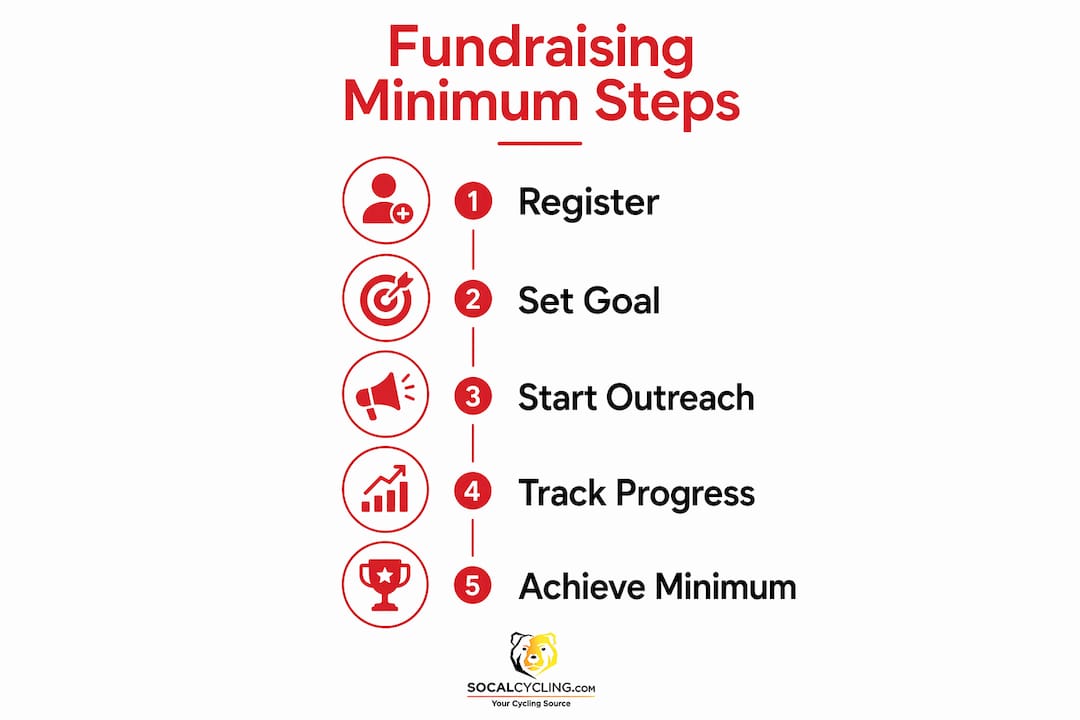
Here is a practical sequence that works for most riders:
- Set up your personal fundraising page the day you register, not the week before the event.
- Send a personal email to your ten closest contacts first, before posting on social media.
- Share your training updates alongside your fundraising link so donors feel connected to your progress.
- Post a mid-campaign update showing how much you have raised and how close you are to the goal.
- Send a final thank-you message to every donor after the ride, including a photo from the event.
Pro Tip: Ask your employer about matching gift programs. Many companies match employee donations dollar for dollar, which can cut the time needed to reach your minimum in half.
Practical strategies to meet your charity ride fundraising goals
Early outreach is the single most effective tactic for meeting charity ride fundraising goals. Riders who start asking for donations the week they register consistently outperform those who wait until a month before the event. The cause feels fresh, your motivation is high, and donors have time to plan their giving.
Personal storytelling converts better than generic asks. Donors respond to specific, concrete reasons. “I’m riding 100 miles to fund pediatric cancer research because my nephew was diagnosed last year” raises more money than “I’m doing a charity ride, please donate.” The Arthritis Foundation’s cycling events, for example, coach riders to connect their personal experience with the foundation’s research mission before making any ask.
Tax-smart fundraising tools like donor-advised funds, employer matching programs, and qualified charitable distributions help participants reach higher minimums without requiring donors to give more cash out of pocket. These tools are underused by most charity riders and can significantly increase total donations.
The table below compares effective tactics against common pitfalls.
| Tactic | Why it works | Common pitfall |
|---|---|---|
| Start outreach at registration | Maximizes time and donor planning | Waiting until 4 weeks before the event |
| Personal story in every ask | Increases emotional connection | Generic “please donate” messages |
| Break minimum into small gifts | Reduces donor hesitation | Asking for large single donations |
| Use employer matching | Doubles donations at no extra cost | Never checking if matching exists |
| Tiered social media updates | Keeps donors engaged and informed | One post and silence until race day |
Pro Tip: Use a cycling community group to cross-promote your fundraiser. Fellow cyclists are often your most enthusiastic early donors and will share your page within their own networks.
Avoid the last-minute fundraising rush at all costs. Riders who hit their minimum early can focus entirely on training and enjoying the event. Riders scrambling to raise money in the final week face stress that affects both their fundraising and their performance on the day.
Key takeaways
Charity cycling ride minimums exist to protect nonprofit finances, ensure legal compliance, and turn riders into genuine advocates for the cause.
| Point | Details |
|---|---|
| Fees and minimums are separate | Registration fees cover operations; fundraising minimums fund the charity’s mission directly. |
| Nonprofits carry real financial risk | Charities pre-purchase spots, so unmet minimums create direct financial losses for the organization. |
| Tiered deadlines protect everyone | Staged milestones at 50% and 75% keep fundraising on track and reduce last-minute pressure. |
| Early outreach wins | Riders who start fundraising at registration consistently outperform late starters. |
| Tax-smart tools close the gap | Employer matching and donor-advised funds help riders reach high minimums without larger cash asks. |
The real value of the minimum, from where we stand
At Socalcycling, we have covered charity rides across Southern California and beyond for years. The minimum fundraising requirement is the element that separates a charity ride from a regular gran fondo. It is the mechanism that makes the event matter beyond the finish line.
We have watched riders arrive at events frustrated by the fundraising obligation, only to finish the day saying it was the most meaningful ride of their lives. The act of asking people to support your effort, and having them say yes, changes how you experience the miles. You are not just riding for yourself. You are carrying the weight of every donor who believed in the cause enough to contribute.
The charities that communicate their minimum requirements clearly at registration, and provide strong support tools from day one, consistently see higher completion rates and stronger fundraising totals. The ones that bury the details in fine print create confusion and resentment. Transparency at the start is the single biggest factor in participant success.
Our honest observation is that most riders underestimate how achievable the minimum actually is. Ten people giving $25 each is not a heroic fundraising campaign. It is a handful of conversations with people who already like you. Start early, tell your story, and use every tool the charity provides. The minimum is not a barrier. It is a starting point.
Explore charity rides and events with Socalcycling
Socalcycling covers charity cycling events, gran fondos, and community rides across California and nationwide. Whether you are searching for your first charity ride or looking to build on a previous fundraising effort, the Socalcycling event hub connects you with rides that match your distance, cause, and fitness level.

Visit Socalcycling’s California cycling hub for event listings, ride guides, and fundraising resources updated throughout the year. If you want to understand how different event formats compare before committing to a charity ride, the cycling sportive guide gives you a clear breakdown of event types and what to expect from each. For step-by-step help with your first charity ride registration and fundraising setup, the charity ride fundraiser guide walks you through the entire process.
FAQ
What is a fundraising minimum in a charity cycling event?
A fundraising minimum is the total amount a participant must raise from donors to secure their spot in a charity cycling event. It is separate from the registration fee and funds the nonprofit’s mission directly.
Do registration fees count toward the fundraising minimum?
Registration fees do not count toward the fundraising minimum. Fees cover event operations like permits, insurance, and rest stops, while the minimum funds the charitable cause.
What happens if you don’t meet the fundraising minimum?
Failure to meet the minimum can result in the charity revoking your spot. Nonprofits pre-purchase charity entries and cannot absorb the cost of participants who do not fulfill their pledge commitment.
How do tiered fundraising deadlines work?
Many charity events require riders to reach 50% of their minimum months before the event and 75% closer to the date. These milestones keep fundraising on track and reduce last-minute pressure on both riders and organizers.
What is the fastest way to reach a fundraising minimum?
Start outreach the day you register, break your target into small gift amounts, and ask your employer about matching programs. Tax-smart tools like donor-advised funds can also significantly increase your total without requiring larger cash donations from individual donors.
Recommended
- How to Join a Charity Cycling Ride Fundraiser
- What Is a Cycling Passport Event? Your 2026 Guide
- Cycling Sportive Explained: Your Complete Ride Guide
- Why Cycling Events Have Rest Stops: A Rider’s Guide