



Road race categories are defined as structured skill tiers that segment cyclists by experience and ability to ensure safe, fair competition. When you compare road race categories as a beginner, the two most relevant systems are USA Cycling’s Cat 5–Cat 1 ladder and British Cycling’s 4th–Elite progression. Both systems exist for the same reason: to keep new riders racing against others at a similar level while they build the pack skills, fitness, and tactical awareness that higher categories demand. Governing bodies like USA Cycling and British Cycling set these standardized ladders, and understanding how they differ is the fastest way to find your right starting point.
How do beginner road race categories compare in the US and UK?
USA Cycling categories run from Cat 5 at the entry level to Cat 1 at the elite end. Cat 5 is designed specifically for riders new to racing. Races at this level feature shorter distances and lower intensity, giving beginners room to learn group dynamics without the pressure of marathon efforts.
British Cycling starts at 4th category and progresses to Elite. The system is points-based from the start, meaning you earn your way up through race results rather than simply completing a set number of events. To move from 4th to 3rd category, you need 12 points. Advancing from 3rd to 2nd requires 40 points in a single season. That structure rewards consistent performance over time.
The two systems differ in one important practical way. The US system uses race completion counts and results to trigger upgrades. The UK system uses a running points tally that resets each season. Both approaches push beginners toward the same goal: developing safe, competent group riding before moving into faster fields.
One critical nuance: category numbers do not translate directly across countries. A US Cat 5 race and a UK 4th category event may feel very different depending on the specific event classification and local field size. Matching event conditions to your skill level matters more than matching numbers on paper.
| Feature | USA Cycling | British Cycling |
|---|---|---|
| Entry level | Cat 5 | 4th category |
| Top level | Cat 1 | Elite |
| Upgrade method | Race count and results | Points accumulated per season |
| Points to first upgrade | Not points-based | 12 points (4th to 3rd) |
| Race distances at entry | Shorter, less technical | Shorter, beginner-friendly events |
What race formats suit beginners best?
Race format shapes your experience as much as category level does. The three main formats you will encounter as a newcomer are criteriums (crits), road races, and time trials. Each one develops a different skill set.

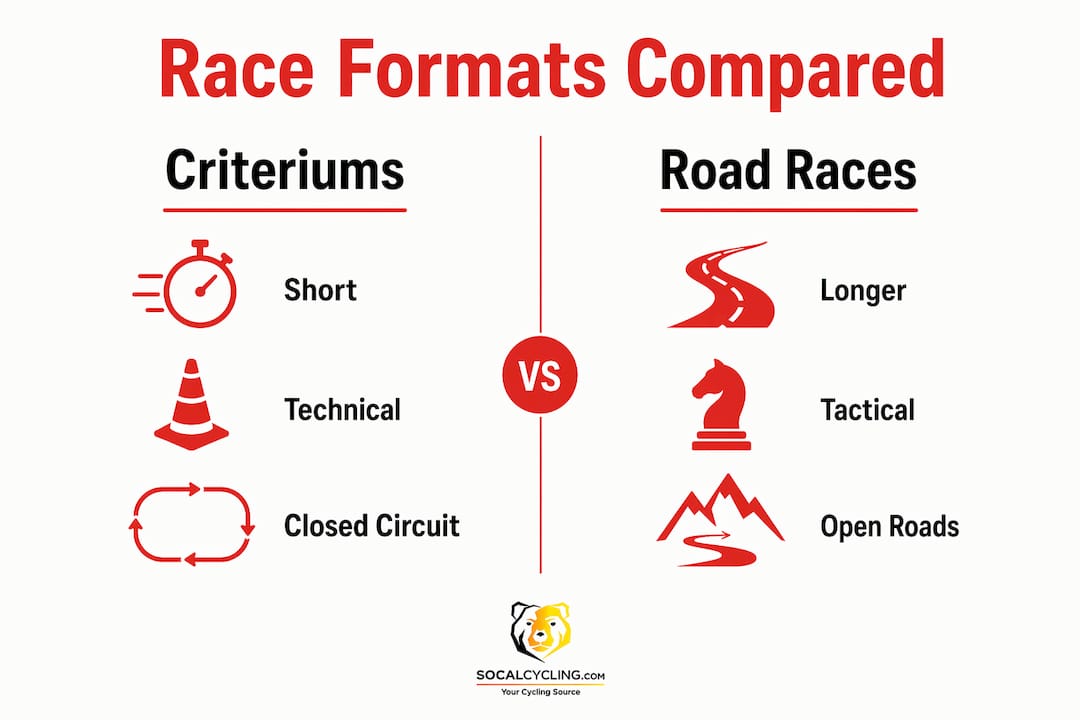
Criteriums are short, technical races held on closed circuits, usually lasting under an hour. They feature repeated accelerations, tight cornering, and constant pack interaction. Crits are excellent for beginners because the course is contained, the race duration is manageable, and you get dozens of repetitions of the same corners and surges. That repetition builds cornering confidence and pack awareness faster than almost any other format.
Road races are longer and more tactical. They take place on open roads and require drafting skills, positioning judgment, and endurance over a sustained effort. Choosing your format based on skill goals accelerates your readiness for higher categories. If your weakness is endurance and tactics, road races build those qualities directly. If you need to sharpen your bike handling, crits are the better training ground.
Time trials are solo efforts against the clock. There is no pack, no drafting, and no tactical maneuvering. For beginners, time trials remove the intimidation of group riding entirely and let you focus purely on pacing and power output. They are a low-pressure way to get your first race license punched and build confidence before entering a pack event.
Pro Tip: Start with a criterium or time trial for your first race. Both formats give you a controlled environment to learn race-day logistics before you tackle the demands of a full road race.
What are the requirements to move up from beginner categories?
Upgrading from a beginner category is not just about fitness. Moving from Cat 5 to Cat 4 in the US typically requires completing a minimum of 10 Cat 5 races and demonstrating safe, confident group riding. That race count exists because pack skills take time to develop, and rushing the process creates safety risks for everyone in the field.
The skills that actually matter for upgrading are:
- Positioning near the front third of the pack to avoid crashes caused by accordion effects at the back
- Smooth, predictable movement within the group, including holding your line through corners
- Pacing at a sustainable effort rather than burning matches on early surges
- Communicating hazards to riders around you, such as calling out obstacles or slowing traffic
Positioning near the front third and pacing at 70–80% effort are the two pack skills that most directly separate riders who are ready to upgrade from those who are not. Raw fitness is secondary to these fundamentals.
In the UK, the points-based progression gives you a clear strategic framework. You know exactly how many points separate you from the next category, so you can target specific events that offer the best points opportunities for your current ability. That transparency is one of the UK system’s genuine advantages for beginners who like measurable goals.
Pro Tip: Keep a simple race log noting your finishing position, pack comfort level, and any incidents. Reviewing it after 5 races will show you exactly which skills need the most work before you upgrade.
| Upgrade step | US requirement | UK requirement |
|---|---|---|
| Entry to next category | 10 Cat 5 races completed | 12 points earned |
| Key skill assessed | Safe group riding | Consistent race results |
| Season reset | No | Points reset annually |
What practical steps help beginners choose the right category?
Choosing the right starting category comes down to an honest assessment of three things: your current fitness, your group riding experience, and your goals for the season. Most beginners overestimate their readiness for higher categories and underestimate how different racing feels compared to training rides.
Start with these steps:
- Assess your group riding experience. If you have never ridden in a tight pack at speed, start at the lowest available category without exception. Safety in a race field depends on predictable behavior, and that only comes with practice.
- Choose a beginner-friendly format first. A local criterium or cycling sportive gives you race-day experience in a lower-stakes environment before you commit to a full road race.
- Join a local club or training group. Riding with a cycling group near you is the single fastest way to build the pack skills that categories actually test.
- Contact race organizers directly. Most organizers are happy to advise first-timers on which category and format fits their current ability.
- Accept variability within categories. Even within Cat 5 or 4th category, field quality varies by region, season, and event size.
“Safe group riding, positioning, and pacing are the true measures that differentiate road race categories more than raw fitness alone.” — USA Cycling category guidance
The most common mistake beginners make is treating category selection as a fitness question. It is a skills question first. A rider with strong legs but poor pack awareness is a hazard in any category. A rider with modest fitness but excellent bike handling will have a safer, more enjoyable first season and progress faster as a result.
Key Takeaways
Beginner road racers who match their category choice to their actual pack skills and race format preferences progress faster and race more safely than those who chase higher categories too soon.
| Point | Details |
|---|---|
| Start at the lowest category | Cat 5 (US) and 4th category (UK) exist specifically to protect and develop new racers. |
| Format shapes skill development | Use crits for cornering and pack handling; use road races to build drafting and endurance. |
| Upgrade criteria differ by country | US requires 10 Cat 5 races; UK requires 12 points to move from 4th to 3rd category. |
| Pack skills outrank raw fitness | Positioning, smooth movement, and pacing matter more than power output for safe category progression. |
| Categories don’t translate directly | A US Cat 5 and a UK 4th category race can feel very different depending on event classification and field size. |
The Socalcycling take on starting your road racing career
We have watched a lot of beginners come through their first seasons, and the pattern is consistent. The riders who thrive are not the ones with the best FTP numbers. They are the ones who spend their first 10 races learning where to sit in the pack, when to follow a wheel, and when to let a gap go rather than chase it into a dangerous situation.
The instinct to upgrade quickly is understandable. Nobody wants to feel like they are racing below their ability. But the beginner category is not a waiting room. It is a classroom. Every Cat 5 or 4th category race teaches you something about reading a field, managing your effort, and staying safe in a group that no training ride can replicate.
Our honest advice: resist the upgrade until the race feels comfortable, not just survivable. When you finish a Cat 5 crit and your main thought is “I could have done more,” that is the moment to start thinking about moving up. If you are still focused on staying upright and not getting dropped, you have more to learn, and that is perfectly fine.
Race formats matter more than most beginners realize. We have seen riders who struggled in road races absolutely thrive in crits because the shorter, more repetitive format suited their strengths. Do not assume one format defines your ability. Try both before you decide where you belong. The gravel race scene also offers a genuinely welcoming entry point for riders who want competitive riding without the intensity of a tight criterium pack.
Socalcycling has the race calendar you need
Socalcycling.com covers road racing, criteriums, gran fondos, and beginner-friendly events across Southern California and beyond. Whether you are looking for your first Cat 5 race or trying to find a local crit to sharpen your pack skills, the Socalcycling event calendar keeps you connected to what is happening in the cycling community.

The site also features athlete development stories, race previews, and category-specific coverage that helps new racers understand what to expect before they pin on a number. From cycling event guides to local club resources, Socalcycling.com is built for cyclists at every level, including those just getting started.
FAQ
What is the beginner road race category in the US?
The beginner road race category under USA Cycling is Cat 5. It features shorter distances and lower intensity races designed to help new riders learn group riding basics safely.
How many races do I need to move from Cat 5 to Cat 4?
Riders typically need to complete a minimum of 10 Cat 5 races and demonstrate safe, confident group riding before upgrading to Cat 4.
How does the UK beginner road race category work?
British Cycling starts beginners at 4th category. Progression is points-based, requiring 12 points to advance to 3rd category within a season.
Are criteriums or road races better for beginners?
Criteriums are generally more beginner-friendly because they are shorter, held on closed circuits, and give riders repeated practice at cornering and pack positioning in a contained environment.
Do US and UK road race categories match up directly?
No. A US Cat 5 race and a UK 4th category event do not automatically represent the same competition level. Event classification and local field conditions better predict race intensity than category numbers alone.
Recommended
- Why Gravel Events Have Different Categories: 2026 Guide
- Gravel Race Event Examples Across the United States
- Cyclocross Race Calendar Checklist for 2026–2027
- Cycling Sportive Explained: Your Complete Ride Guide