


A Cat 5 cycling race is the entry-level competitive category in USA Cycling road, track, and cyclocross racing, built specifically for newcomers learning to race safely in a group. Category 5, the formal industry term, sits at the bottom of the USA Cycling classification ladder and focuses on bike handling, pack etiquette, and race experience rather than raw speed or results. If you have never pinned on a race number before, Cat 5 is exactly where you belong. Socalcycling covers these beginner categories regularly because they are where most lifelong racers get their start.
What is a Cat 5 cycling race, and what makes it different?
Category 5 is the entry-level tier for USA Cycling road, track, and cyclocross competition. The category exists to give complete novices a structured, lower-pressure environment to learn the basics of racing. Unlike higher categories where tactics and fitness dominate, Cat 5 prioritizes safety and skill development above everything else.
The field in a Cat 5 race is made up entirely of beginners. That shared inexperience actually creates a more forgiving atmosphere, though it also means the group can be unpredictable. Race promoters design Cat 5 courses with predictability in mind, using controlled environments and simpler layouts to build confidence among new competitors.

One key distinction separates Cat 5 from every other category: the main goal is learning, not winning. Riders who treat their first Cat 5 race as a fitness test often miss the point entirely. The riders who progress fastest are the ones who focus on reading the group, holding their line, and communicating clearly with the riders around them.
What to expect in a Cat 5 race: formats, distances, and competition
Criteriums are the most common Cat 5 race format. A criterium, or crit, is a mass-start road race on a short, closed circuit repeated for a set number of laps or a fixed time. Typical lap distances run around 3 km, with the total race lasting anywhere from 20 to 45 minutes depending on the event. That short duration is intentional. It keeps the physical demand manageable while giving you repeated practice at cornering, accelerating out of turns, and holding position in a pack.
Here is what you will typically encounter in a Cat 5 criterium:
- Short, repeated laps on a closed circuit with clearly marked corners
- A neutral rollout at the start to let the field settle before racing begins
- Bell laps signaling the final circuit, which triggers the sprint finish
- Officials on course to monitor safety and enforce rules
- Smaller fields compared to higher categories, usually 20–50 riders
The learning curve in pack riding is steeper than most beginners expect. Riding alone at 20 mph feels completely different from riding at 20 mph with 30 other riders within arm’s reach. Wheel overlap, sudden braking, and unexpected accelerations all become real concerns the moment you enter a group.
Pro Tip: Before your first race, spend several weeks riding in a local cycling group to get comfortable with wheel-to-wheel proximity. The sensory experience of a bunch sprint is difficult to replicate alone.
Average speeds in Cat 5 crits are lower than in Cat 4 or Cat 3 races, but the stop-and-go nature of criterium racing makes them physically demanding in a different way. You will accelerate hard out of every corner, recover briefly on the straights, and repeat that pattern for the entire race. Your cardiovascular system and your legs will both feel it.
Licensing and equipment requirements for entering a Cat 5 race
Getting to the start line requires a USA Cycling license. You have two options as a new racer.
- One-day license: Available at most events, this lets you race without committing to a full season. It is the lowest-barrier entry point for first-timers.
- Annual license: Covers all USA Cycling events for the calendar year and costs more upfront but pays off quickly if you plan to race more than a few times.
One-day licenses reduce entry barriers significantly for riders who want to test racing before committing. Most event registration platforms let you purchase a one-day license at checkout when you sign up for a race.
Equipment requirements for Cat 5 follow standard USA Cycling rules:
- Helmet: An ANSI or CPSC-certified hard-shell helmet is mandatory. No exceptions.
- Bike: Any road-legal bicycle in good mechanical condition. Drop bars are standard for crits but not always required at the Cat 5 level.
- Numbers: Provided at registration. You pin them to your jersey as directed by race officials.
- No aero helmets with visors in most criterium events unless specifically permitted by the race director.
Entry fees for Cat 5 races are deliberately kept lower than for higher categories. Race promoters want new riders to show up and keep coming back. Pre-registration online is almost always cheaper than day-of registration, so sign up early.
Pro Tip: Check the cycling event calendar on Socalcycling well before race day. Many popular Cat 5 events fill their fields weeks in advance.
How do you move from Cat 5 to Cat 4?
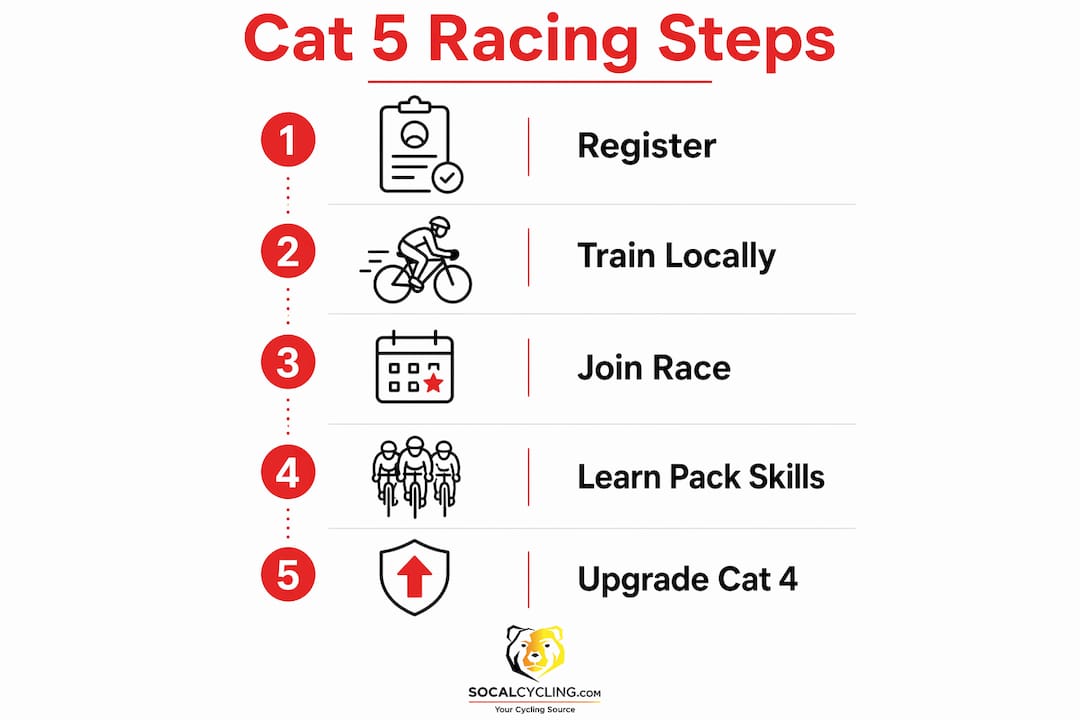
The progression from Cat 5 to Cat 4 follows a clear, experience-based standard set by USA Cycling. Here is how the upgrade process works:
- Complete a minimum of 10 races. Ten races is the baseline requirement to request an upgrade from Cat 5 to Cat 4. Results do not matter at this stage. Participation does.
- Demonstrate safe pack riding. Officials and race directors observe your behavior in the field. Predictable riding, proper signaling, and controlled cornering all factor into whether you are ready to move up.
- Submit an upgrade request. You apply through your USA Cycling account once you have the required races logged. The upgrade is not automatic.
- Get comfortable before moving up. Upgrade only when you can keep up safely in moderately paced group rides without feeling overwhelmed. Rushing the process puts you and other riders at risk.
- Understand that higher categories use results. Cat 4 to Cat 3 and beyond require placing well in races, not just finishing them. The system shifts from experience-based to performance-based as you climb.
The gap between Cat 5 and Cat 4 is smaller than most beginners fear. Ten races go by quickly when you are racing regularly. The bigger challenge is developing the group riding instincts that make Cat 4 racing manageable.
Pro Tip: Log every race in your USA Cycling account immediately after the event. Missing race records can delay your upgrade request by weeks.
Safety and etiquette in Cat 5 races: what new racers need to know
Cat 5 races emphasize predictable riding, clear communication, and group awareness above all else. A crash in a Cat 5 field affects everyone around you, not just you. The habits you build in your first ten races will define how safe and enjoyable your racing career becomes.
The most common sources of crashes in beginner fields include:
- Overlapping wheels with the rider in front, which causes falls when that rider moves laterally
- Grabbing brakes suddenly without warning, which compresses the group behind you
- Drifting lines in corners instead of holding a consistent arc through the turn
- Looking down at your front wheel instead of scanning 10–15 riders ahead
Communication is a skill, not an instinct. Call out hazards like potholes, gravel, or stopped traffic. Point down with your hand to indicate road obstacles. Shout “slowing” or “stopping” before you reduce speed. These habits feel awkward at first and become automatic within a few races.
“Even though crashes occasionally happen, emphasis on communication and group riding etiquette in Cat 5 drastically lowers risks for beginners.” — Racing 101, THR Cycling
Structured group rides before racing are the single best preparation tool for new Cat 5 competitors. They replicate the sensory experience of pack riding without the pressure of competition. Find a cycling group near you and commit to riding with them weekly before your first race. The confidence you build there transfers directly to the start line.
Key Takeaways
Cat 5 is the foundation of competitive amateur cycling, and success in it depends far more on pack skills and safe riding habits than on fitness or speed.
| Point | Details |
|---|---|
| Cat 5 definition | Category 5 is USA Cycling’s entry-level racing tier for road, track, and cyclocross beginners. |
| Race format | Criteriums with laps of around 3 km are the most common Cat 5 format, lasting 20–45 minutes. |
| Licensing options | New racers can use a one-day license to enter Cat 5 events without a full annual commitment. |
| Upgrade requirement | Completing a minimum of 10 races is required to request a Cat 5 to Cat 4 upgrade. |
| Key skill priority | Pack handling and predictable riding matter more than raw fitness at the Cat 5 level. |
The honest truth about starting out in Cat 5 racing
We have watched hundreds of riders line up for their first Cat 5 race at events across Southern California, and the pattern is almost always the same. The riders who arrive thinking they need to be fitter are the ones who struggle most. The riders who arrive thinking they need to be smarter are the ones who progress fastest.
Success in Cat 5 depends more on pack handling than on peak fitness. That ratio is roughly 80% skill to 20% raw power for beginners. Most new racers flip that equation in their heads and spend months doing interval training when they should be doing group rides.
The mental side of Cat 5 racing also catches people off guard. The noise, the speed, the proximity of other riders, and the adrenaline of a race start all hit at once. Your brain processes a lot of new information in those first few minutes, and it is completely normal to feel overwhelmed. The solution is repetition, not more training. Each race you finish makes the next one feel more manageable.
Our honest advice: race as many Cat 5 events as you can in your first season, focus entirely on staying safe and learning the group, and resist the urge to upgrade the moment you hit ten races. The riders who spend extra time in Cat 5 building real pack confidence almost always have longer, more enjoyable racing careers than the ones who rush to Cat 4 before they are ready.
— Socalcycling
Cat 5 racing resources and events at Socalcycling
Socalcycling covers beginner-friendly cycling events, race calendars, and athlete development stories across Southern California and beyond. Whether you are looking for your first Cat 5 criterium or want to understand the full spectrum of cycling event types, the site has the coverage and community to support your racing goals.

The Socalcycling event calendar lists local races, gran fondos, and training rides updated throughout the season. New racers will find race previews, safety guides, and event registration links all in one place. Check the calendar regularly, because Cat 5 fields fill up fast and early registration almost always saves you money at the door.
FAQ
What is a Cat 5 cycling race?
A Cat 5 cycling race is the entry-level competitive category in USA Cycling, designed for beginners learning bike handling, pack etiquette, and race experience. It covers road, track, and cyclocross disciplines.
How many races do you need to upgrade from Cat 5 to Cat 4?
USA Cycling requires a minimum of 10 races to request an upgrade from Cat 5 to Cat 4. The upgrade is experience-based, not results-based.
Do I need a license to race Cat 5?
Yes. You can use a one-day USA Cycling license for individual events or purchase an annual license if you plan to race multiple times in a season.
What type of races do Cat 5 cyclists compete in?
Criteriums are the most common Cat 5 race format, featuring short laps of around 3 km on a closed circuit. Track and cyclocross events also have Cat 5 fields depending on the region.
Is Cat 5 racing safe for complete beginners?
Cat 5 races are structured to minimize risk for new riders through controlled courses and enforced etiquette rules. Practicing in structured group rides before your first race significantly reduces your crash risk.
Recommended
- Cycling Sportive Explained: Your Complete Ride Guide
- What Is a Cycling Omnium Event? Your Race Guide
- Cyclocross Race Calendar Checklist for 2026–2027
- Why Gravel Events Have Different Categories: 2026 Guide