



Recovery weeks are the intentional, scheduled reductions in training load that convert accumulated fatigue into measurable fitness gains. Without them, the stress you put into every interval, climb, and long ride simply piles up without producing the adaptation you’re working toward. The default scheduling rule: follow a 3-build:1-recovery mesocycle, dropping total weekly volume substantially while keeping a small maintenance dose of intensity.
The immediate benefits of building recovery weeks into your training calendar are concrete:
- Faster adaptation: Your body rebuilds and supercompensates during the unload, not during the hard weeks.
- Lower injury risk: Periodic load reduction keeps your acute:chronic workload ratio inside the safe band.
- Improved motivation: Mental freshness returns when training stress drops, making the next build block more productive.
Platforms like TrainerRoad and coaching systems like CTS (Carmichael Training Systems) both structure their plans around this cadence because the physiology demands it.
Table of Contents
- Why recovery weeks work: the science of supercompensation
- How often should you take a recovery week?
- What does a recovery week actually look like?
- How to maximize adaptation during your recovery week
- How do you know if you’re actually recovering?
- Recovery week vs. taper week: what’s the difference?
- Common recovery-week mistakes and how to fix them
- What the evidence says about sleep and planned recovery
- How recovery weeks protect your long-term health as a cyclist
- Key Takeaways
- The Socalcycling perspective on recovery weeks
- Sources and further reading
Why recovery weeks work: the science of supercompensation
Supercompensation is the process by which your body, after absorbing a training stimulus and recovering from it, rebuilds to a level above its previous baseline. The catch is that the rebound only happens if you give it enough time and space. Push load continuously without a scheduled unload, and fatigue accumulates faster than fitness, a state coaches call non-functional overreaching that can take weeks or months to reverse.
The fatigue-versus-fitness dynamic is worth understanding clearly. During a build block, your fitness is rising, but so is fatigue, and fatigue masks fitness. You may actually feel slower or flatter in week three of a hard block even though your underlying aerobic capacity has improved. The recovery week strips away the fatigue layer and lets the fitness show through.
Fitness is built during training, but it is realized during recovery. Skipping the unload week is the equivalent of depositing money into an account you never open — the gains are there, but you cannot access them. Coach consensus from TrainerRoad and CTS aligns on this point: the recovery week is not optional downtime, it is the phase where adaptation actually lands.
Research on professional cyclists confirms the mechanism. A study on reduced-volume training found that a single day of reduced-volume training after three days of heavy load produced measurable improvements in perceived fatigue, mental energy, and creatine kinase (CK) levels, a blood marker of muscle damage. The group that maintained high volume showed continued negative trends across every marker.
Consequences of skipping recovery weeks consistently include:
- Performance plateau or regression despite continued hard training
- Elevated CK and other markers of chronic muscle damage
- Increased susceptibility to overuse injuries (tendinopathies, stress reactions)
- Psychological burnout and declining motivation
How often should you take a recovery week?
The 3-on/1-off cadence is the most widely used default, and it is not arbitrary. The aerobic system can absorb progressively increasing load for roughly three weeks before the recovery cost outpaces the adaptive return. Beyond that point, adding another build week produces diminishing returns and rising injury risk.
Practical scheduling rules to follow:
- Default (most cyclists): 3 build weeks + 1 recovery week. Weekly volume drops substantially; short maintenance intensity is preserved.
- Masters athletes (45+) or high-stress periods: Move to a 2:1 cadence. Older athletes recover more slowly, and life stress compounds training stress in ways that accelerate overreaching.
- Very low-volume riders (under 6 hours/week): A 4:1 cadence is sometimes manageable, but the cost of taking an extra recovery week is small and the cost of skipping one is large.
- Unscheduled recovery week triggers: Take one early when two or more of the following signals appear concurrently.
Signals that override the calendar and demand an early recovery week:
- Heart rate at a fixed power output drifting upward over several sessions
- RPE creeping higher at wattages that previously felt controlled
- Sleep quality declining or waking feeling unrefreshed
- Acute:chronic workload ratio climbing past approximately 1.5
Two concurrent signals is the threshold. A single bad day is noise; two signals together mean the calendar loses and the body wins.
What does a recovery week actually look like?
The structure is consistent regardless of your volume tier: fewer rides, shorter sessions, lower intensity zones, and one or two short openers to preserve neuromuscular qualities. What changes is the absolute number of hours.

| Rider Profile | Build Week Baseline | Recovery Week Target | Reduction |
|---|---|---|---|
| Time-crunched | 4–6 hours | 2–3 hours | 40–60% |
| Moderate volume | 6–10 hours | 3–5 hours | 40–60% |
| High volume | 10+ hours | 5–6 hours | 40–60% |
Sample recovery week (moderate-volume rider, 6–10 hr baseline):
- Monday: Full rest or 20-minute easy walk
- Tuesday: 45–60 min easy Zone 2 spin, conversational pace only
- Wednesday: 50–60 min with 4–6 x 20-second openers at high cadence, full recovery between each; otherwise Zone 2
- Thursday: Rest or light mobility work
- Friday: 45 min easy Zone 2
- Saturday: 60–75 min at the lower end of Zone 2, no group hammer-fest
- Sunday: Rest or short walk
For time-crunched riders (4–6 hr baseline), compress each session by 10–15 minutes and limit the week to three or four rides total. High-volume riders (10+ hours) follow the same pattern but can extend the Saturday ride to 90 minutes, staying firmly in Zone 2.
Intensity guidance is specific: avoid long sweet-spot efforts, threshold intervals, or group rides where you cannot control the pace. The openers on Wednesday exist to keep the neuromuscular system awake, not to create training stress.
How to maximize adaptation during your recovery week
The recovery week is when most of the adaptive work happens at the cellular level. Undermining it with poor sleep, inadequate protein, or hard cross-training wastes the opportunity.
Recovery week checklist:
- Sleep first: Prioritize 8–9 hours per night. Growth hormone peaks during deep sleep, and protein synthesis accelerates overnight. Behavioral adjustments like consistent bed and wake times, a cool dark room, and limiting screens before bed make a measurable difference.
- Keep protein steady: Your body is in active repair mode. Dropping protein intake during a recovery week blocks the adaptation you are trying to capture. Aim for the same daily protein target as your build weeks. For deeper guidance on fueling around training, the Socalcycling long-distance fueling guide covers macronutrient timing in detail.
- Reduce carbohydrates proportionately: With volume down 40–60%, you need fewer carbs. Match carbohydrate intake to your actual energy output rather than eating at build-week levels.
- Hydration: Maintain normal fluid intake. Reduced sweat loss does not mean reduced hydration need during repair.
- Light mobility and soft-tissue work: Foam rolling, targeted stretching, and easy yoga sessions support tissue repair without adding systemic stress. A physiotherapy-guided approach to optimizing recovery between sessions can add structure to this process.
- Avoid hard gym sessions or intense cross-training: A heavy squat session or a tempo run creates the same systemic fatigue load you are trying to reduce. Keep cross-training to easy walking or short swims.
Pro Tip: Include one short set of openers mid-week, 4–6 x 20–30 seconds at high effort with full recovery between each. This preserves glycolytic and neuromuscular qualities while the cardiovascular system unloads. Without them, many riders arrive at the first build session of the next block feeling flat and sluggish.
How do you know if you’re actually recovering?
Monitoring recovery is not about chasing a single number. It is about reading trends across multiple indicators over several days.
Objective markers to track:
- Resting heart rate (RHR): Measure first thing in the morning before getting up. A downward trend across the recovery week confirms the parasympathetic system is reasserting itself.
- Heart rate variability (HRV): Rising HRV trend over 5–7 days signals improving readiness. A single high or low reading means little; the direction of the trend is what matters.
- Power at heart rate: If you can hold a given wattage at a lower heart rate by day 5–7 of the recovery week, adaptation is landing.
- Acute:chronic workload ratio: Watch this number drop back toward 1.0–1.2 as the recovery week progresses.
- Sleep duration and quality: Tracking via a wearable or sleep diary gives you a concrete data point on whether behavioral changes are working.
Subjective markers:
- RPE at a fixed effort dropping back toward expected levels
- Mood improving and general irritability declining
- Muscle soreness resolving
- Motivation to train returning, the “itch to ride hard” is a reliable signal
Many athletes feel worse in the first 2–3 days of a recovery week as accumulated fatigue surfaces. This is normal and expected. Gains typically become evident by day 5–7 if the recovery week is executed properly. Do not cut the recovery week short because the first two days feel flat.
Pro Tip: Use two concurrent positive indicators as your green light to resume building. One good HRV reading or one fresh-feeling ride is not enough. Two signals together, say, HRV trending up AND RPE back to baseline, give you confidence the recovery is real.
Recovery week vs. taper week: what’s the difference?
These two tools serve completely different purposes, and confusing them is one of the most common planning errors in self-coached cycling.
| Dimension | Recovery Week | Taper Week |
|---|---|---|
| Purpose | Consolidate adaptation after a training block | Sharpen for a specific priority event |
| Timing | Every 3–4 weeks throughout the season | 1–3 weeks before a goal race |
| Volume reduction | 40–60% below build-week baseline | 30–50%, declining progressively |
| Intensity pattern | Low; short maintenance openers only | Includes short, race-intensity efforts |
| Duration | One week | 1–3 weeks depending on event distance |
| When to choose | After every build block, year-round | Only before priority events |
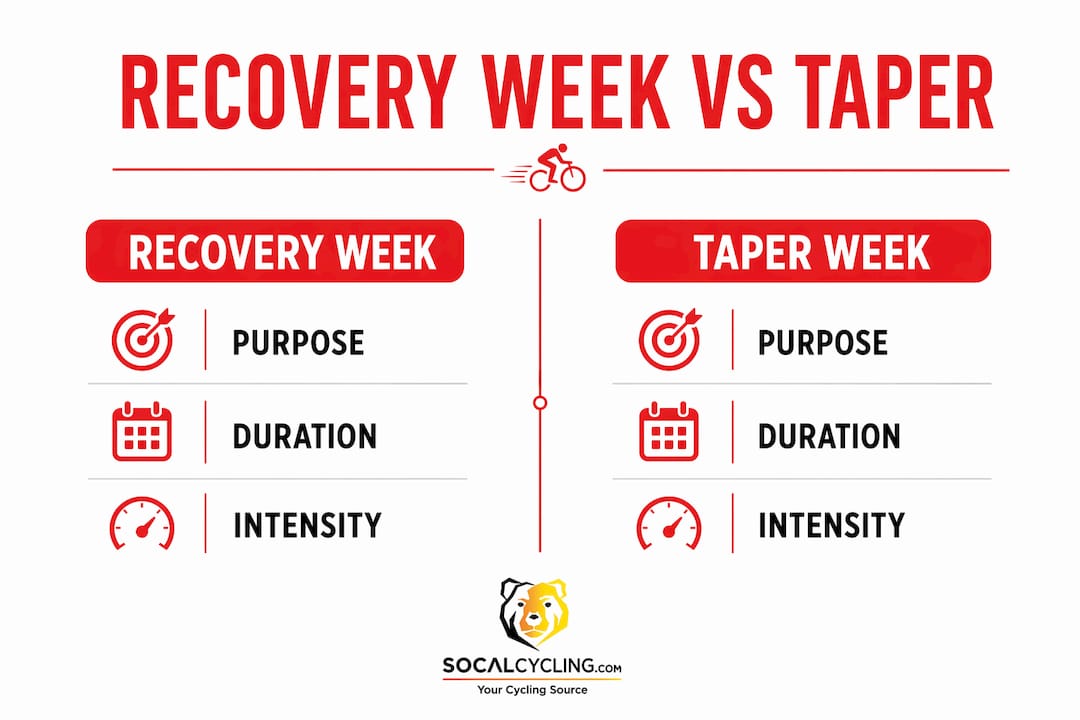
TrainerRoad’s guidance draws this line clearly: a recovery week is in-block consolidation, while a taper is event-specific sharpening that includes brief exposures at race intensity to prime the neuromuscular system. Using a recovery-week protocol before a goal event leaves you under-primed; using a taper protocol mid-block leaves you under-recovered.
Common recovery-week mistakes and how to fix them
Most riders make one of four mistakes that turn a recovery week into either a wasted break or an accidental training stimulus.
- Going too hard out of guilt: The most common error. Dropping only one ride and calling it a recovery week means arriving at the next build still fatigued. Fix: commit to the 40–60% volume cut and track your hours honestly.
- Going completely off the bike: Full rest mid-block detaches the neuromuscular system and leaves you flat at the start of the next build. Fix: keep two or three easy rides and include one short set of openers.
- Cutting calories or protein too far: The body is rebuilding. Under-fueling blocks adaptation. Fix: reduce carbohydrates proportionately to volume, but hold protein steady.
- Adding hard cross-training: A hard gym session or a tempo run creates the same systemic load you are trying to reduce. Fix: limit cross-training to easy walking, light swimming, or mobility work.
The psychological trap is real too. Guilt and FOMO push riders to add “just one more interval” or join the Saturday group ride at full gas. Reframe the recovery week as a performance tool, not a concession. The Road Cycling Academy puts it well: you are cashing in the training coins you have been depositing for three weeks. Skipping the recovery week means the coins stay in the jar.
What the evidence says about sleep and planned recovery
The research base for scheduled recovery is solid. A randomized controlled trial in recreational runners found that undulatory training loads with a taper-like reduction in the final week produced the greatest cardiorespiratory fitness gains and the lowest markers of muscle injury, including CK levels, compared to linear or staggered loads without a recovery period. The group that trained linearly without load reduction showed increased protein catabolism and muscle damage markers after eight weeks.
Coach guidance from CTS, TrainerRoad, and the Road Cycling Academy converges on three practical priorities during recovery weeks:
The recovery week is not zero. It is the precise dose that lets supercompensation actually happen. Volume drops, intensity gets sharper and shorter, and sleep and nutrition stay high. An undernourished, sleep-deprived recovery week is a wasted one — the adaptive window is open, but nothing comes through it.
Applying this evidence to a weekly checklist:
| Priority | Action |
|---|---|
| Sleep | Target 8–9 hours; consistent schedule; cool, dark room |
| Protein | Hold at build-week levels; do not reduce with volume |
| Carbohydrates | Reduce proportionately to volume drop |
| Intensity | One short opener session; otherwise Zone 1–2 only |
| Monitoring | Track RHR, HRV trend, and RPE daily |
The Road Cycling Academy’s rest and recovery guide frames the underlying mechanism through General Adaptation Syndrome: training pushes you below baseline (alarm reaction), recovery allows the body to rebuild above it (resistance stage), and skipping recovery risks pushing into exhaustion. The supercompensation window opens approximately 36–72 hours after the training stimulus and closes within 3–7 days if no new stimulus follows. A well-timed recovery week keeps you cycling through that window productively.
How recovery weeks protect your long-term health as a cyclist
Injury prevention is where recovery weeks pay dividends that compound over a full season and across multiple years of training. Overuse injuries in cyclists, including patellar tendinopathy, IT band syndrome, and lower-back issues, develop when cumulative load exceeds the tissue’s capacity to repair between sessions. A scheduled recovery week every three to four weeks gives connective tissue, tendons, and bones the time to remodel and strengthen rather than simply accumulate micro-damage.
The acute:chronic workload ratio framework makes this concrete. When your current week’s load climbs above roughly 1.5 times your four-week rolling average, injury risk rises measurably. A 40–60% volume cut in week four brings that ratio back inside the safe band before tissue damage accumulates. For masters riders, this matters even more: recovery capacity declines with age, and a 2:1 build-to-recovery cadence is often the difference between a consistent training year and a season interrupted by injury. Socalcycling’s century ride training guide covers how to integrate recovery weeks into longer training blocks for endurance events.
Beyond physical health, the mental benefits are concrete. Reduced training load lowers cortisol, improves mood, and restores the intrinsic motivation that hard training erodes over time. Riders who build recovery weeks into their plans consistently report higher training quality in the subsequent build block, not just because their legs are fresher, but because their focus and drive have returned.
Key Takeaways
Recovery weeks convert training stress into lasting fitness by allowing supercompensation to occur; the default cadence is 3 build weeks followed by 1 recovery week with a 40–60% volume reduction.
| Point | Details |
|---|---|
| Schedule the cadence | Default is 3 build weeks + 1 recovery week; shift to 2:1 if you are 45+ or showing two warning signals. |
| Cut volume 40–60% | Drop total weekly hours by 40–60% but keep one short opener session to preserve neuromuscular fitness. |
| Hold protein steady | The body is in active repair mode during recovery; cutting protein blocks adaptation. |
| Monitor two signals | Use two concurrent indicators (HRV trend + RPE, or RHR + mood) as your green light to resume building. |
| Block it now | Schedule your next recovery week within the next 3–4 weeks and treat it as a non-negotiable training session. |
The Socalcycling perspective on recovery weeks
Here at Socalcycling, we have watched riders across Southern California and beyond chase fitness by adding more miles, more intervals, and more intensity, only to arrive at their goal event flat, injured, or burned out. The pattern is consistent and preventable. Recovery weeks are not a sign of weakness or a concession to fatigue. They are the mechanism by which hard training actually works.
What we find most riders underestimate is how precise the recovery week needs to be. It is not a holiday, and it is not zero. The 40–60% volume cut, the maintenance openers, the sleep priority, and the steady protein intake are all part of a specific prescription. Get the dose right and you will feel the difference by day five or six: legs that respond, power numbers that surprise you, and a genuine eagerness to train hard again. That feeling is supercompensation, and it is available to every cyclist who is willing to back off long enough to let it happen.
We encourage every rider in our community to try the templates in this guide, track your HRV and resting heart rate through the week, and report back. The Socalcycling community is built around exactly this kind of performance-focused, evidence-backed conversation. For more on how to plan your training around your event calendar, our cycling event category guide is a strong next read.
Sources and further reading
- TrainerRoad Blog: Why Rest, Recovery and Tapering Are Necessary to Get Faster — Coach-backed explainer distinguishing recovery weeks from tapers; foundational for scheduling and physiology sections.
- Roadman Cycling: Cycling Recovery Week — What to Do and Why It Works — Practical guide covering volume reduction percentages, the “feeling worse” phenomenon, and common mistakes.
- AdaptCycling: How Often to Take a Recovery Week as a Self-Coached Cyclist — Detailed periodization framework covering acute:chronic workload ratios, cadence alternatives, and intensity prescription.
- Road Cycling Academy: What Is a Cycling Recovery Week? — Accessible coach-authored guide with the “cashing in gold coins” framing and practical scheduling advice.
- Road Cycling Academy: Cycling Recovery — Why Rest Matters for Performance — Evidence-backed overview of General Adaptation Syndrome, supercompensation timing, and recovery modalities.
- Journal of Strength and Conditioning Research: Reduced-Volume Training in Professional Cyclists — Peer-reviewed study showing CK and subjective fatigue improvements after a single reduced-volume day in professional cyclists.
- Sports Medicine Open: Undulatory vs. Linear Load Manipulations in Aerobic Training — Randomized controlled trial demonstrating superior fitness gains and lower muscle-damage markers with undulatory loads and taper-like recovery periods.
- Socalcycling: How to Fuel Long Distance Cycling Rides Effectively — Practical macronutrient and fueling guide for cyclists; recommended follow-up for recovery-week nutrition.
Recommended
- Why Cycling Events Have Rest Stops: A Rider’s Guide
- How to Fuel Long Distance Cycling Rides Effectively
- Cycling Event Category Guide: What Riders Need to Know
- How to Plan Century Ride Training: Your 12–28 Week Guide