

Under California law, an e-bike must fall into Class 1, 2, or 3, carry a motor no larger than 750 watts, and meet strict speed and labeling requirements. Class 1 and 2 e-bikes top out at 20 mph of motor assistance; Class 3 tops out at 28 mph. Riders on Class 3 bikes must be at least 16 and wear a helmet, and every legal e-bike carries a permanent label stating its class, top assisted speed, and motor wattage.
That baseline matters more than usual right now. In April 2026, Attorney General Rob Bonta and California district attorneys issued a consumer alert on e-bike safety warning that vehicles exceeding 28 mph on pedal assist, 20 mph on throttle alone, or 750 watts of motor output are not e-bikes under state law. They’re mopeds or motorcycles, regardless of what a retailer’s sticker says.
Here’s the quick version:
- Class 1: Pedal-assist only, 20 mph max, no throttle.
- Class 2: Throttle-assisted, 20 mph max.
- Class 3: Pedal-assist, 28 mph max, speedometer required, minimum rider age 16.
- Not an e-bike: Anything over 750 watts, or exceeding those speed caps, or missing pedals entirely.
Key Takeaways
California classifies e-bikes into three tiers by speed and throttle type, and the 2026 AG alert signals enforcement is now targeting retailers selling overpowered devices as compliant e-bikes.
| Point | Details |
|---|---|
| Three classes define legality | Class 1 and 2 cap at 20 mph, Class 3 at 28 mph, all under 750 watts. |
| Class 3 has strict rider rules | Minimum age 16, mandatory helmet for all riders, required speedometer. |
| Labels prove compliance | Every legal e-bike must show classification, top speed, and wattage permanently. |
| Modifications change legal status | Removed pedals or unlocked speed governors can reclassify a bike as a moped. |
| Enforcement now targets retailers | The April 2026 AG alert warns sellers, not just riders, face consumer protection action. |
Table of Contents
- What California E-Bike Laws Actually Say About the Three Classes
- Who Can Ride What: Age, Helmets, and Equipment Rules
- Riding on Roads, Bike Lanes, and Trails
- Buying or Selling: Labeling and Certification Duties
- Illegal Conversions, E-Motos, and the 2026 Crackdown
- Battery Safety: Certification and Fire Risk
- Checklist: Verify Legality Before You Buy
- Parking and Storage Rules You Should Know
- Penalties and Fines for Breaking E-Bike Rules
- Do You Need Insurance to Ride an E-Bike in California?
- The Gap Between the Statute and What Riders Actually Face
- Frequently Asked Questions
- Sources
What California E-Bike Laws Actually Say About the Three Classes
The core of California e-bike regulations lives in Vehicle Code Section 312.5. It defines an electric bicycle as a bicycle with fully operable pedals and an electric motor under 750 watts, then splits that definition into three tiers.
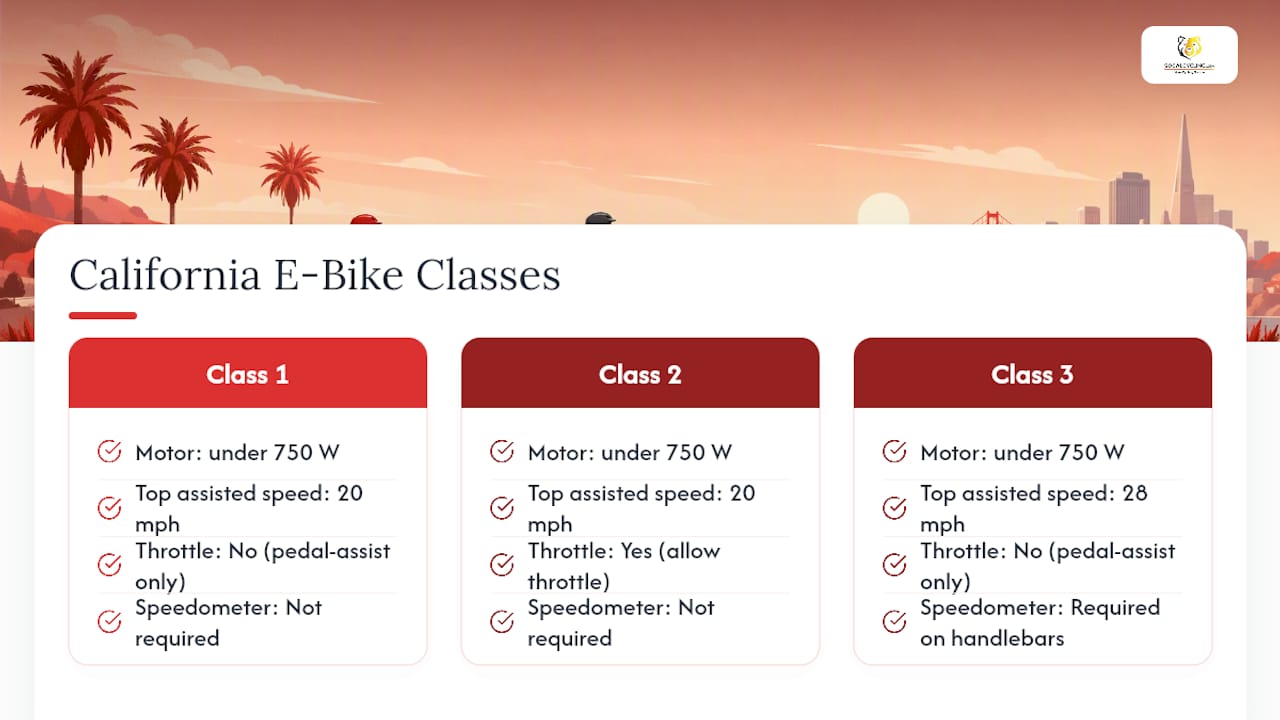
Class 1 gives you pedal-assist power only. The motor kicks in while you pedal and cuts out at 20 mph, with no throttle mode at all. Class 2 adds a throttle, letting you accelerate without pedaling, but it’s capped at the same 20 mph. Class 3 raises the ceiling to 28 mph but only through pedal assist, and the law requires a speedometer on the handlebars so the rider can actually see the number.
One detail trips up a lot of buyers: any class can include a walk-assist or launch feature that powers the bike up to 3.7 mph without pedaling, typically used to get moving from a stop. That’s legal across all three classes and isn’t the same as a Class 2 throttle.
Every compliant bike must carry a permanent label showing its classification number, top assisted speed, and motor wattage. If that label isn’t there, or the bike does things the label doesn’t disclose, you’re not looking at a legal e-bike.
Who Can Ride What: Age, Helmets, and Equipment Rules
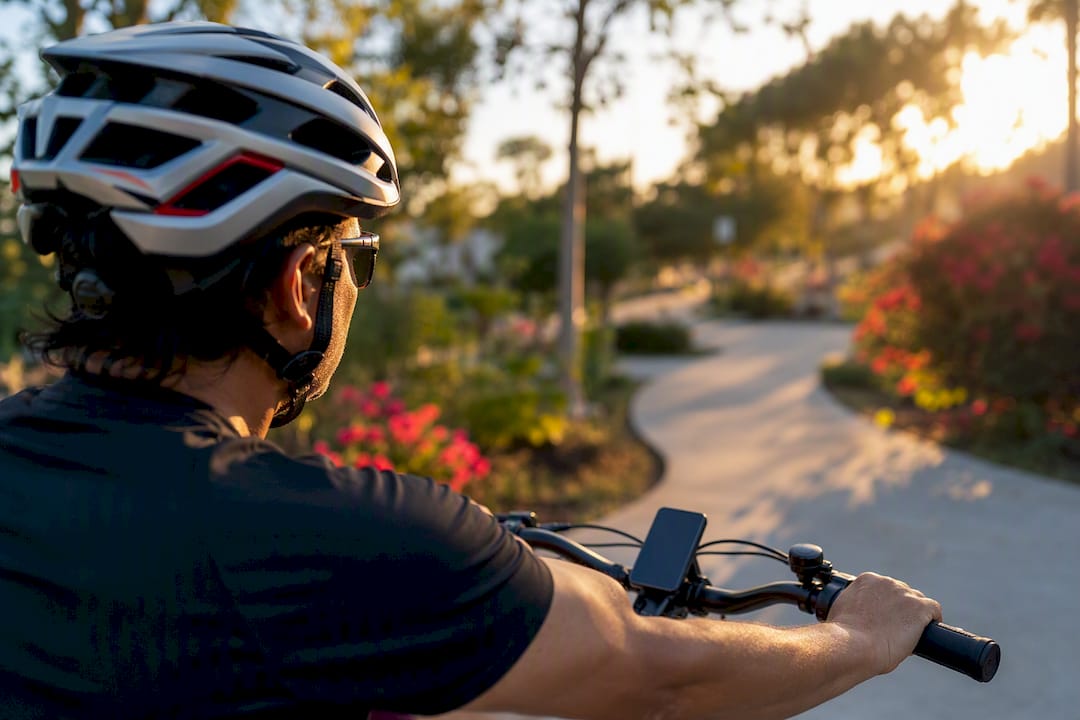
California e-bike age limit rules are narrower than most people assume. Only Class 3 has a hard minimum age: 16. Classes 1 and 2 have no statewide age floor, though plenty of parents apply their own judgment before handing a nine-year-old a throttle bike.
Helmet rules follow a two-track system:
- Riders and passengers under 18 must wear a helmet on any e-bike class.
- Every rider and passenger on a Class 3 e-bike must wear a helmet, regardless of age.
- Helmets should meet ASTM or CPSC certification standards, the same bar as standard bicycle helmets.
- Class 3 bikes must have a working speedometer visible to the rider.
Pro Tip: Check the helmet’s inner label for a CPSC certification sticker before your teen’s first ride. A helmet without one won’t satisfy the requirement even if it looks the part.
The speedometer isn’t a suggestion. Enforcement guidance treats it as part of what separates a compliant Class 3 bike from something operating illegally at higher speeds with no way to verify compliance.
Riding on Roads, Bike Lanes, and Trails
E-bikes generally get the same rights and responsibilities as regular bicycles under Sections 21200 and 21200.5, meaning Class 1 and 2 bikes can typically use bike lanes, streets, and shared pathways just like a standard bicycle. Class 3 bikes usually can’t use bike paths or trails unless a local agency specifically allows it.
Local governments and park agencies keep their own authority here, and they use it. A regional park district might ban all e-bike classes on singletrack while allowing them on paved multi-use paths a mile away.
Before you head out on unfamiliar trails:
- Look for posted signage at trailheads specifying which classes are allowed.
- Check the specific park or county website, since rules vary by jurisdiction even within Southern California.
- Call the local ranger station or parks department if signage is ambiguous or missing.
- Assume a new trail restricts e-bikes until you confirm otherwise, especially in state parks.
Buying or Selling: Labeling and Certification Duties
Retailers carry real legal exposure under current California e-bike regulations, and buyers should know what a legitimate bike looks like on the shelf. The label required by VEH §312.5 has to be permanent and legible, showing classification number, top assisted speed, and motor wattage in a font roughly Arial size 9 or larger.
SB-1167 pushes this further by directing battery testing and certification standards referencing UL 2849 and EN 15194, the industry benchmarks for electrical and fire safety in e-bike batteries. The bill’s direction also touches rental operators, who would need to document that the batteries in their fleet meet tested standards before renting them out.
- Confirm the label matches what the salesperson claims about speed and wattage.
- Ask whether the battery has UL 2849 or EN 15194 certification documentation.
- Walk away from any bike marketed as “easily unlocked” to exceed its class limits.
Illegal Conversions, E-Motos, and the 2026 Crackdown
Modifying a legal e-bike can strip its legal status entirely. Swapping in a higher-voltage battery, removing the pedals, or unlocking a speed governor through firmware changes can push a bike past the 750-watt or 28-mph threshold, and once it crosses that line, California treats it as a moped or motorcycle rather than a bicycle.
That reclassification carries consequences most riders don’t expect:
- DMV registration becomes mandatory, along with a license plate.
- Riders need an M1 or M2 motorcycle license depending on the vehicle’s specs.
- Liability insurance requirements kick in, the same as any other motor vehicle.
- Officers can impound the vehicle under CVC 22651.08 if it doesn’t meet the legal e-bike definition.
The AG’s April 2026 alert specifically calls out “e-motos,” bikes styled to look like standard e-bikes but built with motorcycle-grade power, often marketed directly to teenagers and their parents. The Attorney General’s office is coordinating with district attorneys statewide, and enforcement is increasingly aimed at the retailers selling these devices as e-bikes, not just the riders on them.
Battery Safety: Certification and Fire Risk
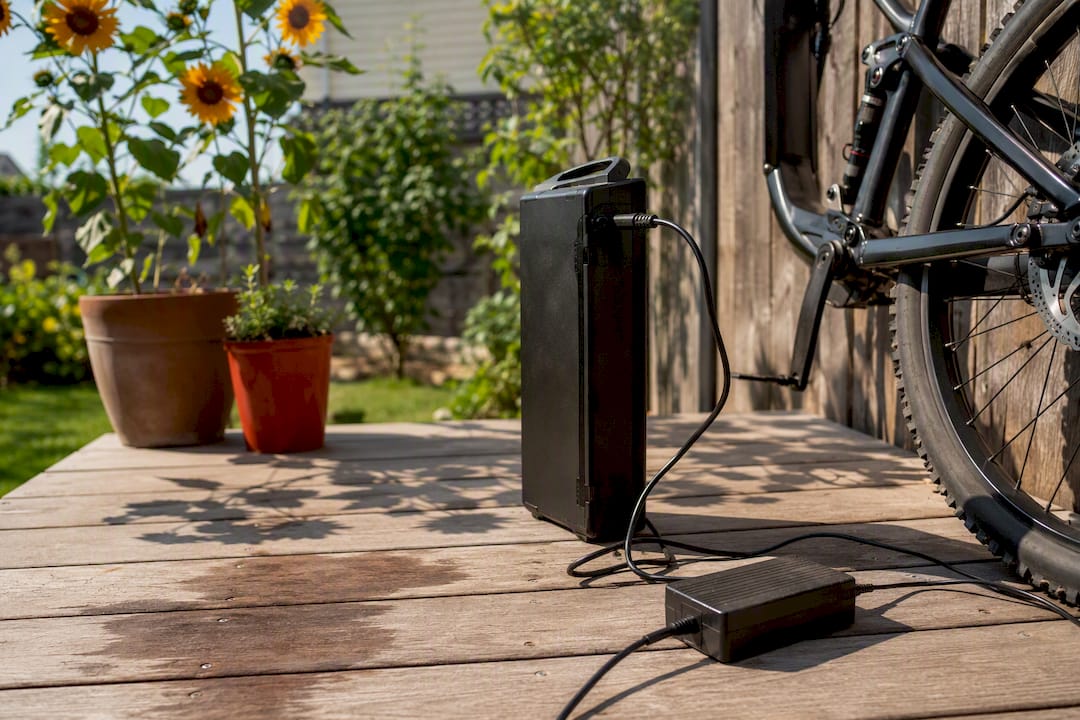
Battery fires tend to trace back to a small set of causes: counterfeit or uncertified cells, damaged batteries that keep getting charged anyway, and off-brand chargers that don’t match the battery’s specifications. SB-1167’s push toward UL 2849 and EN 15194 testing exists specifically because uncertified batteries have caused a disproportionate share of documented e-bike fire incidents nationally.
A few habits cut that risk substantially:
- Charge on a hard, non-flammable surface, never on a bed or carpeted stairwell.
- Never leave a battery charging unattended overnight if you can avoid it.
- Retire any battery that’s swollen, cracked, or was dropped hard.
Pro Tip: Ask a dealer or rental operator directly whether they can produce UL 2849 or EN 15194 certification paperwork for the battery. A legitimate shop should have it on hand without hesitation.
Checklist: Verify Legality Before You Buy
Confirming a bike’s legal status takes about ten minutes if you know what to look for.
- Photograph the permanent label and confirm it lists classification number, top speed, and wattage.
- Cross-check that label against the manufacturer’s published specs online.
- Test whether the throttle moves the bike without pedaling; that determines Class 2 versus Class 1 or 3.
- On private property, verify the top assisted speed doesn’t exceed what the label claims.
- Ask for battery certification documentation before handing over payment.
- Search for firmware “unlock” instructions online tied to that model; their existence is a red flag.
- Check your city or county’s trail and bike-lane rules for that specific class.
Pro Tip: If a listing or salesperson can’t produce the permanent label in a photo before you buy, treat that as a dealbreaker, not a formality.
Socalcycling’s Take on Local Enforcement Trends
Socalcycling has covered Southern California’s cycling community long enough to watch e-bike adoption outpace public understanding of the rules. Our event and community coverage regularly touches on modified vehicles showing up at rides where they don’t belong, and the safety friction that creates for everyone sharing the road or trail.
We track these enforcement trends alongside race and event coverage because they affect the same riders. Follow our ongoing California cycling coverage for updates as enforcement actions develop.
Parking and Storage Rules You Should Know
California doesn’t impose a single statewide parking code for e-bikes the way it does for cars, but local ordinances fill that gap, and they vary block by block in some cities. Most municipalities treat e-bikes like standard bicycles for parking purposes, meaning designated bike racks are fair game and sidewalks generally are not, especially where a parked bike blocks pedestrian access or ADA-compliant paths.
Apartment buildings and HOAs have started writing their own e-bike storage clauses, largely driven by battery fire concerns rather than parking congestion. Some now require batteries to be stored or charged in specific locations, away from stairwells and building exits, and a growing number restrict indoor charging entirely for anything above a certain wattage.
A few practical habits keep you clear of both official rules and building-specific ones:
- Use marked bike racks or designated e-bike parking where available, particularly near transit stations.
- Avoid chaining a bike to fire hydrants, accessibility ramps, or building entrances, which several California cities cite specifically in local codes.
- Check your lease or HOA agreement for battery charging and storage clauses before assuming your garage setup is compliant.
- If you park at a commercial property, look for posted e-bike or micromobility parking signage, since retailers are increasingly adding it.
Theft is the other half of the storage equation. E-bikes routinely retail for the price of a used car, and that makes them a target. A hardened chain lock through the frame and rear wheel, combined with parking in visible, well-lit areas, does more to prevent loss than any legal requirement ever will.
Penalties and Fines for Breaking E-Bike Rules
Penalties escalate depending on what exactly went wrong, and the range is wider than most riders expect. A straightforward equipment violation, like a Class 3 rider without a helmet or a missing permanent label, typically draws a citation and fine similar to standard bicycle infraction fines, generally in the range of other non-moving vehicle-equipment tickets under the Vehicle Code.
The more serious exposure comes when a modified bike gets reclassified as a moped or motorcycle. At that point you’re not looking at a bicycle infraction anymore. Riding an unregistered, unlicensed motor vehicle on a public road can bring a misdemeanor charge, a considerably higher fine, and vehicle impound under CVC 22651.08, the same statute CHP guidance references for removing vehicles that don’t meet the legal e-bike definition.
Retailers face their own exposure now too. The AG’s consumer alert makes clear that selling a device marketed as an e-bike when it exceeds legal thresholds can trigger consumer protection enforcement against the business itself, not just a fine against the buyer. That’s a meaningful shift from a few years ago, when enforcement leaned almost entirely on riders.
Parents should note that a minor riding an illegally modified e-bike doesn’t insulate the household from consequences. Impound fees, towing costs, and potential civil liability for injuries caused by an unregistered vehicle can land squarely on the adult who purchased it.
Do You Need Insurance to Ride an E-Bike in California?
California doesn’t mandate insurance for Class 1, 2, or 3 e-bikes the way it does for cars and motorcycles. A legally compliant e-bike operates under the same insurance-free framework as a standard bicycle. That said, “not required” and “not advisable” are two different things.
Homeowners and renters policies sometimes exclude e-bike theft or liability by default, particularly for higher-value models, so it’s worth a direct call to your carrier rather than assuming standard coverage applies. Some insurers now offer e-bike-specific riders that cover theft, accidental damage, and liability if you injure someone or damage property while riding.
Liability is the piece riders underestimate most. If you collide with a pedestrian or another cyclist and cause injury, a personal liability policy or an e-bike-specific rider can be the difference between a manageable claim and paying out of pocket. That coverage gap disappears entirely if a bike gets reclassified as a moped or motorcycle, because then state-mandated liability insurance becomes a legal requirement, not an option, before you can register or ride it.
If you’re organizing group rides or events where participants bring e-bikes, checking whether your event insurance covers e-bike categories is worth a conversation with your provider well before race day. Anyone building out an event calendar should also review our guide to organizing cycling events for the broader liability picture beyond e-bikes specifically, and check our cyclocross calendar checklist if you’re planning participation logistics for mixed-bike events.
The Gap Between the Statute and What Riders Actually Face
The conventional advice on this topic stops at reciting wattage and speed numbers, and that’s the easy part. What the statute and the AG’s alert actually reveal is a system playing catch-up with a retail market that’s been selling motorcycle-grade power under bicycle branding for years.
The real risk isn’t misunderstanding Class 1 versus Class 3. It’s assuming that because a product is labeled and sold as an “e-bike,” it legally qualifies as one. It often doesn’t, and the burden of figuring that out has landed squarely on parents and buyers rather than retailers, at least until enforcement against sellers catches up to enforcement against riders.
If you take one thing from this: verify the label and the wattage before you verify anything else. Everything else, helmet rules, trail access, insurance, only matters once you’ve confirmed you’re actually dealing with a legal e-bike and not a disguised moped.
Frequently Asked Questions
How fast can e-bikes go in California?
Class 1 and 2 e-bikes are limited to 20 mph of motor assistance. Class 3 e-bikes can reach 28 mph, but only through pedal assist, never through throttle alone.
What is the California e-bike age limit?
Only Class 3 has a mandatory minimum age of 16. Classes 1 and 2 have no statewide age floor, though helmet rules still apply to riders under 18.
Do I need a license to ride an e-bike in California?
No, as long as the bike genuinely meets Class 1, 2, or 3 requirements. If a bike has been modified beyond those limits, it may require a motorcycle license and DMV registration.
Is there a California e-bike helmet law?
Yes. Riders and passengers under 18 need a helmet on any class, and everyone riding a Class 3 e-bike needs a helmet regardless of age.
Can local parks ban e-bikes even if they’re legal on the street?
Yes. Parks, trail systems, and counties can restrict or prohibit specific e-bike classes on their property even when the bike is fully compliant with state vehicle code.
Sources
- California Code, VEH 312.5
- Too Fast, Too Furious: Attorney General Bonta, California District Attorneys Issue Consumer Alert on E-Bike Safety, Legal Requirements
- CHP internal guidance: Electric bicycles and other devices (policy & enforcement guidance)
- Electric Bike (E-Bike), Scooter, and Motorcycle Laws — Fremont Police Department, CA