



Start euhydrated, sip early and often, and never let body-mass loss during a ride climb past 2%. That’s the entire foundation of smart hydration, and everything else in this guide builds on it. If you take one thing from what follows, the 2% threshold is the one that matters most: cross it, and your aerobic capacity, thermoregulation, and power output all take a measurable hit.
Here’s the checklist Socalcycling recommends before you clip in:
- Prehydrate deliberately. Drink about 500 ml (17 oz) roughly two hours before a ride if you’re not already well hydrated. This gives your kidneys time to process the excess so you’re not sloshing at the start line.
- Sip on a schedule, not on thirst. By the time you feel thirsty, you’re already behind. Small, frequent sips beat big gulps every time.
- Bring electrolytes for anything over an hour. Sodium becomes essential once rides stretch past 60 minutes or the temperature climbs, and it pairs naturally with carbohydrate-electrolyte (CHO‑E) drinks.
- Know your sweat rate. A simple pre/post-ride weigh-in tells you exactly how many milliliters per hour you need to replace.
- Never test a new fueling strategy on race day. Save the experimenting for training rides.
Quick stat: Cyclists who kept body-mass loss under 2% during a three-hour ride in the heat completed their time trial 8% faster than those who replaced less fluid, even with matched sodium levels.
Pro Tip: If you’re curious about sodium hyperhydration or a higher carb-per-hour target, dial it in during a low-stakes group ride first. Your gut and your electrolyte balance need practice, not surprises.
Key Takeaways
Cyclists who avoid more than 2% body-mass loss, sip fluids on a schedule, and match carbohydrate and sodium intake to ride duration can improve performance and recovery for many riders.
| Point | Details |
|---|---|
| Start euhydrated | Drink about 500 ml roughly two hours before rides that need extra fluid reserve. |
| Avoid the 2% threshold | Body-mass loss beyond 2% measurably impairs aerobic performance and thermoregulation. |
| Use CHO‑E past one hour | Carbohydrate-electrolyte drinks improve time to exhaustion on rides over 60 minutes. |
| Personalize with a sweat test | A simple pre/post-ride weigh-in converts your losses into a precise ml/hr target. |
| Trial hyperhydration in training | Sodium-loading protocols need practice runs, never a race-day debut. |
| Rehydrate at 1.5x losses | Replace about 1.5 liters per kilogram lost after a ride, with sodium included. |
Table of Contents
- Why Cyclist Hydration Best Practices Actually Change Performance
- What Should You Do the Night Before and Two Hours Before a Ride?
- How Much Should You Drink During a Ride?
- How Do You Measure Your Own Sweat Rate?
- How Much Sodium and Carbohydrate Do You Actually Need?
- When Does Sodium Hyperhydration Make Sense, and What Are the Risks?
- Bottles, Packs, or Both: What’s Right for Your Ride?
- How Should You Rehydrate After a Ride?
- What Are the Warning Signs of Dehydration and Overhydration?
- Sample Hydration Templates by Ride Length
- What Evidence Backs These Hydration Guidelines?
- What SoCalCycling Has Learned Covering Hydration on the Road
- Frequently Asked Questions
- Sources
Why Cyclist Hydration Best Practices Actually Change Performance
Dehydration doesn’t just make you thirsty. It reduces plasma volume, which forces your heart to work harder to move the same amount of blood, and it blunts your body’s ability to shed heat through sweat. The result is a drop in the power you can sustain, not just discomfort.
The ACSM-related research on fluid replacement links body-mass loss beyond 2% to measurable declines in aerobic performance. That number isn’t arbitrary. It marks the point where reduced cardiac output and impaired thermoregulation start compounding each other, and the effect gets worse in heat.
A trial comparing fluid replacement strategies during three hours of cycling in hot conditions found that riders who replaced about 80% of their projected fluid losses, keeping body-mass loss under that 2% mark, posted an 8% faster time trial than riders who replaced only 60%. Serum sodium was similar between groups. The difference came down to plasma volume and thermal strain, not electrolyte concentration alone.
Carbohydrate-electrolyte drinks add another layer of protection. A systematic review and meta-analysis of 26 studies found CHO‑E supplementation improved time to exhaustion (standardized mean difference of 0.60) and supported blood glucose levels during moderate-to-high intensity exercise. Translation for the road: the right drink doesn’t just replace fluid, it keeps your muscles fueled and your sodium levels stable at the same time.
- Reduced plasma volume forces higher heart rate at the same power output.
- Impaired sweating raises core temperature faster in heat and humidity.
- CHO‑E drinks support both blood glucose and sodium, extending time to exhaustion.
What Should You Do the Night Before and Two Hours Before a Ride?
Hydration strategy starts well before you touch your bike. The 24 hours leading into a ride set your baseline, and the two hours before it fine-tune your plasma volume.
The 24-hour window. Eat a normal, balanced diet with adequate sodium, especially if you know you’re a heavy sweater or the forecast calls for heat. Skip heavy alcohol the night before a big effort. Alcohol is a diuretic, and it will undercut whatever hydration work you do the next morning.
The two-hour rule. ACSM guidance recommends drinking about 500 ml roughly two hours before exercise when you need to top off plasma volume. That timing matters: drink it too close to the start and you’ll spend the first 20 minutes looking for a bathroom instead of settling into your effort.
For overnight rides, multi-day gran fondos, or back-to-back training blocks, extend this thinking across days rather than hours. Weigh yourself each morning. A downward trend of more than a pound or two suggests you’re not fully recovering fluid losses between efforts, and it’s worth adjusting your evening rehydration accordingly.
Pre-ride checklist:
- Weigh yourself in consistent conditions (morning, after using the bathroom, before eating).
- Drink 500 ml about two hours out if you’re not already topped off.
- Pack extra electrolyte mix if the forecast shows heat or humidity above your usual training conditions.
- Test any new drink mix in a warm-up spin, not on the ride itself.
| Point | Details |
|---|---|
| Prehydration timing | Drink ~500 ml about two hours before rides that demand extra fluid reserve. |
| Avoid late alcohol | Skip heavy drinking the night before long or hot rides to prevent added fluid loss. |
| Multi-day tracking | Weigh in each morning during stage races or back-to-back rides to catch cumulative deficits. |
How Much Should You Drink During a Ride?
The answer depends on duration, intensity, and heat, but the underlying rule is simple: match intake to sweat rate, and add carbohydrate-electrolyte drinks once you pass the one-hour mark.
For rides under an hour, plain water usually covers it. Between one and two hours, a light CHO‑E drink starts paying off, especially if the pace is brisk. Past two hours, planned carbohydrate intake becomes a performance lever, not just a comfort measure. The CHO‑E meta-analysis backs a range of 30 to 60 grams of carbs per hour for most riders, with well-adapted athletes pushing toward 90 or more on very long events.
Sodium deserves its own attention. ACSM guidance points to roughly 0.5 to 0.7 grams of sodium per liter of fluid during exercise, and that concentration does double duty: it improves fluid retention and it makes the drink taste better when you’re sweating heavily, which keeps you drinking. If you’re climbing toward a summit finish or anticipating a hard effort, take your sip a few minutes ahead of the intensity spike rather than mid-effort, when a full stomach and hard breathing don’t mix well. Course maps that show elevation and water stops are worth studying beforehand for exactly this reason.
Quick stat: A meta-analysis of 26 studies found CHO‑E supplementation improved blood glucose response with a standardized mean difference of 0.82 (p < 0.001), one of the strongest effects in the carbohydrate-electrolyte research.
- Rides under 1 hour: water is typically sufficient.
- Rides 1 to 2 hours: light CHO‑E drink, especially at higher intensity.
- Rides over 2 hours: 30 to 60 g/h carbs, scaling toward 90 g/h for trained athletes on very long efforts.
- Sodium target: 0.5 to 0.7 g per liter of fluid during exercise.
Pro Tip: Avoid drinking a full bottle in one go before a climb. A large bolus right before hard effort is a common trigger for gastrointestinal distress. Small, steady sips work better than a last-minute chug.
How Do You Measure Your Own Sweat Rate?
Generic hydration advice only gets you so far because sweat rates vary enormously between riders, sometimes by a factor of three or four even at similar intensities. The fix is a field test you can run yourself in about 20 minutes.
- Weigh yourself nude or in dry, minimal kit right before your ride.
- Ride for a set duration under conditions typical for your training (note temperature and intensity).
- Remove sweat-soaked kit and weigh yourself again in the same minimal state.
- Subtract any fluid you drank during the ride from your weight loss to isolate true sweat loss.
- Convert to a per-hour rate: divide total fluid loss by ride duration in hours.
The Korey Stringer Institute frames the math simply: 1 kilogram of body-mass loss equals roughly 1 liter of sweat. So if you lose 1.2 kg over a two-hour ride and drank 500 ml along the way, your true sweat loss is 1.7 liters, or about 850 ml per hour.
Run this test more than once. Heat, humidity, altitude, and intensity all shift your numbers, so a rate measured on a cool spring morning won’t hold up on a August climb. Watch for confounders too: a bathroom break mid-ride will throw off your math, and a cheap bathroom scale can introduce enough error to skew your per-hour estimate.
Pro Tip: Test your sweat rate on a hot day and a cool day separately, then keep both numbers. You’ll use the cool-weather figure for most training and the hot-weather figure for summer events and altitude camps.
How Much Sodium and Carbohydrate Do You Actually Need?
Carbohydrate and sodium work as a team, not as separate line items on a nutrition label. The systematic review and meta-analysis on CHO‑E strategies found improved time to exhaustion (SMD 0.60, p = 0.006) when riders used carbohydrate-electrolyte drinks during moderate-to-high intensity exercise, and that effect held up alongside better blood glucose stability.
Practical numbers to work from: 30 to 60 grams of carbohydrate per hour covers the vast majority of endurance rides. Riders tackling very long events, think six-plus hour gravel races or double centuries, can push toward 90 to 120 g/h, but only after training their gut to handle it. That adaptation takes weeks, not days.
Sodium concentration in most commercial sports drinks lands between 0.4 and 0.8 grams per liter, which lines up with ACSM’s practical range. Isosmotic drinks, generally in the 4 to 8% carbohydrate concentration range, empty from the stomach efficiently without slowing fluid absorption. Go much higher in concentration and you risk delayed gastric emptying, which is a common cause of the sloshing, nauseated feeling riders blame on “bad nutrition” when it’s really just too much sugar in too little water.
- Standard carb target: 30 to 60 g/h for most rides over an hour.
- High-end target: up to 90 to 120 g/h for very long events, built gradually in training.
- Sodium range: 0.4 to 0.8 g per liter, matching ACSM’s 0.5 to 0.7 g/L guidance.
- Isosmotic drinks (4 to 8% carb concentration) balance fluid delivery with fuel delivery.
If you’re building toward a century or gran fondo, pair this with a structured fueling plan so your carb intake scales with your training block, not just race week.
Pro Tip: Increase your carb intake per hour by about 10 grams every few long rides rather than jumping straight to 90 g/h. Your gut adapts gradually, and rushing it usually ends with a stop on the side of the road.
When Does Sodium Hyperhydration Make Sense, and What Are the Risks?
Sodium hyperhydration, deliberately loading extra sodium and fluid before a ride to expand total body water, isn’t for everyone or every ride. But in specific situations it has real evidence behind it.
A controlled trial found sodium hyperhydration improved cycling time-trial performance by roughly 5% in female cyclists exercising in hot conditions, with higher sustained power output and no increase in cardiovascular strain. A related study from the same research group found similar results, improving performance with no change in thermal strain. The mechanism appears to be better fluid retention and cardiovascular stability heading into a hot, demanding effort, particularly useful for long events with limited aid-station access.
That benefit comes with real caveats. Response to sodium loading varies by sex and, for women, by menstrual cycle phase, so what works for one rider on one day may not replicate perfectly. Overdoing fluid intake around a hyperhydration protocol risks dilutional hyponatremia, a dangerous drop in blood sodium from drinking more than your body can process. Concentrated sodium or carbohydrate solutions can also trigger gastrointestinal distress if your gut hasn’t been trained for them.
Hyperhydration protocols should always be trialed in training first, with careful attention to measured dosing, body weight, and how you feel. Race day is the wrong place to discover your body doesn’t tolerate a new sodium-loading routine.
Safety checklist before trying sodium hyperhydration:
- Test the exact protocol, dose, and timing in a training ride first.
- Weigh yourself before and after to confirm you’re not overdrinking relative to sweat loss.
- Watch for headache, nausea, or confusion, all early signs something is off.
- If you suspect hyponatremia (confusion, seizures, vomiting), stop immediately and seek medical care rather than drinking more fluid.
Bottles, Packs, or Both: What’s Right for Your Ride?
Your hydration system should match your ride length, support access, and personal habits, not just whatever came stock on your bike.
Bottles are light, cheap, and easy to refill at rest stops or gas stations. Two standard cages cover most rides under two hours. Their downside: limited volume means you’re refilling more often on long or hot days, and reaching for a bottle at speed takes practice.
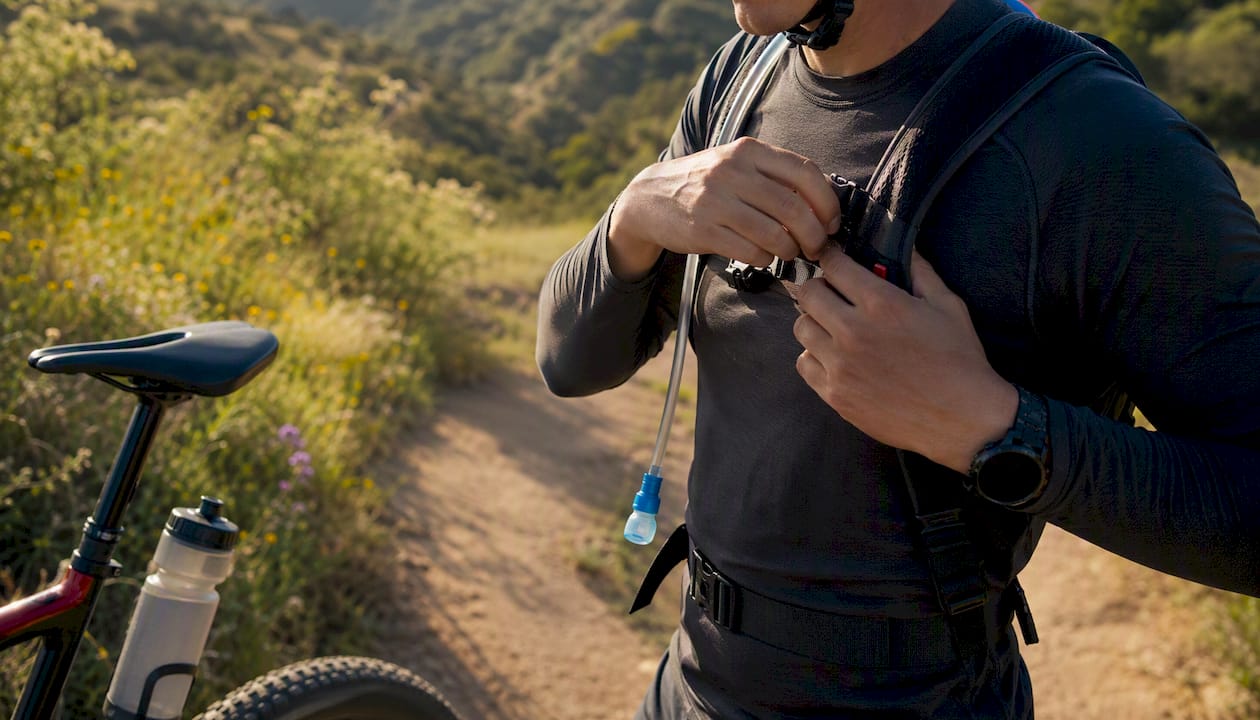
Hydration packs carry far more volume, often 1.5 to 3 liters, and let you sip hands-free, which matters on technical mountain bike trails or gravel descents where reaching for a bottle is risky. The tradeoff is extra weight on your back and a bit more heat retention against your body in already-hot conditions.
Frame bags with a bladder or flask split the difference, adding capacity without a full backpack, though they eat into space you might want for tools or spares.
For supported events, check the rest-stop spacing ahead of time so you know exactly how many bottles to carry between refills. On hot days, an insulated bottle keeps your drink palatable for far longer, and a palatable drink is one you’ll actually keep sipping.
Maintenance basics: rinse bottles after every ride, run a mild bleach-water solution through hydration bladders and hoses weekly to prevent mold and bacteria buildup, and carry a spare valve or bite piece on multi-day trips where a failure would be a real problem.
Pro Tip: For rides with mixed intensity, run a two-bottle setup: plain water in one cage, your CHO‑E mix in the other. That way you control exactly when you’re taking in carbs versus just topping off fluid, instead of diluting your fuel source every time you’re thirsty.
How Should You Rehydrate After a Ride?
Recovery starts the moment you clip out, and the math is straightforward: replace about 1.5 liters of fluid for every kilogram of body mass lost, with sodium included to help your body actually hold onto that fluid instead of flushing it out as urine. That 1.5x replacement figure accounts for the fact that plain water alone triggers faster urine production, undermining your rehydration effort.
If your next hard session is more than 24 hours away, you have room to breathe. Normal meals and regular fluid intake will get you back to baseline without any special protocol. But if you’re racing again the next day, or you’re mid-stage-race, aggressive rehydration in the hours right after finishing matters far more.
Track your progress with more than just thirst. Morning body weight compared to your pre-ride baseline, urine color (pale straw is the target, not clear and not dark amber), and how you feel the next morning all tell you whether your rehydration actually worked. Salty snacks, broth, or a recovery drink with added sodium all beat plain water for restoring what you lost, and pairing that with proper recovery-week nutrition keeps the whole week on track instead of just the one ride.
Quick stat: ACSM’s post-exercise fluid replacement guidance calls for roughly 1.5 liters per kilogram lost when rapid rehydration is required, specifically because normal water intake alone won’t offset urine losses fast enough.
- Replace ~1.5 L of fluid per kg of body mass lost for fast recovery.
- Include sodium in post-ride drinks or meals to improve fluid retention.
- Track morning weight and urine color as simple recovery indicators.
- Slower recovery windows (24+ hours) don’t need an aggressive protocol, just normal meals and fluids.
What Are the Warning Signs of Dehydration and Overhydration?
Knowing the difference between too little fluid and too much fluid can matter more than any drink mix you choose, because the wrong response to either one makes things worse.
Dehydration signs build gradually: persistent thirst, darker urine, lightheadedness, a climbing heart rate at your normal pace, and muscle cramping late in a ride. These are your body’s early warnings, and they respond well to slowing down and getting fluids and electrolytes on board.
Overhydration and hyponatremia signs look deceptively similar at first, nausea and headache, but progress toward confusion, disorientation, and in severe cases seizures. This is a medical emergency, not something to hydrate your way out of. If you or a riding partner shows confusion or altered mental state on a ride, stop fluid intake entirely and get medical help.
Here’s the decision flow to keep in your head:
- Mild symptoms (thirst, fatigue, mild cramping) — slow your pace, take an electrolyte drink, find shade if it’s hot.
- Worsening symptoms (persistent dizziness, dark urine, ongoing cramps) — stop riding, rehydrate steadily, and monitor closely.
- Severe neurological signs (confusion, slurred speech, seizure) — this is an emergency. Stop all fluid intake and get medical care immediately.
Larger organized events plan for exactly this scenario, which is part of why medical staff at cycling events matter as much as aid stations. If you’re riding solo or in a small group, know your route’s access points to help before you need them.
Sample Hydration Templates by Ride Length
Templates give you a starting point. Your measured sweat rate is what turns a template into your actual plan.
Short ride (under 1 hour): Water only, no special electrolyte plan needed unless it’s extreme heat. One bottle is typically enough.
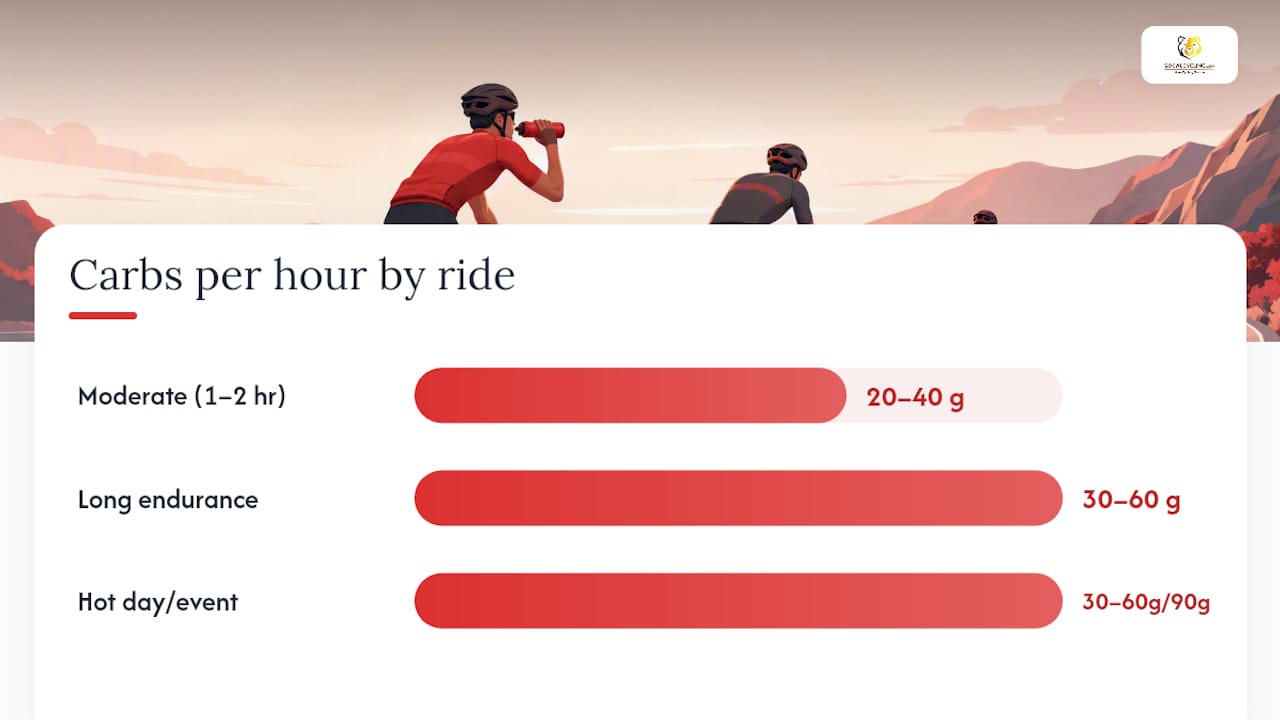
Moderate ride (1 to 2 hours): 500 to 750 ml/hr of water or light CHO‑E drink, 20 to 40 g/h carbs if pace is brisk, minimal sodium focus unless conditions are hot.
Long endurance ride (2.5+ hours): 600 to 1,000 ml/hr scaled to your sweat rate, 30 to 60 g/h carbs, sodium at 0.5 to 0.7 g/L, refill planned around known stops.
| Ride type | Fluid target | Carbs/hr | Sodium target |
|---|---|---|---|
| Short (<1 hr) | Ad libitum water | Not needed | Not needed |
| Moderate (1–2 hrs) | 500–750 ml/hr | 20–40 g | 0.5 g/L if hot |
| Long endurance (2.5+ hrs) | 600–1,000 ml/hr | 30–60 g | 0.5–0.7 g/L |
| Hot day/event | +20–30% over baseline | 30–60 g (up to 90 g trained) | 0.5 to 0.7 g/L |
For multi-day events or ultra-distance rides with aid-station support, logistics matter as much as the science. A rider covering long stages might need close to 5 liters of total fluid support per day between riding and recovery, which is why serious ultra-events plan aid-station spacing and supply resupply well in advance. If you’re building toward your first century, a structured training plan is the natural place to start layering in these hydration templates so they’re second nature by event day.
One-page pre-ride checklist:
- Weigh in and check hydration status the morning of the ride.
- Drink 500 ml about two hours before if extra fluid is needed.
- Pack bottles or pack sized to your known sweat rate.
- Carry electrolyte mix for anything over an hour.
- Plan refill points if the ride exceeds your carried capacity.
What Evidence Backs These Hydration Guidelines?
The recommendations throughout this guide draw from a handful of core sources: the ACSM position stand on exercise and fluid replacement, a systematic review and meta-analysis of carbohydrate-electrolyte supplementation, and recent controlled trials on sodium hyperhydration in cyclists. Each covers a specific piece of the puzzle: ACSM sets the baseline fluid and timing recommendations, the meta-analysis quantifies carbohydrate and electrolyte benefits across 26 studies, and the hyperhydration trials show what’s possible in hot-weather racing when protocols are tested carefully.
These guidelines have real limits worth naming plainly. Most hyperhydration research happens in controlled lab conditions, not on open roads with traffic, climbs, and variable weather. Sweat rate and sweat sodium concentration vary enormously between individuals, sometimes by a factor of several, so any template here is a starting point, not a prescription. Sex-specific responses to sodium loading, especially across the menstrual cycle, still need more research before firm dosing rules emerge.
This guide offers general, evidence-based hydration information for cyclists and isn’t a substitute for individualized medical advice. If you have a heart condition, kidney disease, take medications that affect fluid balance, or experience severe symptoms during or after a ride, talk to a physician before adjusting your hydration or sodium intake.
- ACSM position stand: baseline for prehydration timing, during-ride carbs, and sodium ranges.
- CHO‑E meta-analysis: quantifies carbohydrate and electrolyte benefits for time to exhaustion and blood glucose.
- Sodium hyperhydration trials: show performance gains in heat, with caveats around individual variability.
- Consult a clinician for any medical condition that affects fluid or sodium balance.
What SoCalCycling Has Learned Covering Hydration on the Road
Years of covering gran fondos, gravel races, and training rides across Southern California have taught the Socalcycling team one consistent lesson: the science gets you most of the way there, but logistics decide whether you actually execute the plan. Riders show up to events with a solid hydration strategy on paper and then abandon it the moment an aid station runs out of their preferred mix or the course profile doesn’t match what they trained for.
A few things that don’t always show up in the studies but matter on race day:
- Carry a backup electrolyte source that doesn’t need water to activate, like electrolyte capsules, in case a bottle gets lost or an aid station is dry.
- Adjust your plan mid-ride when the weather doesn’t match the forecast. A cooler morning that turns into a scorching afternoon climb calls for pulling your hot-day template forward, not waiting until you’re already behind.
- Pack a spare bottle cage bolt and a valve for your bladder on long or remote rides. Small mechanical failures in your hydration system cause bigger problems than most riders expect.
Some riders find that training aids like pacing playlists help maintain steady effort on long rides, which indirectly supports better hydration discipline by keeping intensity, and therefore sweat rate, more predictable. If you’re looking for more rider-sourced tips on what actually works in the field, the cycling forums Socalcycling tracks are worth a scroll before your next big event.
If you’re organizing a supported ride or event and need to think through hydration logistics at scale, from aid-station spacing to on-course medical readiness, Socalcycling’s coverage of the race director’s role in event planning breaks down exactly what goes into keeping riders safe and fueled from start to finish.
Frequently Asked Questions
How much water do cyclists need per hour?
It depends on your measured sweat rate, but most riders fall between 500 and 1,000 ml per hour. A pre/post-ride weigh-in gives you your exact number instead of guessing.
What are the best cycling drinks for long rides?
For rides over an hour, a carbohydrate-electrolyte drink with 30 to 60 grams of carbs per hour and 0.5 to 0.7 grams of sodium per liter covers most riders. Plain water works fine for shorter efforts.
When should cyclists start drinking electrolytes during a ride?
Once a ride passes the one-hour mark, or sooner in hot or humid conditions, sodium becomes important for fluid retention and sustained performance.
How do I know if I’m dehydrated on the bike?
Watch for persistent thirst, dark urine, lightheadedness, an unusually high heart rate for your effort, and cramping. These are early signs worth acting on before they worsen.
What is post-ride hydration supposed to look like?
Aim to replace about 1.5 liters of fluid for every kilogram of body mass lost, and include sodium through food or a recovery drink to help your body retain that fluid rather than flush it out.
This article is general information, not a substitute for advice from a qualified doctor. Consult a qualified healthcare professional about your own circumstances before acting on anything here.
Sources
- PubMed: Effects of dehydration on performance (ACSM-related research)
- Carbohydrate and electrolyte supplementation strategies to enhance sports performance: systematic review and meta-analysis (MDPI, 2026)
- Korey Stringer Institute: hydration and sweat-rate testing
- Springermedizin
Recommended
- How to Fuel Long Distance Cycling Rides Effectively
- Why Cycling Events Have Rest Stops: A Rider’s Guide
- Why Recovery Weeks Are Essential for Cyclists
- Why Event Course Maps Matter for Cyclists: 2026 Guide