



A cycling event category is a formal classification that groups riders or races by skill level, discipline, or format to ensure fair and organized competition. Understanding what a cycling event category means is the first step toward choosing the right race, setting realistic goals, and progressing through the sport with confidence. Governing bodies like USA Cycling and British Cycling define these categories across disciplines including road, track, mountain biking, and cyclocross. Whether you are lining up for your first criterium or watching the Tour de France, cycling event classifications shape every aspect of how races are structured and experienced.
What is a cycling event category and why does it matter?
A cycling event category is the official term for a classification system that separates riders or races based on ability, experience, age, gender, or discipline. The industry also uses the term “race classification” when referring to professional events, while “rider category” applies to amateur licensing systems. Both terms describe the same core idea: structured groupings that make competition fair and meaningful.
Categories matter because they protect newer riders from racing against seasoned competitors at speeds and distances beyond their current fitness. They also create a clear development path. A rider who enters at the beginner level can track their progress, earn points, and advance through defined tiers. Without categories, cycling events would either exclude beginners entirely or become chaotic and unsafe.
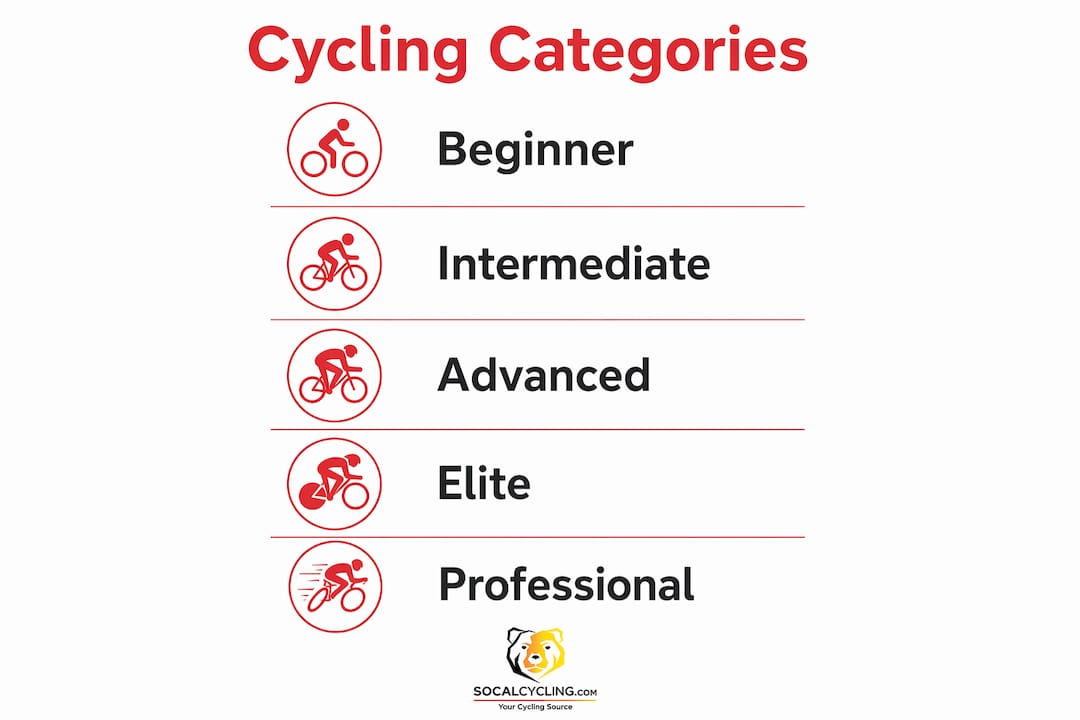
USA Cycling and British Cycling organize races into tiered categories from beginner to elite to ensure fair competition. That structure is the backbone of amateur cycling in both countries and sets the standard that most regional federations follow.
How do amateur cycling categories work?
Amateur cycling categories use a numbered tier system that reflects rider experience and race results. USA Cycling runs five categories for road racing, labeled Cat 5 through Cat 1. Cat 5 is the entry point for new licensed racers. Cat 1 represents the highest amateur level, just below professional status.
Progression through the USA Cycling system is based on race results and upgrade points. A Cat 5 rider typically needs to complete a set number of races before upgrading to Cat 4. From Cat 4 onward, points earned through top finishes drive advancement. The system rewards consistent performance rather than just participation.
British Cycling uses a parallel points-based structure. UK riders must earn 12 points to move from 4th to 3rd category, and 200 points to move from 2nd to 1st category within a season. That jump from 2nd to 1st is significant. It reflects a real leap in race pace, tactics, and physical demand.
Race characteristics change noticeably at each level. Cat 5 events are shorter, slower, and more forgiving tactically. By Cat 1 and Cat 2, races feature aggressive breakaways, high sustained speeds, and complex team dynamics. Road cycling categories also include age and gender divisions such as Junior, Masters, and parallel women’s ladders, each with their own safety considerations and points systems.
- Cat 5 / 4th Category: Entry level. Focus on race craft, pack riding, and basic tactics.
- Cat 4 / 3rd Category: Intermediate. Riders have race experience and begin competing for results.
- Cat 3 / 2nd Category: Advanced amateur. Races are faster and more technically demanding.
- Cat 2 / 1st Category: Near-elite. Riders compete at regional and national level events.
- Cat 1 / Elite: Top amateur tier. Riders may compete alongside professionals in some events.
Pro Tip: Before entering your first race, check whether the event requires a USA Cycling or British Cycling license. Some local events offer a “citizen” category for unlicensed riders, which is a low-pressure way to experience racing before committing to the full category system.
What are the main types of cycling events and disciplines?
Cycling event types fall into two broad groups: competitive races and non-competitive mass participation events. Competitive races include criteriums, road races, time trials, track events, mountain bike cross-country, and cyclocross. Non-competitive events include sportives, gran fondos, charity rides, and training rides. The distinction matters because categorization works differently in each group.
Competitive disciplines each have distinct terrain, equipment, and format requirements:
- Road racing: Point-to-point or circuit races on paved roads. Road races vary from 50km to 350km, with criteriums being short, intense races on closed circuits.
- Track cycling: Races held on velodromes. Events include the sprint, pursuit, and omnium. The cycling omnium combines multiple track disciplines into a single points competition.
- Mountain biking: Off-road events on dirt trails. Cross-country, downhill, and enduro are the main formats, each with separate category structures.
- Cyclocross: Cyclocross races typically last 30–60 minutes and mix running with riding on varied terrain, including mud, sand, and barriers. The short format makes it one of the most beginner-friendly competitive disciplines.
- Gravel racing: Events on unpaved roads and mixed surfaces. Gravel events have distinct categories that often blend competitive and non-competitive formats within the same event.
Non-competitive events like cycling sportives do not use rider categories in the same way. Participants are grouped by distance or pace rather than ability tier. The goal is completion and personal achievement, not podium placement.
Support level critically affects rider preparation and event planning, often more than discipline alone. Supported events provide aid stations and checkpoints throughout the course. Self-supported events require riders to carry nutrition, tools, and navigation equipment independently. Knowing which type you are entering shapes your entire preparation strategy.
| Event type | Format | Category system |
|---|---|---|
| Criterium | Short circuit, multiple laps | USA Cycling Cat 1–5 |
| Road race | Point-to-point or loop | USA Cycling Cat 1–5 |
| Cyclocross | Mixed terrain, short laps | Age and ability tiers |
| Sportive | Non-competitive, distance-based | Pace groups or distance |
| Gravel race | Mixed surface, varied distance | Open, competitive, or hybrid |
How do professional cycling race classifications work?
Professional cycling uses a completely different classification system from amateur categories. The Union Cycliste Internationale (UCI) assigns race classifications that define field strength, team eligibility, and ranking points available. These classifications do not measure difficulty for the rider. They measure the prestige and competitive weight of the event.
The top tier is the UCI WorldTour, which includes races like the Tour de France, Giro d’Italia, and Paris-Roubaix. Below that sits the UCI ProSeries, followed by Continental Circuit events. Each tier uses a code system. A race labeled 1.UWT is a one-day WorldTour event. A race labeled 2.Pro is a multi-stage ProSeries race. UCI assigns race categories like 1.UWT or 1.Pro to define field strength and points available, not difficulty level. Riders and fans often misread these codes as difficulty ratings, which is a common mistake.
“Terminology differs between amateur categories and professional race classifications.” — Complete guide to cycling terms
Within a single professional race, multiple simultaneous classifications run at the same time. The Tour de France features four main classifications: General Classification (overall time), Mountains Classification (climbing points), Points Classification (sprint finishes), and Young Rider Classification (best rider under 26). Each classification awards a distinct jersey and accumulates points through separate criteria. A rider can compete for all four simultaneously, which creates layered competition within a single race.
Amateur riders use classifications primarily to group competitors by ability, while professionals use classifications to distinguish sub-competitions and awards within the same race. That is the clearest way to separate the two systems. One organizes who races together. The other organizes what riders are competing for within the same event.
How to choose the right event category as a rider
Matching your skill level to the right category is the single most important decision you make before your first race. Entering too high a category puts you at risk physically and tactically. Entering a category far below your ability wastes your time and skews results for other riders.
Start by being honest about your fitness and race experience. If you have never raced before, Cat 5 or 4th Category is the correct starting point regardless of your training volume. Race experience and fitness are not the same thing. A strong recreational rider still lacks the pack-riding skills and tactical awareness that racing develops over time.
- Check the event’s category requirements before registering. Some events require a minimum number of prior races or a valid license.
- Review the race distance and elevation for your target category. Cat 5 road races are typically shorter and flatter than Cat 3 events.
- Consider the discipline before committing. A strong road rider may find cyclocross technically challenging even at the beginner level.
- Track your upgrade points after each race. Knowing where you stand helps you plan your season and set realistic advancement goals.
- Factor in support level for non-competitive events. A self-supported gravel event demands different preparation than a fully supported gran fondo, even at the same distance.
Pro Tip: Attend a local race as a spectator before entering. Watching the pace, positioning, and tactics at your target category level gives you a realistic picture of what to expect on race day.
Progression timelines vary by discipline and how frequently you race. Most Cat 5 riders upgrade to Cat 4 within a single season of active racing. Moving from Cat 3 to Cat 2 typically takes multiple seasons of consistent results. Patience and consistency matter more than raw speed at the early stages.
Key takeaways
Cycling event categories define fair competition by grouping riders and races according to ability, discipline, and format, making them the foundation of organized cycling at every level.
| Point | Details |
|---|---|
| Amateur category systems | USA Cycling uses Cat 5–1; British Cycling uses 4th Category to Elite, both based on points and results. |
| Professional classifications | UCI codes like 1.UWT define field strength and ranking points, not race difficulty. |
| Discipline shapes format | Road, track, cyclocross, gravel, and mountain biking each use distinct category structures. |
| Support level matters | Whether an event is supported or self-supported affects preparation as much as the discipline itself. |
| Start at the right level | New racers should always enter the lowest category regardless of training fitness. |
Socalcycling’s take on why categories change the sport
Categories are not just administrative boxes. They are the reason cycling remains accessible and exciting at every level of participation. We have covered races from beginner criteriums in Southern California to UCI WorldTour events, and the one constant is that riders who understand their category race smarter and enjoy the sport more.
The progression system deserves more credit than it gets. Knowing you need 12 points to move up a category in British Cycling, or that a string of top-five finishes in Cat 4 earns you an upgrade, gives your training a concrete target. That specificity is motivating in a way that vague improvement goals never are.
What we find most underappreciated is the safety dimension. Beginner categories exist partly to keep new riders away from the high-speed chaos of elite fields. A Cat 5 race at 25 mph average is a very different physical and tactical environment from a Cat 1 race at 30 mph with aggressive racing. Respecting that gap protects riders and improves the quality of competition at every tier.
The professional classification system is where most casual fans get lost. Seeing a race coded as 2.1 and assuming it is harder than a 1.UWT event is a natural mistake, but it misreads what those codes actually measure. Understanding that UCI classifications define prestige and points rather than physical difficulty reframes how you watch professional racing entirely.
Our advice: learn your category system, race within it honestly, and use the progression structure as your roadmap. The sport rewards riders who respect the process.
Socalcycling: your resource for cycling events and categories
Socalcycling covers the full spectrum of cycling, from beginner-friendly local events to professional road racing across North America and worldwide. Whether you are searching for your first race or trying to understand how UCI classifications work, Socalcycling delivers the context and detail you need.

The Socalcycling event hub features race calendars, discipline guides, and category breakdowns updated throughout the season. Riders looking for specific formats can find detailed coverage of gravel races across the United States, cyclocross schedules, road racing news, and non-competitive sportive events. If you are planning your 2026 season, the cyclocross race calendar checklist is a practical starting point for scheduling events by discipline and category level.
FAQ
What is a cycling event category?
A cycling event category is a formal classification that groups riders or races by skill level, discipline, age, or gender to ensure fair competition. Governing bodies like USA Cycling and the UCI define these categories for both amateur and professional events.
How many categories are there in USA Cycling road racing?
USA Cycling uses five road racing categories, from Cat 5 (beginner) to Cat 1 (elite amateur). Riders advance through the system by earning upgrade points based on race results.
What is the difference between amateur categories and professional race classifications?
Amateur categories group riders by ability so they compete against peers of similar skill. Professional UCI classifications define the prestige and ranking points of an event, not the difficulty of the course.
What types of cycling events exist beyond road racing?
Major cycling disciplines include road racing, track cycling, mountain biking, cyclocross, and gravel racing. Each discipline uses its own category structure, and non-competitive formats like sportives and gran fondos use distance or pace groups instead of ability tiers.
How do I know which category to enter as a new racer?
New racers should always start at the lowest available category, Cat 5 in USA Cycling or 4th Category in British Cycling, regardless of fitness level. Race experience and pack-riding skills develop separately from training fitness and take time to build safely.
Recommended
- Why Gravel Events Have Different Categories: 2026 Guide
- Cycling Sportive Explained: Your Complete Ride Guide
- What Is a Cycling Passport Event? Your 2026 Guide
- What Is a Cycling Omnium Event? Your Race Guide