


Cycling event registration fees differ because of non-negotiable safety and regulatory costs, the organizer’s business model, and the experience features built into the event — and all three have pushed prices higher since 2020. Before you click “register,” here is what your money is actually covering:
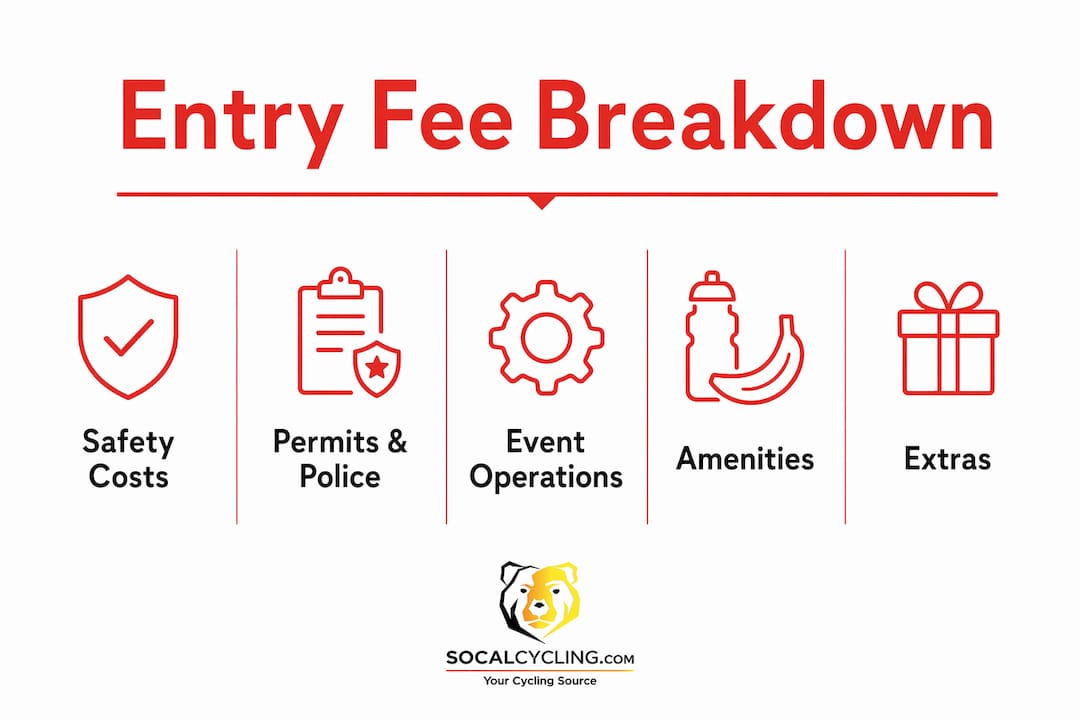
- Liability insurance and USA Cycling permits — required for nearly every sanctioned event
- Police and traffic control — often billed at public-employee overtime rates organizers cannot negotiate
- Municipal permits and road closures — fees set by county and city offices, not the race director
- Medical and EMS staffing — contracted paramedics and first responders on course
- Participant experience — swag, post-ride festivals, timing systems, sanitation, and food
Some fees also reflect pure market demand. A sold-out gravel event with a lottery waitlist will price higher next year because the market supports it, not because costs alone justify the increase. Socalcycling breaks down every layer below so you can read any registration page with clear eyes.
Table of Contents
- What your registration fee actually pays for
- Which factors make one event cost more than another
- How organizers set prices and manage demand
- A real budget example and what the data shows
- How to judge whether a fee is worth paying
- How fees compare across different types of cycling events
- Key Takeaways
- The case for fee transparency in cycling
- Authoritative sources and further reading
What your registration fee actually pays for
Race directors report that 50–60% of registration revenue for major road events goes to safety, permitting, and policing, while 30–40% covers participant experience and production. The math behind cycling event costs becomes much clearer when you see it as a line-item budget.
The table below uses real figures from the 2024 Oakland Grand Prix criterium and the 2024 Winters Road Race, published by VeloPromo, to show how costs stack up for two common event formats.
Two things stand out. First, the safety and regulatory line items alone (permits, police, officials, insurance, EMS) account for more than half of total costs in both events. Second, a rural road race costs nearly as much as an urban criterium, even without a city permit office driving up fees, because California Highway Patrol and course logistics fill that gap.
Fixed costs create a baseline fee regardless of field size. An organizer running 100 riders or 300 riders still pays the same permit invoice and the same EMS contract. That is why small events can feel expensive per rider: the fixed overhead does not shrink proportionally when registration numbers are modest.
Multi-day supported rides shift the allocation further. Events like RAGBRAI layer in year-round town coordination, route logistics, and SAG vehicle fleets that a single-day criterium never touches. The registration price reflects planning that runs 12 months, not just race week.
Which factors make one event cost more than another
Several variables predict whether a registration fee will land at $30 or $200. Understanding them lets you evaluate pricing before you commit.
- Business model. Volunteer club events keep overhead low because labor is donated and marketing is minimal. Commercially run events pay year-round staff, professional marketing agencies, and higher contractor rates — all of which flow into the entry fee.
- Scale and crowd control. Larger fields do not automatically mean lower per-rider costs. More participants often trigger additional police details, extra portable toilet units, and expanded medical coverage, each billed at fixed contract minimums.
- Course type and road closures. Closed-road events require police presence and traffic management that open-road rides avoid. Events crossing federal land or state parks add permit layers from agencies like the U.S. Forest Service or the National Park Service.
- Experience features. A post-ride festival with live music, a catered meal, premium finisher medals, and a VIP tent costs real money. Those experiential add-ons are often what separates a $150 gran fondo from a $45 club race.
- Geography and timing. Urban venues carry higher permit fees and parking logistics. Holiday weekend events face premium overtime billing from public agencies. Rural courses may reduce permit costs but increase transportation and SAG expenses.
- Insurance requirements. Cycling event insurance is non-negotiable for sanctioned events, and municipal insurance mandates have grown stricter since 2020, pushing premiums higher across the board.
- Distance pricing anomalies. Many organizers charge one flat fee across all distances to simplify logistics. That makes shorter-distance entries relatively expensive per mile. A 2025 gravel cost survey found the most expensive per-mile cost reached $8.33 per mile — and yes, it was for a short course.
How organizers set prices and manage demand
Tiered pricing is the standard tool race directors use to balance cashflow against registration uncertainty. Early-bird rates lock in revenue before costs are fully known; regular rates cover the bulk of the field; late and day-of rates reflect the operational cost of last-minute logistics and the premium of guaranteed entry.

Caps and lotteries add another layer. When an event sells out consistently, the organizer faces a choice: raise prices to match demand, hold the cap and run a lottery, or expand the field and absorb higher police and facility costs. Sold-out events with lottery waitlists tend to raise prices over time because the market clearly supports it.
Membership discounts (USA Cycling, local club affiliations) and charity-entry slots reduce the sticker price for specific riders but do not reduce the organizer’s cost base. Grassroots events often depend on sponsorships or in-kind services to stay solvent; without that support, tiered pricing and late fees are the primary mechanism to avoid a deficit.
Pro Tip: Check the refund and cancellation policy before registering. A transparent organizer will state whether fees are refundable, transferable, or covered by event cancellation insurance. Opaque or buried refund terms are a yellow flag — not necessarily a dealbreaker, but worth a direct question to the organizer before you pay.
Add-ons (baggage drop, camping, VIP packages) are almost always optional and priced separately from the base entry. Stripping them out is the fastest way to reduce your total cost without sacrificing the core event experience.
A real budget example and what the data shows
The Goosed Cycling Joy Memorial Criterium offers a transparent look at what a small local race actually costs. Their published budget totaled $4,048 for a single-day event, with USAC insurance alone at $557, barricades at $375, and porta-potties at $488. Registration revenue came in a few hundred dollars short of breaking even — and that was with volunteer labor and a waived federation fee.
Scale that up to a mid-size gran fondo with 500 riders, professional timing, EMS on course, and a post-ride festival, and the budget looks closer to the VeloPromo criterium figures: $15,000–$18,000 in fixed costs before a single rider registers.
Experiential events — gravel races, multi-day fondos, festival-style rides — have seen costs rise faster than general inflation since 2020. Municipal overtime billing, tighter insurance requirements, and higher contractor rates for EMS and traffic control all contribute. The medical staffing line item alone has grown as cities require higher coverage ratios for permitted events.
A recent gravel cost survey found the average cost per mile across multiple events fell roughly between $1.00 and $2.00 per mile, providing a useful reference point. That baseline gives you a useful reference point when evaluating whether a specific event’s fee is reasonable for its distance.
How to judge whether a fee is worth paying
Not every high entry fee signals a well-run event, and not every low fee means a bargain. Here is a practical checklist for evaluating any registration page.
What to look for before you register:
- Permit confirmation — is the event sanctioned by USA Cycling, or does it have documented municipal permits?
- Medical staffing details — are paramedics or EMTs listed on course? Check the event medical plan if available.
- SAG vehicle coverage — how many SAG stops, and what is the ratio to course miles?
- Refund and transfer policy — stated clearly, not buried in a PDF.
- Participant cap — a stated limit signals the organizer is managing experience quality, not just maximizing revenue.
Red flags worth noting:
- No permit or sanctioning information anywhere on the event page
- Refund policy absent or limited to “no refunds under any circumstances”
- Last-minute route changes with no explanation
- Third-party registration platform fees that are unusually high (above 8–10% of the entry price)
- Prize list that looks impressive but is funded entirely by entry fees with no sponsor support
Ways to reduce what you pay:
- Register during the early-bird window — the savings are real and the cashflow helps organizers
- Check for USA Cycling or club membership discounts before checkout
- Volunteer at an event in exchange for a complimentary entry — many organizers offer this
- Choose club-run or grassroots events for lower-cost options without sacrificing safety
- Weigh charity-entry tradeoffs carefully: minimum fundraising commitments can exceed the standard entry fee
How fees compare across different types of cycling events
The type of event you enter is the single biggest predictor of what you will pay. Fee structures differ not just in amount but in what they reflect.

Casual fun rides and community rides typically run $20–$50. These events often rely on volunteer labor, minimal permitting, and sponsor support to keep costs down. The cycling event category guide at Socalcycling covers the full spectrum of formats if you want to compare structures side by side.
Sanctioned competitive races (criteriums, road races, cyclocross) generally fall in the $35–$75 range for USA Cycling-permitted events. The VeloPromo Oakland Grand Prix data shows how quickly permit and official fees consume that revenue — leaving organizers dependent on sponsorships to avoid a loss.
Gran fondos and gravel events span the widest range: $60 on the low end for a no-frills grassroots route, up to $200 or more for fully supported events with timing, festivals, and premium swag. The 2025 gravel cost survey’s $2.11 average per mile puts a 100-mile event at roughly $211 at the mean — which tracks with what most riders see on registration pages for mid-tier gravel events.
Charity rides operate differently. The entry fee is often nominal ($25–$75), but participants commit to a fundraising minimum that can run $300–$2,500 or more. That minimum is not a fee — it is a fundraising pledge — but it is worth understanding how charity ride economics work before you sign up.
Multi-day supported rides like RAGBRAI sit at the top of the price range because the cost structure is fundamentally different: year-round staff, town-by-town coordination, and full route logistics across multiple days all require sustained investment that a single-day event never approaches.
Key Takeaways
Entry fees at cycling events vary because safety and regulatory costs set a non-negotiable baseline, while business model, scale, and experience features determine how far above that baseline any given event lands.
| Point | Details |
|---|---|
| Safety costs dominate budgets | Permits, police, insurance, and EMS typically account for 50–60% of total event costs. |
| Business model shapes the baseline | Volunteer club events cost less than commercial promoters who pay year-round staff and marketing. |
| Experience add-ons explain big price gaps | Festivals, premium swag, and full SAG support push gran fondo and gravel fees well above race-only events. |
| Tiered pricing rewards early registration | Early-bird rates save money and help organizers cover fixed costs before the event runs. |
| Event type predicts fee range | Casual rides run $20–$50; sanctioned races $35–$75; gravel and gran fondos $60–$200+; multi-day rides higher still. |
The case for fee transparency in cycling
From where we stand at Socalcycling, the conversation about entry fees too often gets stuck in the wrong place. Riders see a $150 registration and assume profit; organizers absorb a $17,000 cost sheet and wonder why anyone complains. Both reactions are understandable, and both miss the point.
The real issue is transparency. When an organizer publishes a simple line-item summary — even a rough one — the conversation shifts from suspicion to understanding. The VeloPromo budget sheet and the Goosed Cycling breakdown are exactly the kind of documents that build community trust. More organizers should do this, and more riders should ask for it.
We also think the cycling community benefits when riders support well-run grassroots events, even when the fee feels high relative to the distance. A local club criterium charging $45 is often operating at break-even or below. Paying that fee, showing up, and bringing a friend is how those events survive long enough to become traditions.
At the same time, riders deserve to ask specific questions: Is medical staff on course? What does the refund policy cover? Are permits confirmed? Those are not hostile questions — they are the mark of an engaged participant who wants the event to succeed. Browse Socalcycling’s event coverage and guides to find events across California and beyond that publish the details riders need to make informed decisions.
Authoritative sources and further reading
The sources below back the figures and analysis in this article. Use them to verify specific claims or explore the operational side of event organizing in more depth.
- Why Races Cost So Much: Race Directors Break It Down — Runner’s World piece with RunSignup data and race director quotes on cost allocation (50–60% safety/regulatory). Best for understanding the overall fee structure.
- Behind the Wristband: The True Cost of RAGBRAI — BikeIowa’s detailed look at multi-day ride economics and year-round planning costs.
- VeloPromo Event Budget Sheet — Real 2024 line-item budgets for the Oakland Grand Prix and Winters Road Race. The most concrete cost data available for U.S. cycling events.
- The Price of the Ride: Why Cycling Events Are Getting More Expensive — Gear and Grit analysis of insurance, municipal fees, and overtime billing trends.
- 2025 Gravel Events Cost Survey — Guitar Ted’s per-mile cost analysis across 37 gravel events; useful for benchmarking gravel registration fees.
- 2026 Gravel Events Cost Survey — Updated survey showing continued per-mile pricing trends and the gap between short and long distances.
- Promoting the Joy Memorial Crit — Goosed Cycling’s transparent post-race budget breakdown for a small local criterium.
- Entry Fees Are Outrageous — Escape Collective Community — Community thread with organizer and participant perspectives on where money goes.
- Why Cycling Events Need Insurance: 2026 Guide — Socalcycling’s deep-dive on insurance requirements and cost drivers.
- Why Cycling Events Need Medical Staff: 2026 Guide — Covers contracted EMS costs and coverage requirements by event type.
- Cycling Event Category Guide: What Riders Need to Know — Best starting point for comparing event types and understanding how format drives fee differences.
Recommended
- Cycling Event Category Guide: What Riders Need to Know
- Why Cycling Events Need Insurance: 2026 Guide
- Why Prize Lists Matter at Cycling Events
- Why Gravel Events Have Different Categories: 2026 Guide